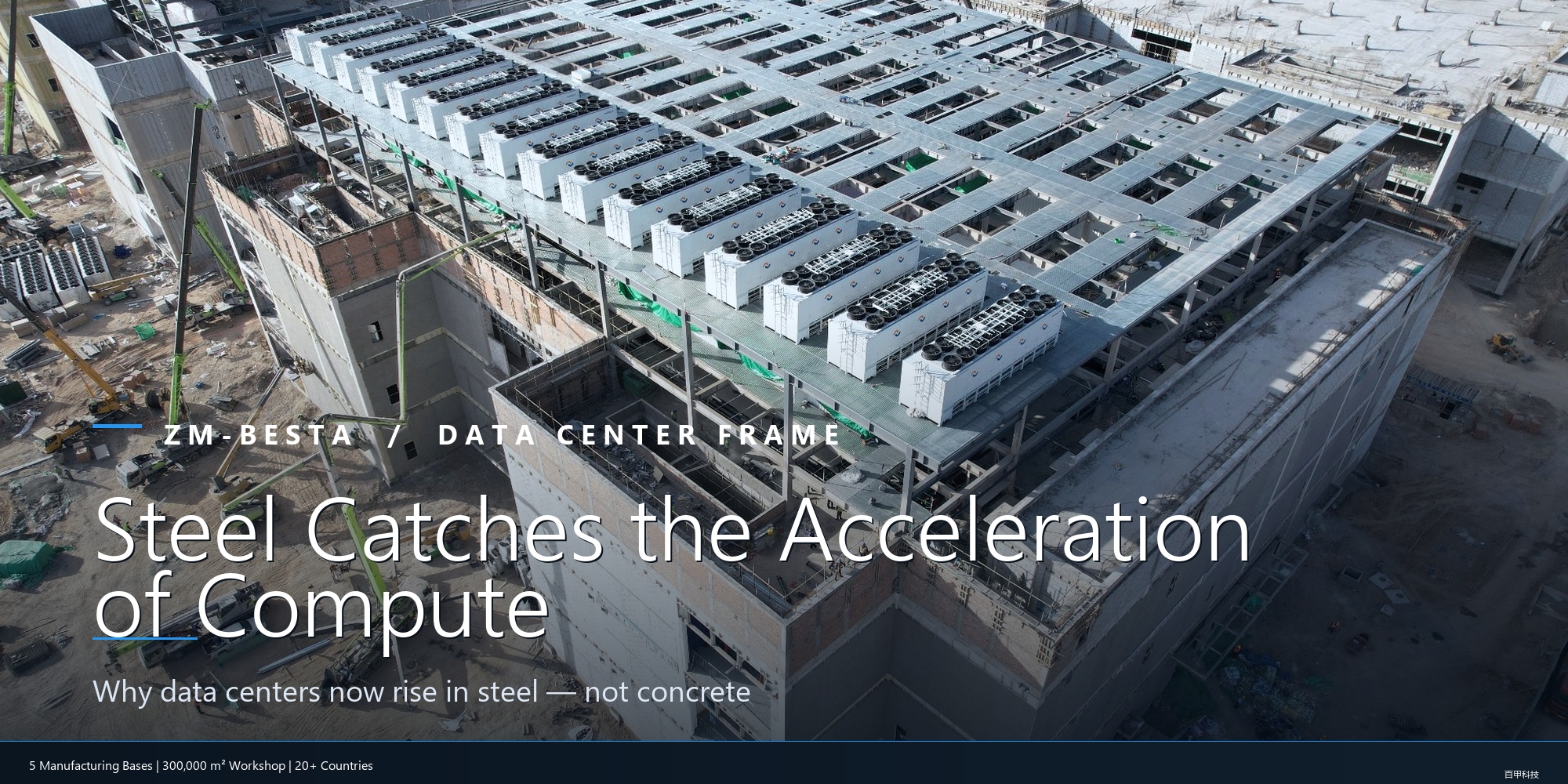
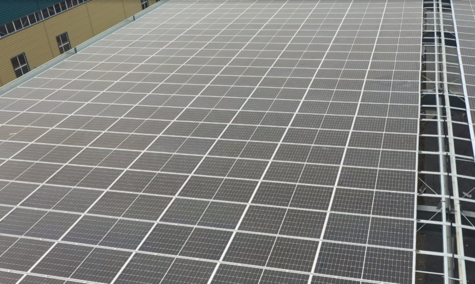
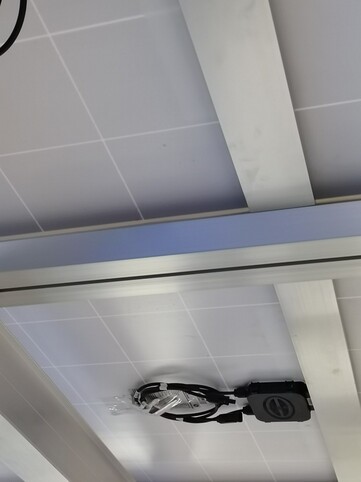
In August, the China Mobile Ningxia Zhongwei Data Center, built with the participation of Xuzhou Zm-Besta Heavy Steel Structure Co., Ltd., is accelerating its construction.
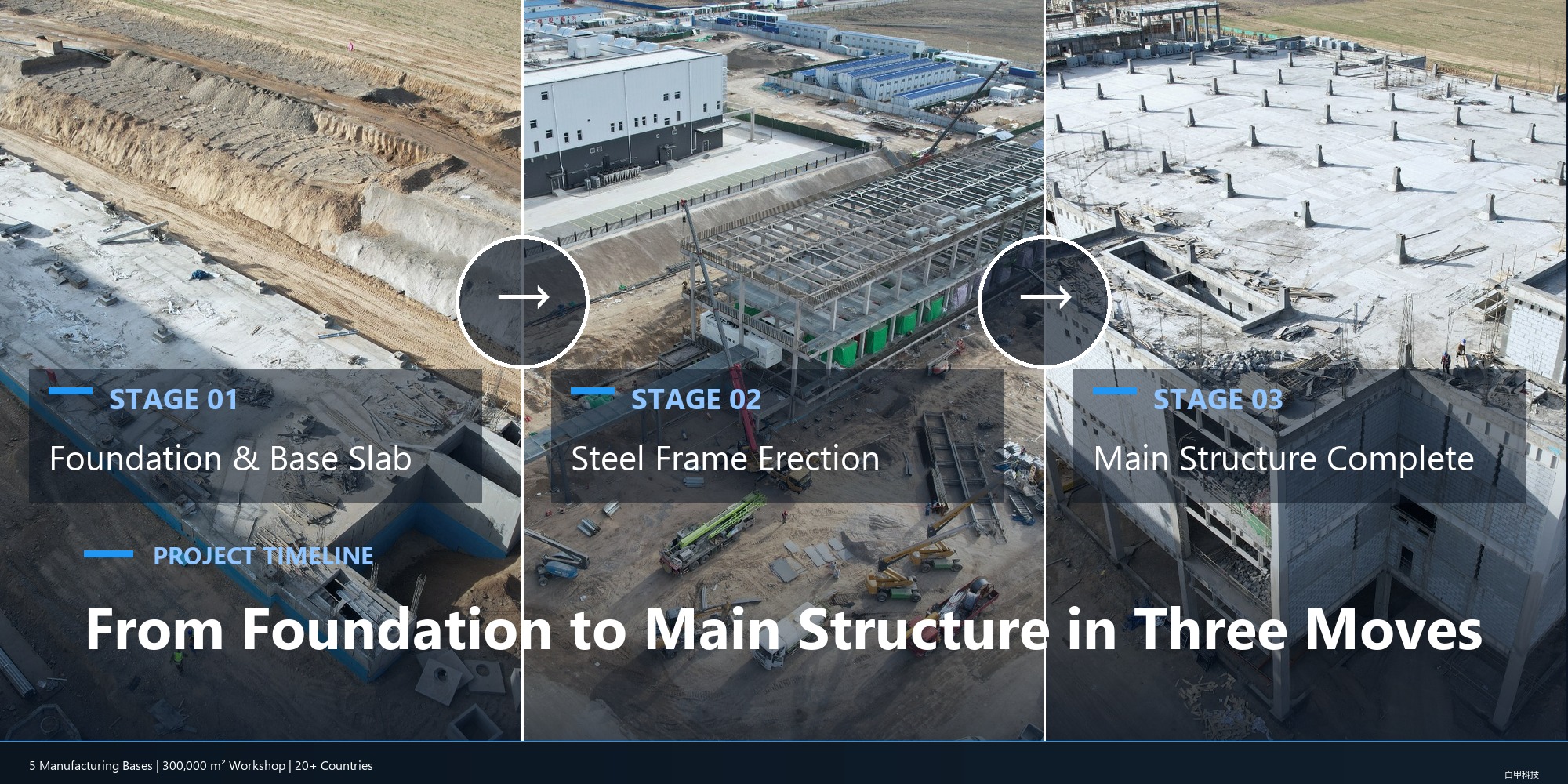
Since July, new bidding packages for large-scale intelligent-computing parks have been successively released in Zhongwei (Ningxia), Wuhu (Anhui) and Shenzhen (Guangdong), China, with construction schedules generally kept within 9 months.
Demand for computing power centers has been fast-forwarded, and the demand curve for steel structures has been pulled taut in tandem — these two developments are happening at the same time.
【Industry Background】 Computing Power Centers Are Being Built at the Speed of “Steel”
A few public figures give us a clear first look at this accelerating engine:
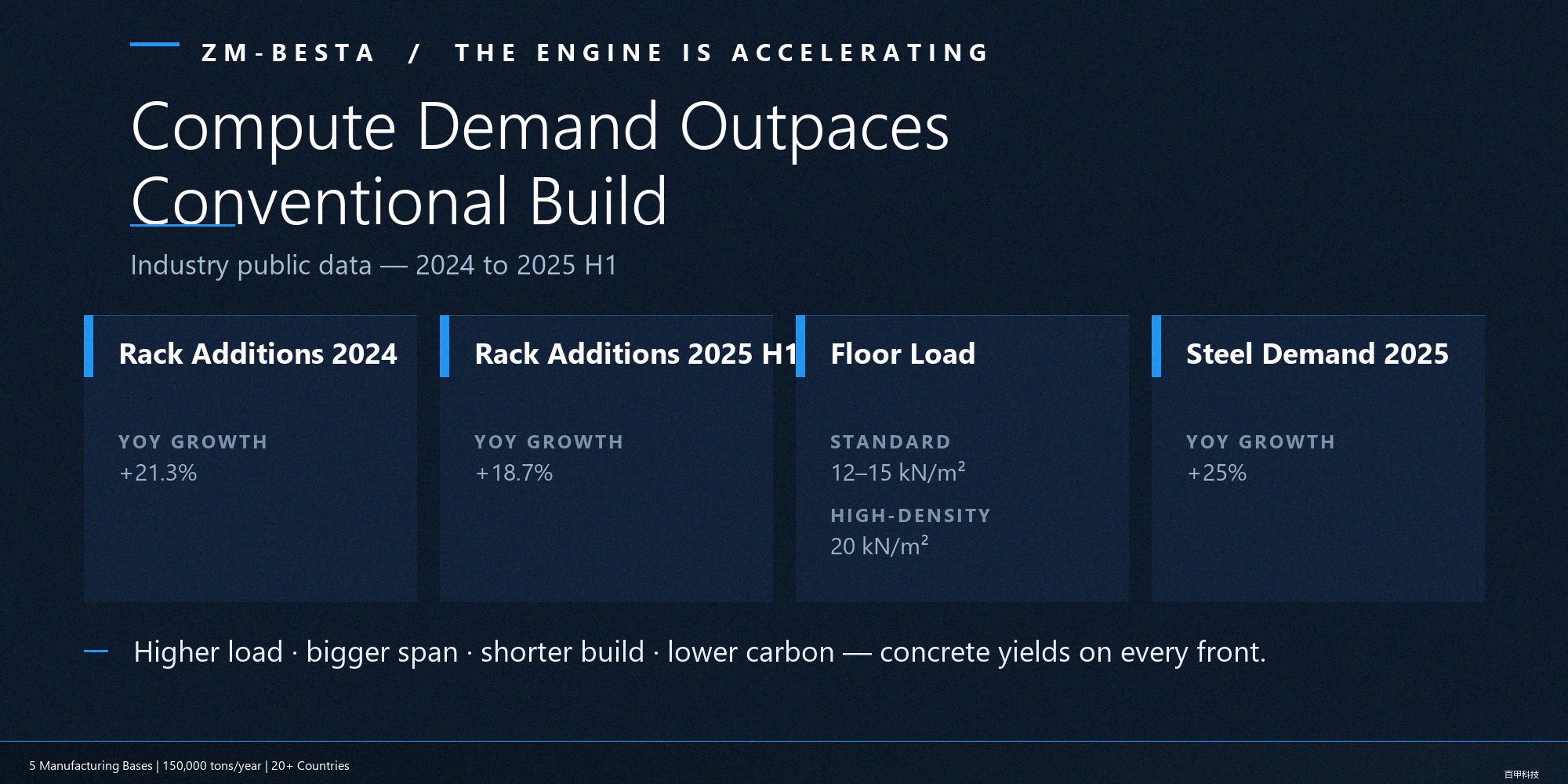
- In 2024, newly added racks in Chinese data centers grew 3%year on year; the first half of 2025 saw another +18.7% year on year.
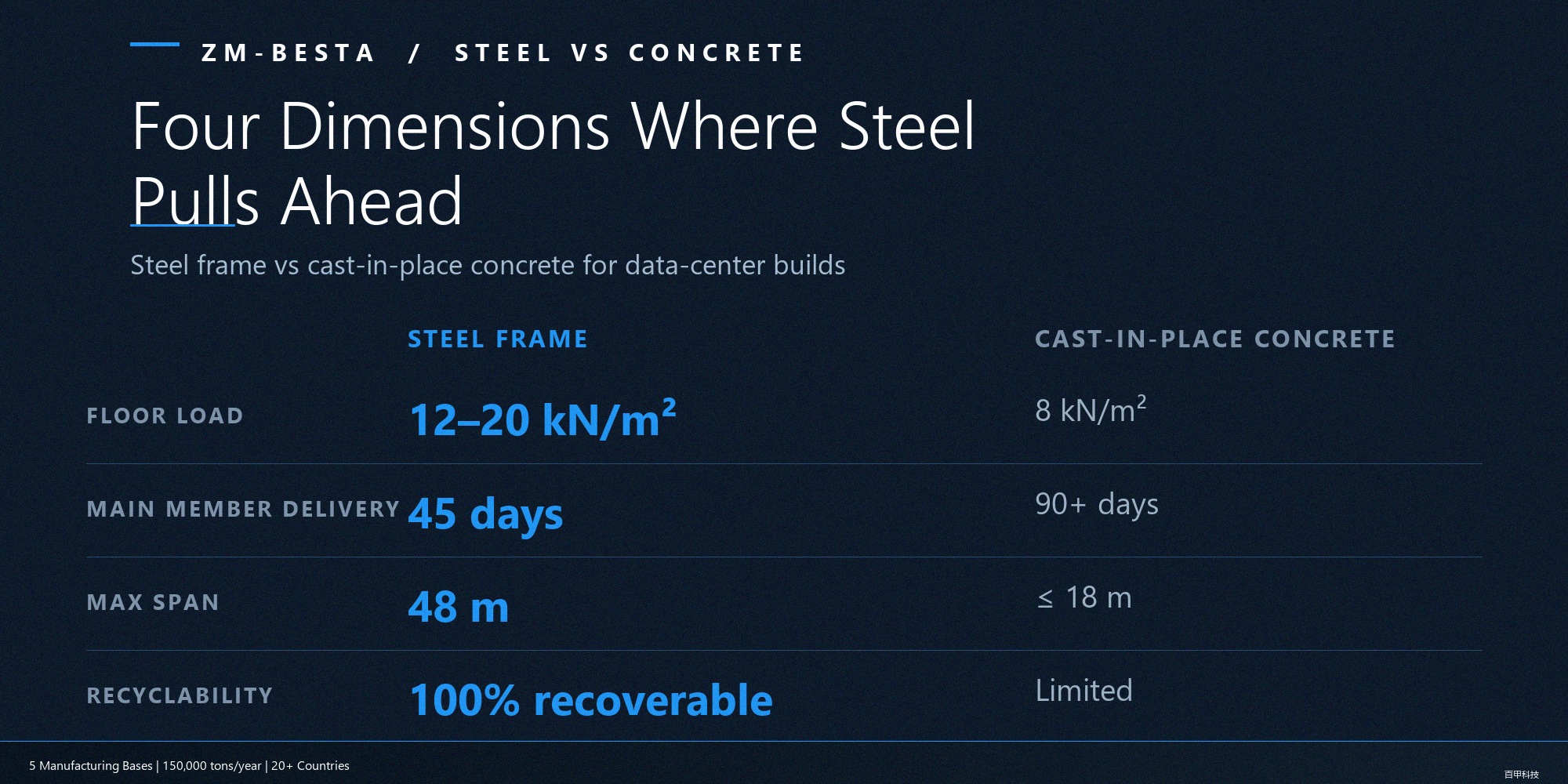
- Floor loads for a single building in large intelligent-computing parks have risen from 8 kN/m²to 12–15 kN/m², with some high-density rack areas reaching 20 kN/m².
- Industry estimates put the year-on-year increase in steel structure usage for Chinese data centers in 2025 at about 25%.
Buildings must be taller, spans wider, schedules shorter, and energy consumption lower — on all four counts, traditional concrete gives way at once, making steel structures almost the only solution that can simultaneously satisfy “heavy load + large span + fast construction + recyclability.
【Zm-Besta’s Answer】 Steel Structure Capability, Calibrated to the Four Metrics of Computing Power Centers
We did not try to be “big and comprehensive”; instead, we folded more than two decades of steel structure capability into the four things computing power centers care about most:
- Fast: with five production bases scheduling in parallel, main structural components for a single package can be delivered within 45 days.
- Heavy: our self-developed box columns and special-shaped joints make the 20 kN/m²floor solution for high-density rack areas directly deployable.
- Large: with a maximum span of 48 meters, cold and hot aisles, equipment mezzanines, and rooftop PV supports are completed in one pass during the main structure phase.
- Green: by embeddingBIPV (Building-Integrated Photovoltaics) into roofs and exterior walls, the campus facade itself becomes a power-generating surface.
Combined, the four advantages make a computing power center roughly 30% faster than a traditional concrete scheme from groundbreaking to structural topping-out.
【Cases Speak】 In the Second Half of the Computing Power Race, “Delivery Certainty” Is Brought Up Before “Price”
This year, we have accumulated steel structure main-delivery experience on several projects in large-scale intelligent-computing / data center scenarios, including a representative project frequently cited by peers:
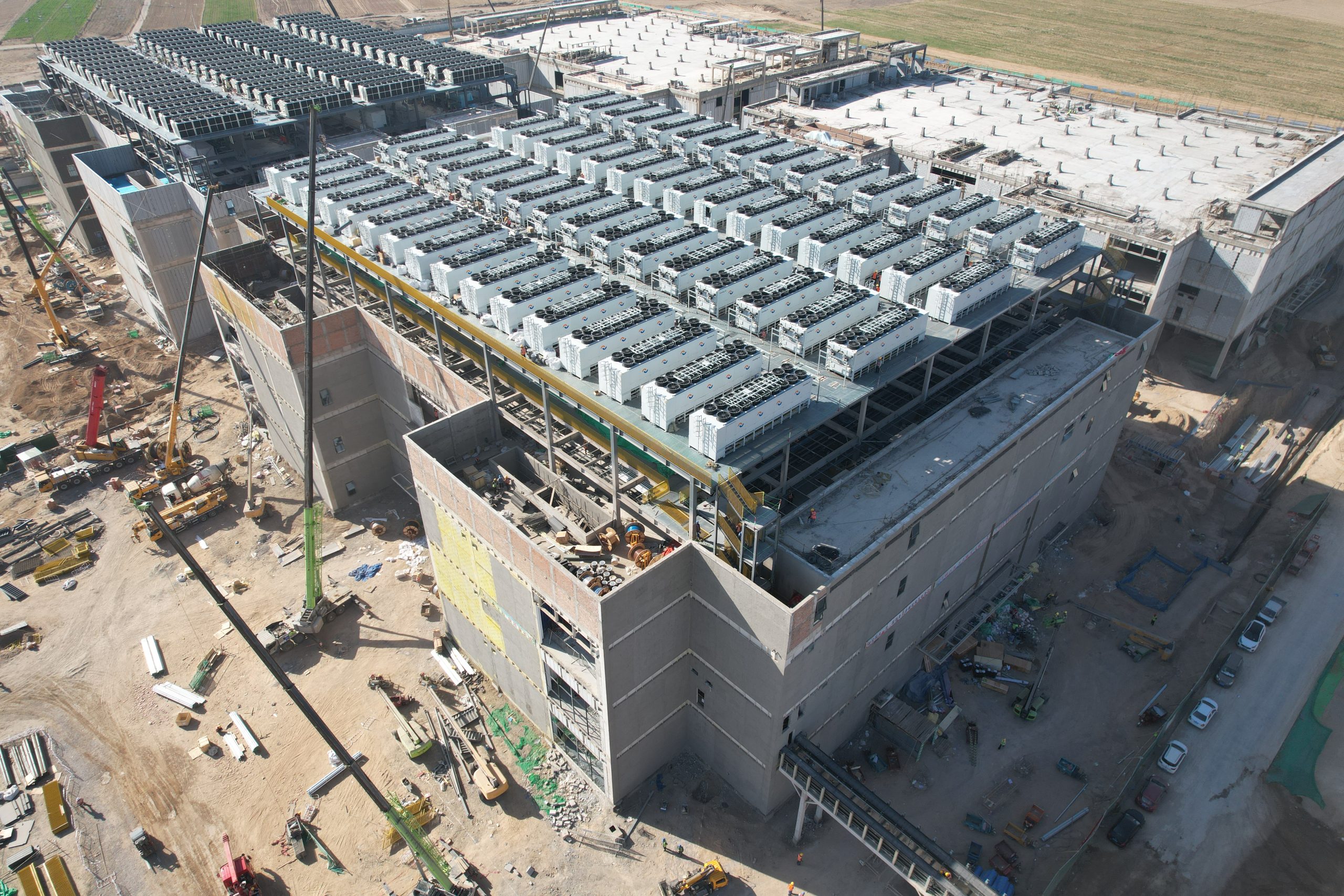
- A large data center cluster in Zhongwei, Ningxia, China: with China Mobile as the owner,Zm-Besta served through the steel structure main works.
These projects do not care about “signing ceremonies,” but together they prove one thing — computing power buyers now choose based on “delivery certainty,” not just “price”.
【Technology & Capacity Support】 Why Zm-Besta Can Do It
Backing that promise is a set of hard numbers:
- Listed on the Beijing Stock Exchange, stock code 920057.
- A national “Little Giant” enterprise (specialized, refined, distinctive, and innovative).
- Fiveproduction bases covering East China, Central China, North China, and Southwest China.
- 30Chinese invention patents and 3 overseas invention patents.
- Eight core technology systems, covering key areas including box columns, special-shaped joints, BIPV integrated envelope systems, and low-carbon welding.
- Internationally leadingBIPV steel-component achievements have been applied at scale in multiple projects.
This is exactly the kind of strength that hyperscale AI data center projects value most.
Take, for example, Indonesia’s CGK hyperscale AI data center campus (Digital Edge CGK) — one of the few campus-scale projects in Southeast Asia planned with an IT capacity of 500 MW, expandable to 1 GW in the long term. Zm-Besta is currently advancing steel structure detailed-design coordination with the relevant parties on this project.
【Cooperation Outlook】 In the Second Half, the Race Is Not About Rack Count but “Delivery Speed × Carbon Bill”
As computing power centers enter the second half, the checklist owners care about is being rewritten: delivery speed, green power, and carbon intensity per unit of computing power are now placed on the same scorecard.
Steel structures naturally sit at the intersection of these three dimensions — faster construction, a recyclable structure itself, and roofs and facades that can be directly converted into BIPV power-generating surfaces.
To computing power center owners, general contractors, and data center operators, we want to say: rather than endlessly comparing prices in bidding documents, let’s first talk about how fast you can get the keys.
To learn more or request steel structure solutions for computing power centers, please contact: info@xzbesta.com