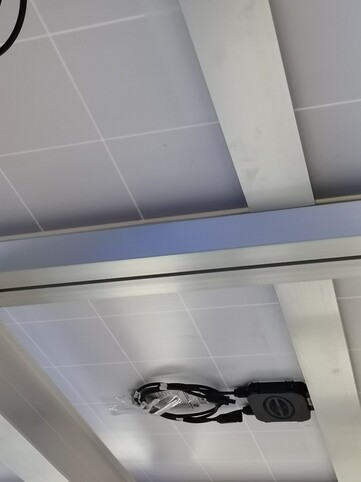
In BIPV project tenders, two procurement models are common: hire one contractor for the building structure and another for the photovoltaic system, or award the entire package to a supplier capable of delivering both structural and PV solutions.
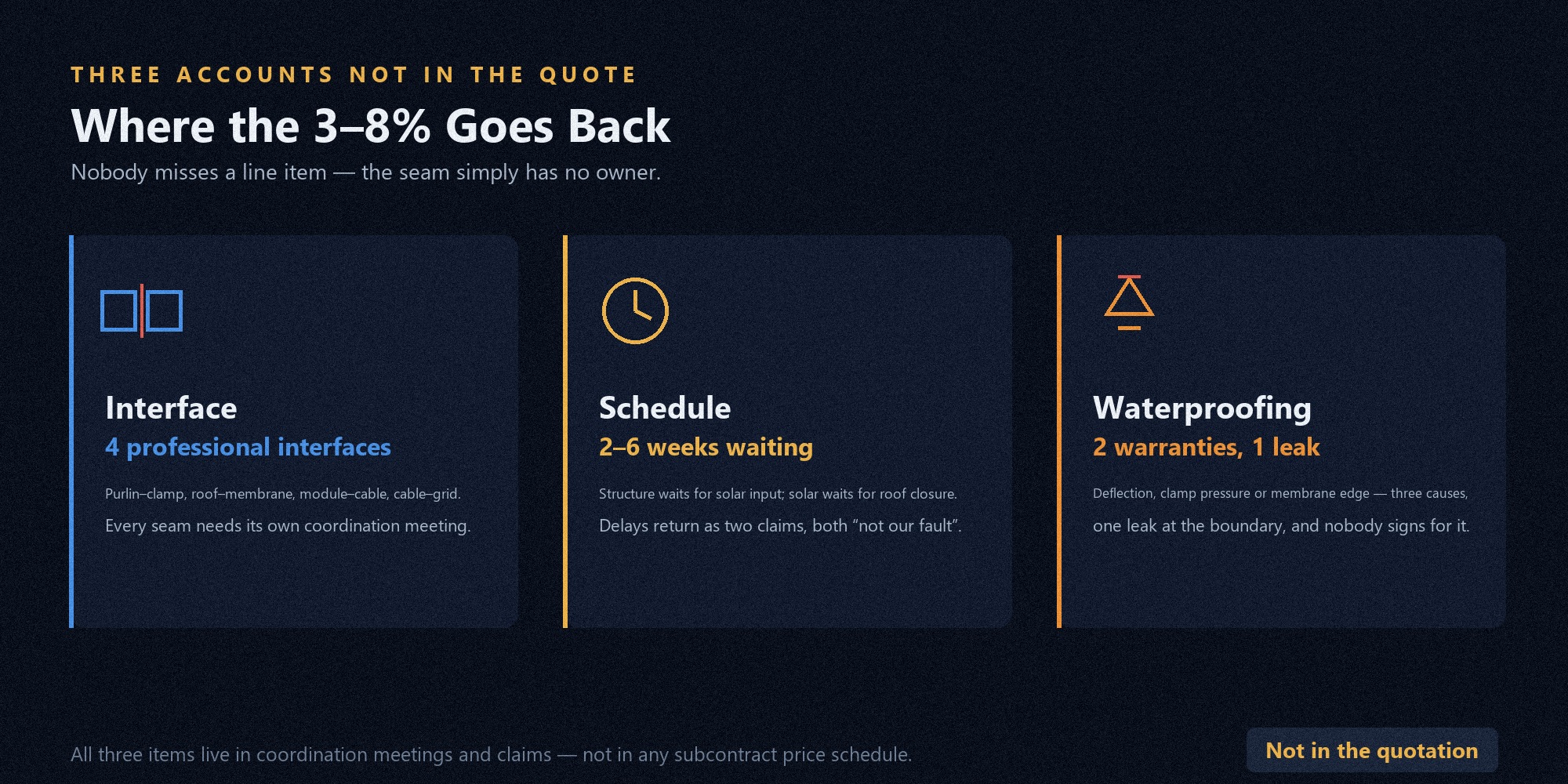
The total quoted price under the first model is often 3%–8% lower. This is not an illusion—the quotation really does show a lower figure.
But the difference is often not genuine savings. Instead, the costs are shifted into areas that the contract never explicitly covers.
Why Does the Subcontracting Model Have a Lower Total Price?
Each Contractor Quotes Only Its Own Scope
The structural subcontractor quotes the steel structure, purlins, and roof panels. The PV subcontractor quotes the modules, mounting systems, cables, and inverters.
Neither contractor quotes the “gap in between”: Do the purlin positions need to be adjusted to match the PV module layout? Who handles waterproof flashing around roof penetrations? Who resolves conflicts between cable routes and structural supports?
No item is necessarily missing from either quotation. The problem is that this interface scope has no clear owner.
Interface Costs Have No Dedicated Line Item
Some project costs are difficult to allocate: coordination meetings, drawing reviews, rework approvals, and responsibility disputes.
These expenses are scattered across management fees and site overheads. They do not appear in either subcontractor’s quotation, but they often emerge in force during the middle stages of a project.
Three Hidden Costs
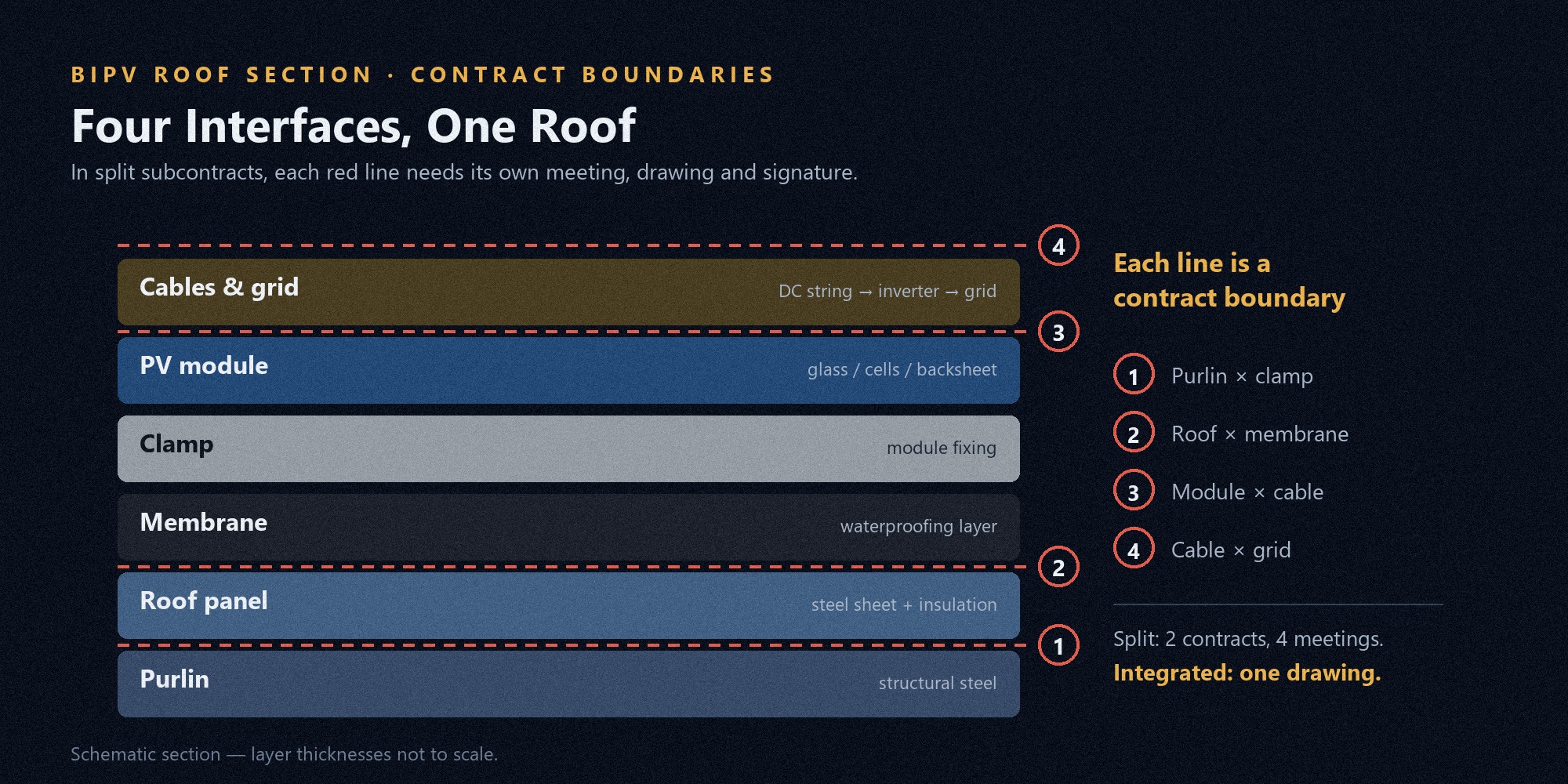
Interfaces: Four Boundaries, Four Rounds of Coordination
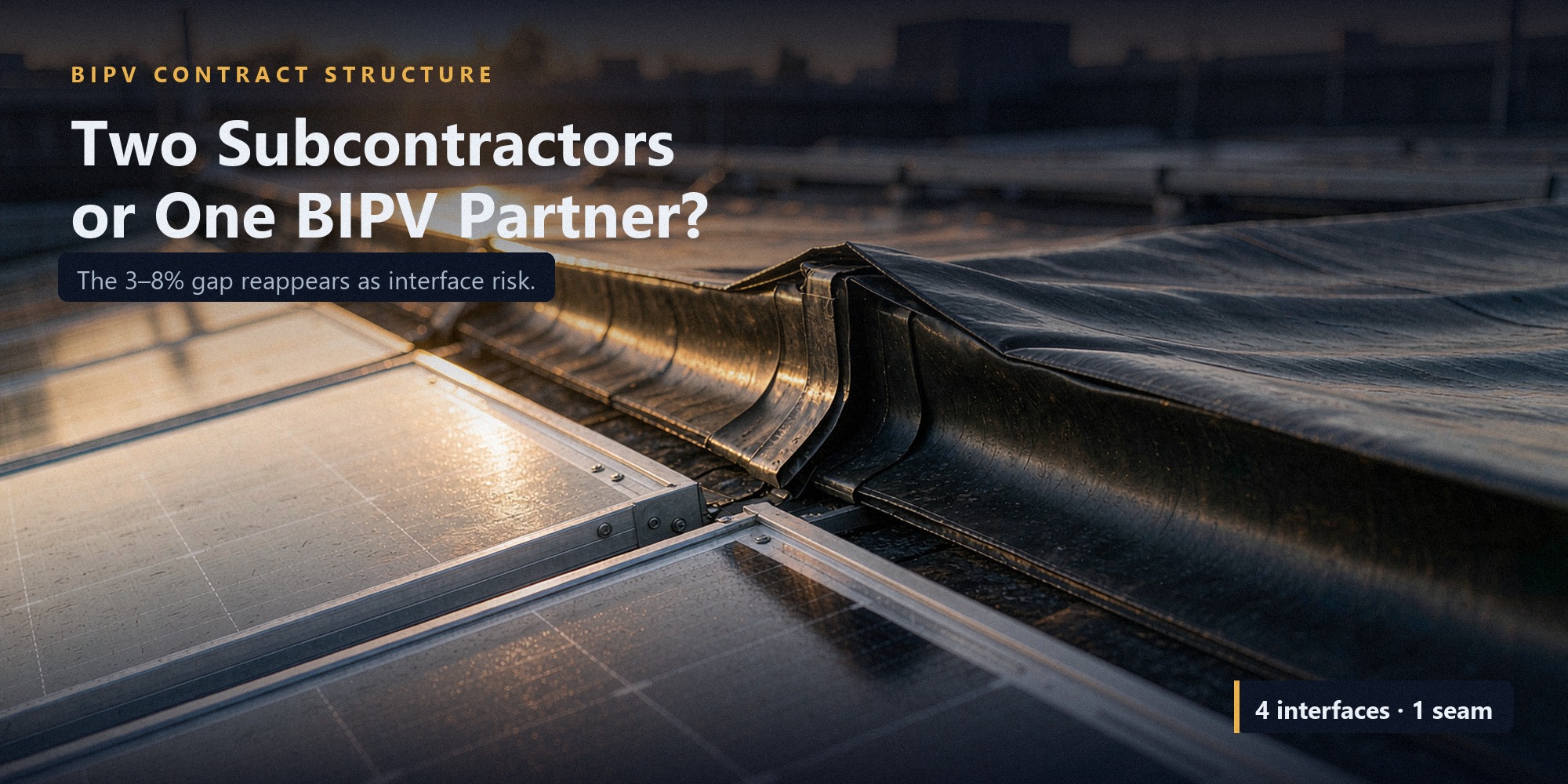
A BIPV roof involves at least four technical interfaces:
1) Purlins and mounting clamps
2) Roofing and the waterproofing layer
3) PV modules and cables
4) Cables and grid connection
With two subcontractors, each interface may require a separate coordination meeting. Even if the meeting minutes are detailed, responsibility can still fall into the gap between the two parties.
Schedule: Sequential Workflows and Claims from Both Sides
The structural team waits for PV design inputs, including module dimensions, loads, and layout. The PV team waits for the structure and roof to be completed before installing equipment on the roof.
This creates a sequential workflow. Any delay at an interface can push the subsequent schedule back by 2–6 weeks.
When a delay occurs, the owner may receive two claims, each stating that the delay was “not caused by us.” Determining responsibility requires meetings, supporting evidence, and potentially an independent third-party assessment—adding even more time.
Waterproofing: Two Warranties, One Leak
Roof leakage is one of the most difficult issues to assign responsibility for.
There may be three possible causes: excessive purlin deflection that opens roof panel joints, improperly tightened mounting clamps, or inadequately secured membrane flashing. Each may point to a different responsible party.
The owner then discovers that roof waterproofing is covered by one warranty, while the PV system is covered by another. If the leak occurs precisely at the interface, neither party may accept responsibility for that section of the roof.
Who Owns the Four Interfaces?
| Interface |
Common Dispute Under Separate Subcontracts |
How an Integrated Supplier Handles It |
| Purlins and mounting clamps |
The structural contractor says it followed the drawings; the PV contractor says the clamps are incompatible. |
Purlins and clamps are designed together, with purlin spacing derived from the PV module layout. |
| Roofing and waterproofing |
The roofing contractor says the PV team made the penetration; the PV contractor says flashing is the roofing contractor’s responsibility. |
Flashing details are defined during structural design, with individual panels designed for removal where appropriate. |
| PV modules and cables |
This is primarily within the PV scope, but cable routing can conflict with structural supports. |
Cable routes and required penetrations are coordinated and reserved at the layout-design stage. |
| Cables and grid connection |
The PV contractor and electrical main contractor point to each other over scope boundaries. |
A dedicated grid-connection interface schedule is prepared and signed off item by item. |
A Detailed Comparison: What Matters Beyond the Total Price?
| Item |
Two Separate Subcontracts |
Integrated Supplier |
| Contracting parties |
Two or more contracts |
One contract |
| Structural load inputs |
Provided later, followed by structural verification |
Calculated and incorporated during structural design |
| Purlins and mounting clamps |
Coordinated between two parties; interfaces may not align |
Covered by the same coordinated drawing set |
| Waterproofing responsibility |
Potential disputes at the interface |
One responsible contracting entity |
| Schedule coordination |
Sequential workflow with interface-related waiting |
Work packages may be coordinated to overlap where feasible |
| Delay claims |
Potential claims from both sides |
Interface issues handled within one contractual relationship |
| Warranty structure |
Separate roofing and PV warranties |
Coordinated warranty arrangement, subject to the agreed contract terms |
| Total price |
Often 3%–8% lower, based on an indicative industry estimate |
May be higher, including interface management costs |
This comparison is not intended to prove that subcontracting is always the wrong choice. It simply makes the cost categories behind the “price difference” more visible.
What Does an Integrated Solution Actually Save?
Incorporating PV Loads into the Structural Design from the Start
The additional dead load of a BIPV system is typically 15–25 kg/m², and maintenance live loads must also be considered.
If these loads are introduced only after the structural drawings have been completed, retrofitting or structural reinforcement may become necessary.
Reinforcement costs involve more than additional steel. They may include structural assessment, reinforcement design, closer purlin spacing, production downtime, and roof dismantling and reinstallation. These costs can consume 15%–25% of the budget allocated for the PV retrofit.
An integrated supplier incorporates the relevant loads during the structural design stage, potentially avoiding this additional work.
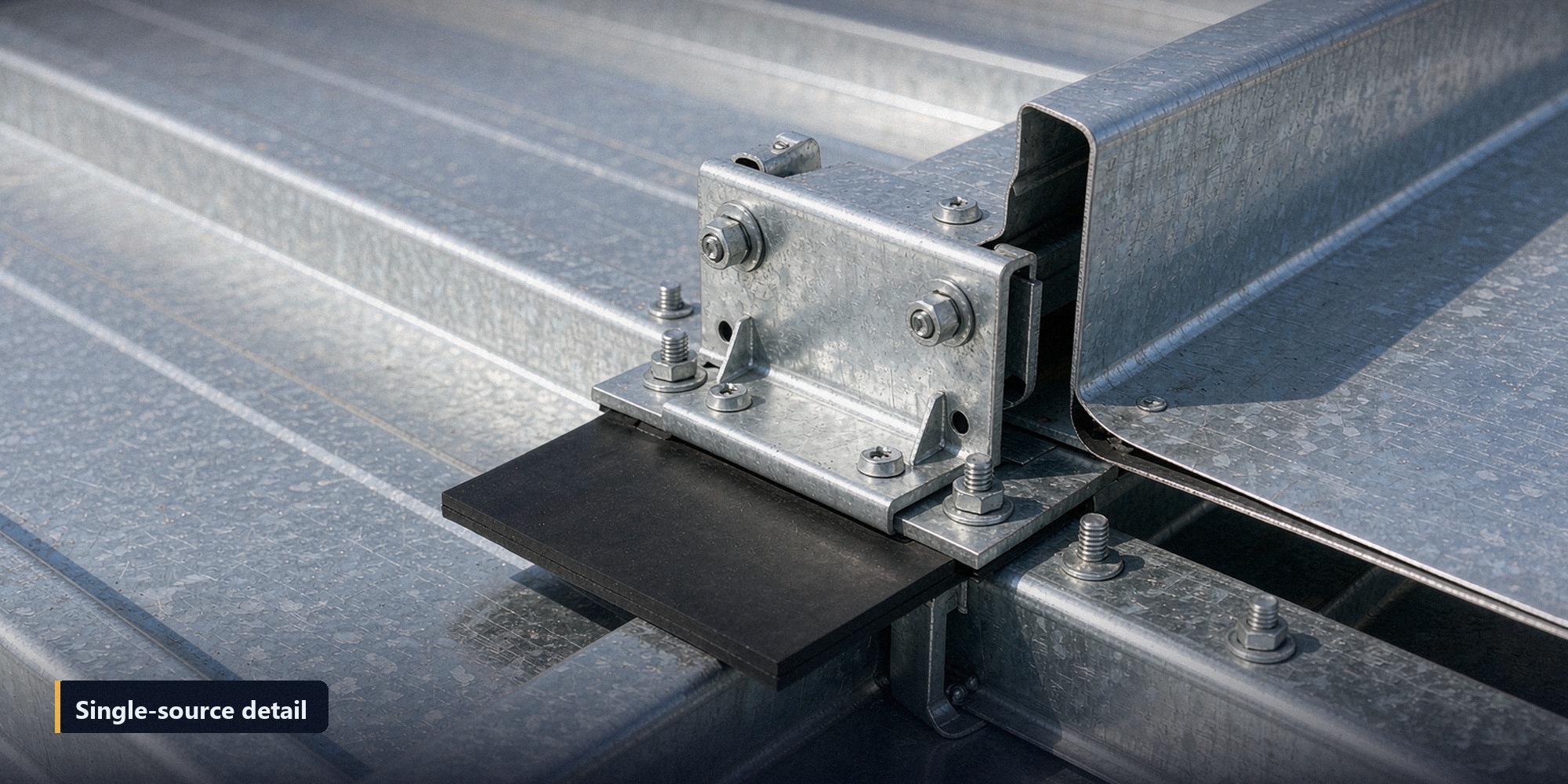
One Drawing Set, One Set of Flashing Details
Roof penetrations, PV mounting clamps, and waterproof flashing can be coordinated in a single set of detailed drawings. The design has one coordinated source, and the site team follows one agreed installation method.
Under a separate-subcontract model, these three elements may be covered by two different drawing sets. The junctions between them are particularly vulnerable to errors—and are also common locations for water ingress.
One Responsible Warranty Provider
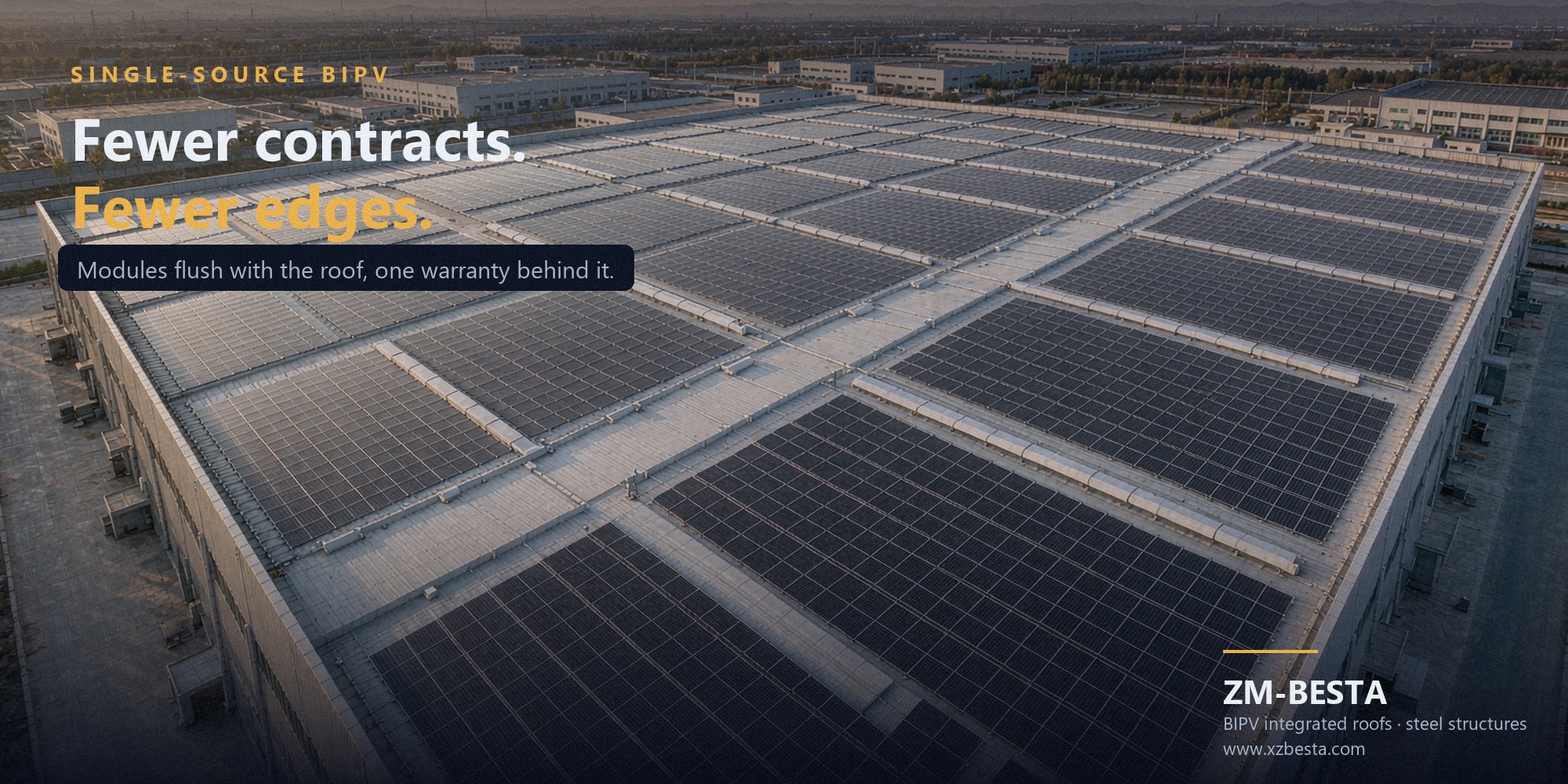
BIPV differs from conventional rooftop PV systems: the PV modules serve as building components rather than simply being added equipment.
The IEA PVPS Task 15 description of BIPV explains that PV modules can directly become building elements, such as roofs, façades, and tiles, while performing both building-envelope and electricity-generation functions.
Because BIPV components serve a building function, roof waterproofing continuity depends on how the different layers work together. The building-envelope guidance from the UK-based SteelConstruction.info website also emphasizes that enclosure performance depends on the interaction between layers, rather than on any single material alone. See its building-envelope guidance.
Having one responsible contracting entity gives the owner a clearer point of contact for warranty claims.
When Is Separate Subcontracting Still a Reasonable Choice?
To be clear, subcontracting is not inherently the wrong choice.
– Small roof areas. For retrofit projects involving only a few hundred square metres, there may be fewer interfaces, making separate subcontracting more flexible.
– An existing general contractor is already appointed. A capable general contractor can manage interfaces, reducing the owner’s need to coordinate the two subcontractors directly.
– The owner has its own operations and maintenance team. An experienced in-house team may be better equipped to diagnose problems and coordinate warranty claims.
– The project is being built in phases. If the structure is completed first and the PV system is installed later, the schedule boundaries are clearer and the interfaces can be explicitly defined in the contract.
The key is not simply which model you choose. It is whether the interface responsibilities are written into the contract before signing: Who provides design inputs? Who makes roof penetrations? Who installs the flashing? Who is the first point of contact if a leak occurs?
How to Tell Whether a Supplier Is Truly Integrated
Ask three questions:
1) Whose drawings include the structural load calculations? The answer should be the same structural design team responsible for coordinating the BIPV system.
2) Who determines the purlin spacing and mounting-clamp layout? The answer should be based on one coordinated layout.
3) Who comes to the roof when a leak occurs? There should be one clearly designated responsible entity—not a process that starts with “conduct an assessment first, then determine responsibility.”
If all three answers point to the same team, the solution is genuinely integrated. If they point to three different parties, the arrangement may simply be three suppliers operating under one brand.
If you need a project-specific comparison of subcontracting versus an integrated solution, send us your roof area, span, and project location.
Email: info@xzbesta.com
Frequently Asked Questions
Q1: Is an integrated supplier’s quotation always higher?
It is often 3%–8% higher because the quotation includes interface management and coordination costs. This price difference should be evaluated alongside the coordination, rework, and delay risks associated with separate subcontracting—not by comparing the total prices alone.
Q2: Is it really difficult to determine responsibility for leaks under a subcontracting model?
Not necessarily, but establishing responsibility can be costly. It may require an investigation into the cause of the leak, reconstruction of installation records, and clarification of each party’s work scope. The owner may need to advance the time and costs involved before seeking reimbursement from the responsible party.
Q3: Can an integrated supplier handle both structural and PV system design?
That is a core capability of an integrated solution. The supplier needs both steel structure design and PV system design capabilities and must be able to coordinate them within the same drawing set and structural load calculations.
Besta has both capabilities and can coordinate the structural and PV loads during the structural design stage.
Q4: Can the situation be improved if the work has already been split between subcontractors?
Yes. At the contract stage, prepare an interface responsibility matrix that specifies the design-input deadlines, work scopes, acceptance criteria, and responsible parties for all four interfaces. Resolving these issues after construction begins is generally more costly.
Q5: Does an integrated supplier leave less room for price negotiation?
It can. A single contracting entity may offer less opportunity for price competition than multiple independent suppliers. The trade-off is between negotiating flexibility and clearer interfaces with a single point of responsibility. The larger and more complex the project, the more valuable this trade-off may become.