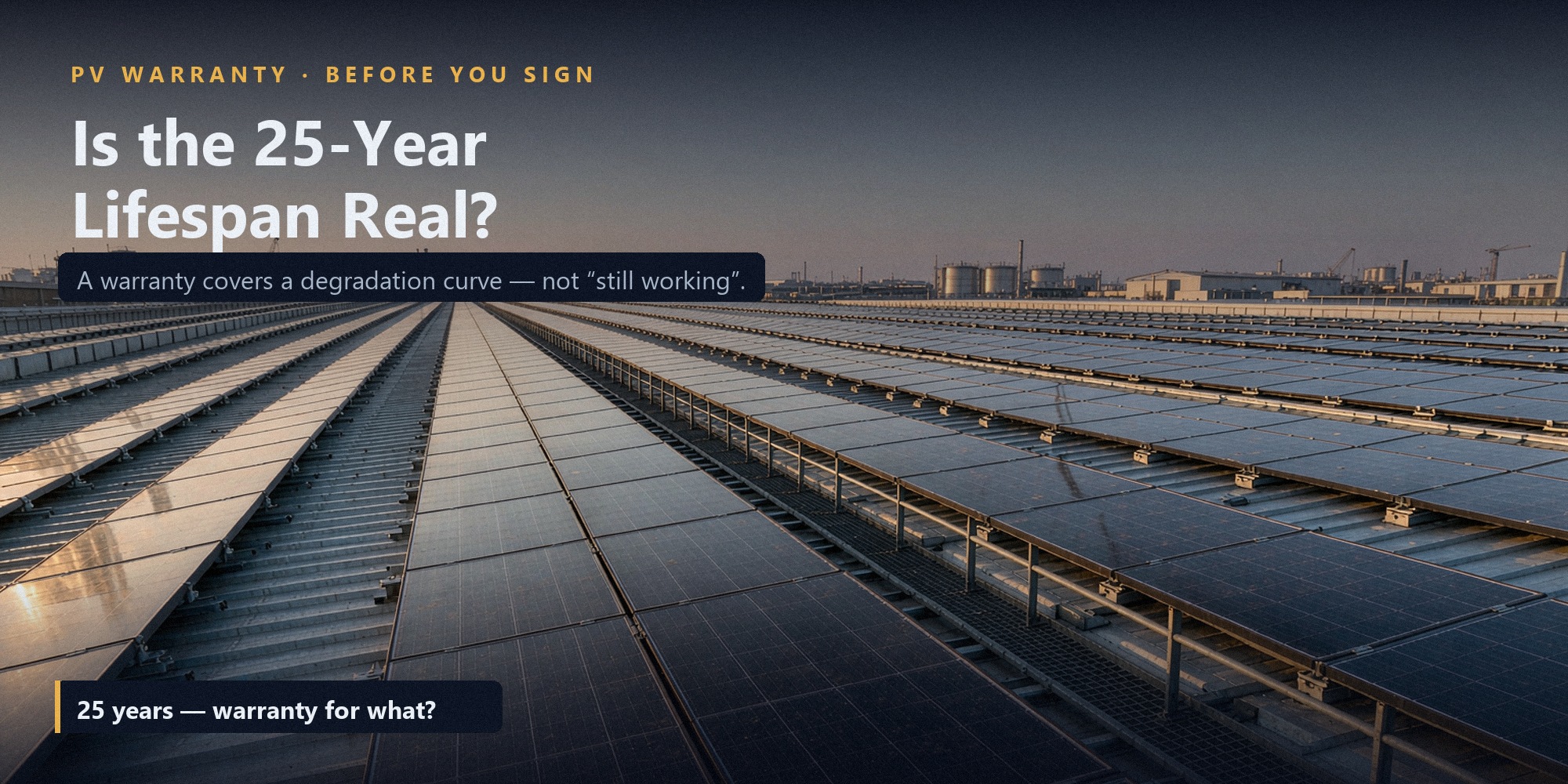
When a solar panel warranty states “25 years,” many buyers assume it means the panel will continue working for 25 years.
These are two very different things. A 25-year warranty typically guarantees a specified power output degradation curve, not simply that the panel will still generate electricity. If you fail to clarify four key points before signing the contract, the compensation you can claim after 25 years may be very different from what you expect.
This article breaks down the solar panel warranty: how to read the degradation curve, what the two types of warranties cover, what certification testing actually proves, and which system components may fail first.
A 25-Year Warranty Guarantees Power Output, Not Simply That the Panel Will Still Work
Two Key Figures in the Warranty Curve
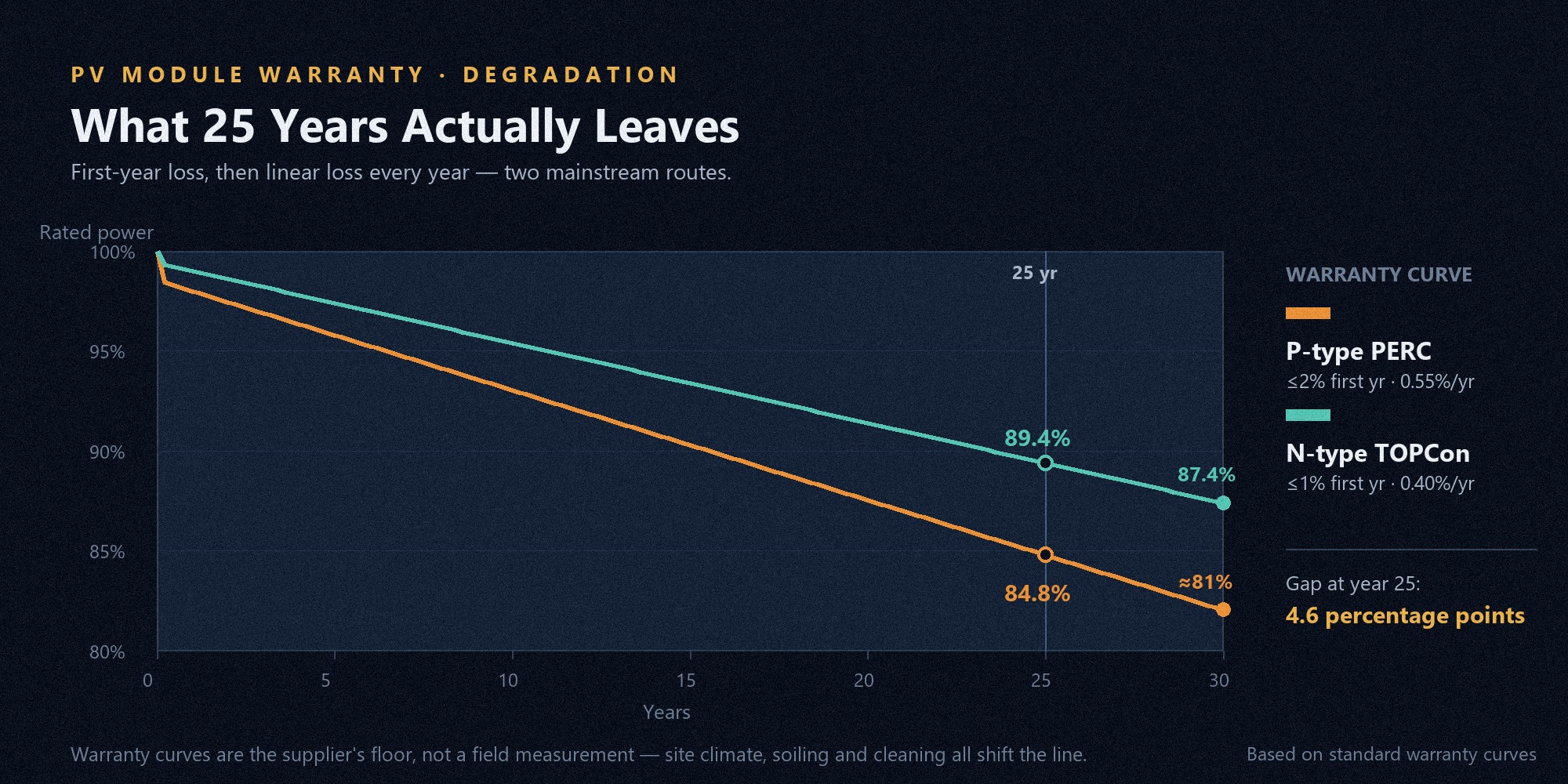
A solar PV module warranty typically specifies two figures: first-year power degradation and annual linear degradation thereafter.
First-year degradation is higher because light-induced degradation (LID) and the initial stabilization process are concentrated in the first few months. Subsequent linear degradation accounts for a major share of power loss over the 25-year period.
The calculation is straightforward: subtract the first-year degradation once, then accumulate the annual degradation over the following years. Remaining power output at Year 25 = 100% − first-year degradation − 24 × annual degradation rate
How Much Difference Is There Between the Two Main Technologies?
| Technology |
First-Year Degradation |
Annual Linear Degradation |
Remaining Power at Year 25 |
Remaining Power at Year 30 |
Typical Warranty Combination |
| P-type PERC |
≤2% |
≤0.55% |
Approx. 84.8% |
Approx. 82% (extrapolated from the same curve) |
12-year product warranty / 25-year power warranty |
| N-type TOPCon |
≤1% |
≤0.40% |
Approx. 89.4% |
Approx. 87.4% |
12–15-year product warranty / 30-year power warranty |
A difference of 4.6 percentage points can translate into hundreds of thousands of kilowatt-hours of electricity over 25 years for a 1 MW rooftop solar PV system.
A Warranty Is a Commitment, Not a Field Measurement
A warranty degradation curve is a manufacturer’s commitment based on testing and modeling. Actual degradation on a rooftop is affected by temperature, humidity, voltage, soiling, and cleaning methods.
The same module model will not necessarily perform the same way after 25 years on a coastal site as it does in a desert environment. A warranty curve defines the guaranteed performance threshold, not the average real-world outcome.
Product Warranty and Power Performance Warranty Are Two Different Commitments
One Covers Defects; the Other Covers Power Output
Product warranty: Covers defects in materials and workmanship, such as backsheet cracking, soldering failures in the junction box, frame delamination, and glass breakage not caused by external forces. A 12-year term is common, while some products offer 15 years.
Power performance warranty: Guarantees that the module’s output power will not fall below the specified degradation curve. A 25-year term is common, while N-type products often offer 30 years.
The two warranties have different terms, claim conditions, and compensation arrangements. Looking only at the words “25-year warranty” means overlooking half of the picture.
Who Pays, What Is Covered, and Who Pays for Labor?
This is one of the most easily overlooked parts of a solar panel warranty.
Warranty terms often commit the manufacturer to replacing the module itself. Removing the old panel, shipping it back to the factory, crane and scaffolding costs, and losses caused by downtime are excluded from many warranty arrangements.
The issue is even more significant for building-integrated photovoltaics (BIPV). The PV modules form part of the roof itself. Replacing a module may require opening the roof and reinstating the waterproofing details. The contract must clearly specify who bears these costs.
Before signing, ask three questions:
- What evidence is required to support a warranty claim?
- Who pays for the labor involved in replacing the module?
- Who is responsible for roof waterproofing during the warranty period?
Certification Tests Show That a Module Meets Defined Requirements, Not That It Will Last 25 Years
What Do IEC 61215 and IEC 61730 Test?
IEC 61215 covers design qualification and type approval. Its test sequences include thermal cycling, damp heat, mechanical loading, hail, and UV preconditioning, among other tests. IEC 61730 addresses PV module safety, including electrical insulation, fire hazards, and structural safety.
Passing these tests demonstrates that a product has met the relevant qualification and safety requirements.
It does not mean that the module is guaranteed to operate without problems for 25 years. These tests are accelerated and limited in duration, while real-world environments involve more complex combinations of stress factors.
What Standard Tests May Not Fully Capture
Degradation of encapsulation materials caused by damp heat, potential-induced degradation (PID), UV-induced degradation (UVID), thin-glass breakage, and bypass-diode connection failures are examples of failure modes that may not be fully reproduced by standard test sequences.
The IEA PVPS Task 13 reliability research highlights that current IEC 61215 testing cannot reveal certain degradation and failure modes associated with encapsulation materials, glass, and junction boxes. Some of these failure modes have safety implications.
Therefore, in addition to reviewing the warranty, ask for records of supplementary or more demanding tests, where applicable:
Damp-heat testing: 2,000 hours
PID testing: 192 hours
Thermal cycling: 200 cycles
Mechanical load testing: 5,400 Pa
Whether these tests have actually been performed—and whether the reports are available—makes a difference.
The First Component to Fail May Not Be the Solar Panel
Components That May Need Replacement Over 25 Years
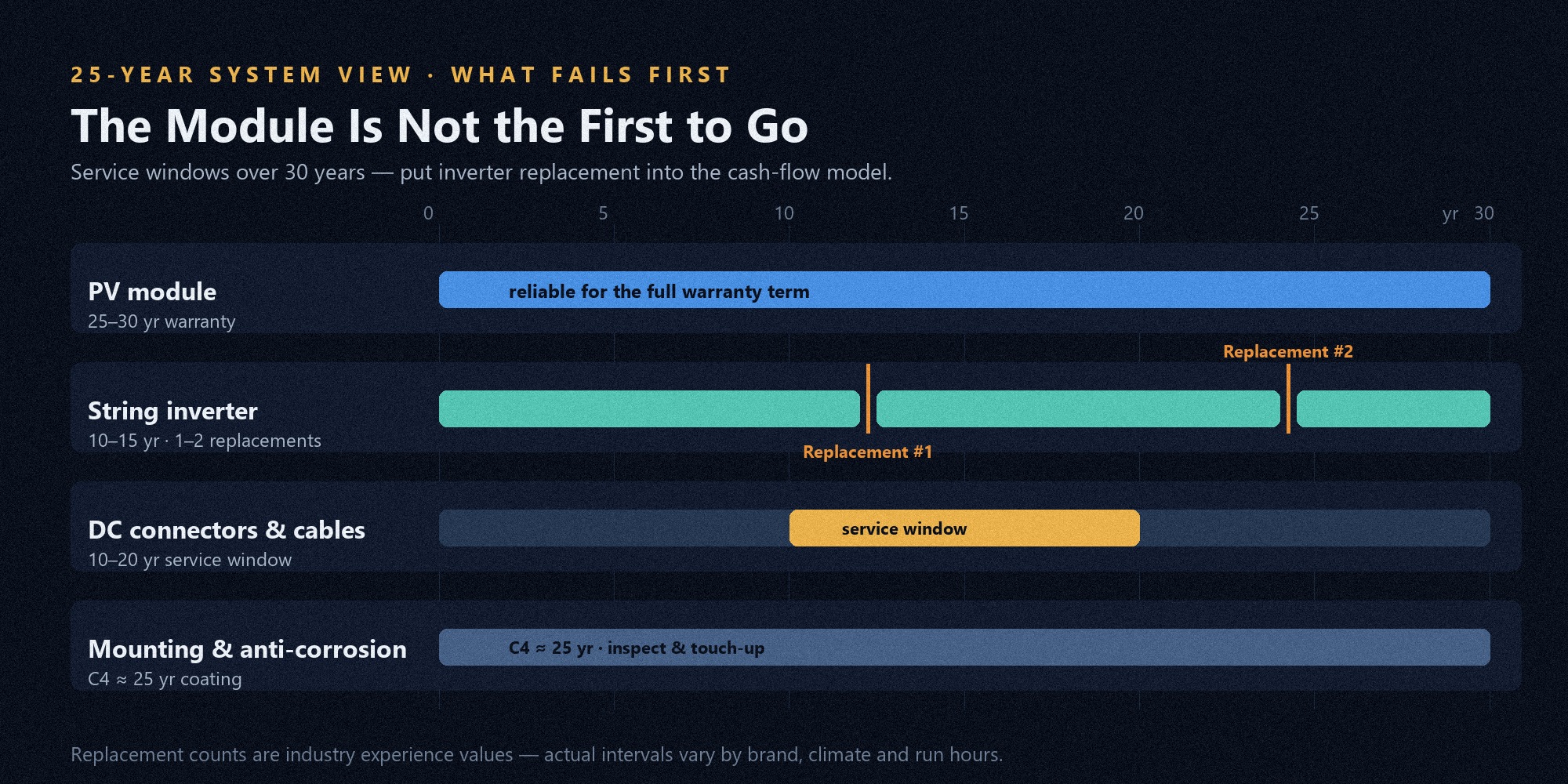
Solar modules are not necessarily the shortest-lived components in a PV system. Inverters and electrical connection components may need replacement during the system’s operating life.
| Component |
Typical Replacement Interval |
Replacement Needed Within 25 Years? |
Potential Impact of Failure |
| PV modules |
25–30 years (based on typical power warranty terms) |
Not normally, apart from normal degradation |
Reduced energy yield; localized hot spots |
| String inverter |
10–15 years |
Yes, typically 1–2 replacements |
Entire string may stop operating |
| DC connectors and cables |
10–20 years |
Depending on site conditions, possibly once |
Increased contact resistance; arcing risk |
| Corrosion protection of mounting structures and purlins |
Approx. 25 years in C4 environments; 15–25 years for duplex coating systems in C5-M environments |
Not normally, but regular inspections are required |
Corrosion and reduced load-bearing capacity |
| Junction box and bypass diodes |
Intended to operate over the module’s service life; failure may require module replacement |
Depends on manufacturing quality and failure conditions |
Localized overheating and potential safety hazards |
When preparing a 25-year cash-flow forecast, include the cost of inverter replacement. This can significantly extend the payback period, and many project proposals overlook this expense.
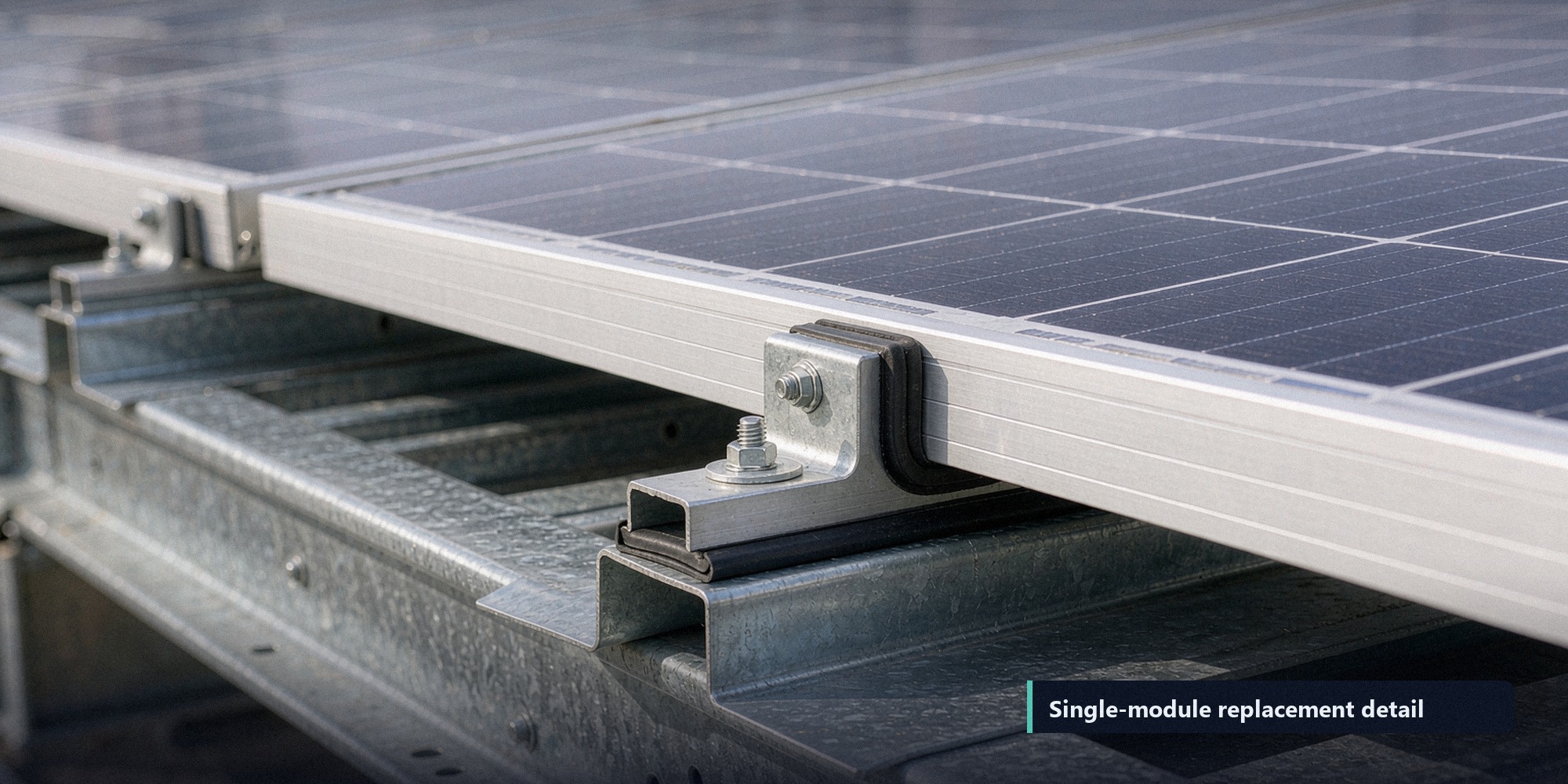
In a building-applied photovoltaic (BAPV) system, the modules are mounted on top of the roof using a mounting structure. Replacing a panel is generally a maintenance operation: lift it out, replace it, and reinstall it.
In a BIPV system, the PV modules themselves form part of the roof. Replacing one may require opening the roof, removing waterproofing details, and reinstating the seals. That is why maintainability must be addressed at the design stage. The drawings should define the maintenance access routes, locations for spare modules, and whether flashing and edge details allow individual modules to be removed and replaced.
This may not appear in the PV module warranty, but it can significantly affect maintenance costs over 25 years.
Four Questions to Ask Before Signing a Solar Panel Contract
- What power output is guaranteed after 25 years?Calculate the figure using the exact degradation rates and decimal places specified in your contract.
- How long are the product and power performance warranties, respectively?Who pays for replacement labor and transportation?
- What supplementary tests have been conducted beyond IEC 61215 and IEC 61730?Can the manufacturer provide the test reports?
- What are the warranty periods for the inverter, electrical connectors, and waterproofing system?How many replacements should be expected over 25 years?
Once you have clear answers to these four questions, you can assess the warranty more completely.
How should you estimate electricity generation over 25 years? Start with the local solar irradiation resource. You can look up the project’s location using the Global Solar Atlas PVOUT data, then apply the annual degradation factors to build a more realistic long-term generation curve.
Frequently Asked Questions
Q1: Does a solar panel stop working when its 25-year warranty expires?
No. A 25-year warranty marks the end of the warranty period, not necessarily the end of the panel’s service life. The module may continue generating electricity after the warranty expires, but the manufacturer may no longer guarantee a minimum power output under that warranty. Its actual service life depends on encapsulation materials, the junction box, and site conditions.
Q2: Is it easy to make a claim under a power performance warranty?
Not necessarily. Evidence is critical. A claim may require a third-party test report, complete electricity generation records, and cleaning and maintenance records. Projects without properly archived monthly generation data may struggle to substantiate a claim. Establish a data archiving system from the first day of grid connection.
Q3: Is TOPCon always better than PERC?
N-type TOPCon modules generally offer advantages in degradation performance and temperature coefficient. Typical figures include lower first-year degradation, annual degradation of approximately 0.40%, and a temperature coefficient of around −0.29%/°C.
However, price, lead time, and the availability of local after-sales service must also be considered. Technology selection should not be based on a single parameter.
Q4: How can a damaged module be replaced on a BIPV roof?
It depends on the design. If maintenance access routes and spare-module locations are planned in advance, and the flashing details allow individual modules to be removed, replacement can be limited to a local work area.
If the roof is designed without practical access for individual module replacement, replacing one module may require dismantling a much larger section, significantly increasing costs. Confirm this during the design stage.
Q5: How should 25-year electricity generation be estimated?
Follow three steps:
- Estimate first-year electricity generation based on the local solar irradiation resource.
- Apply the annual degradation rate from the module’s warranty curve.
- Account for soiling, electrical losses, inverter efficiency, and downtime.
Including all three factors will produce a more realistic estimate.
If you would like a 25-year electricity generation and replacement-cost assessment based on your rooftop conditions and local solar irradiation, send us your basic project information.
Email: info@xzbesta.com