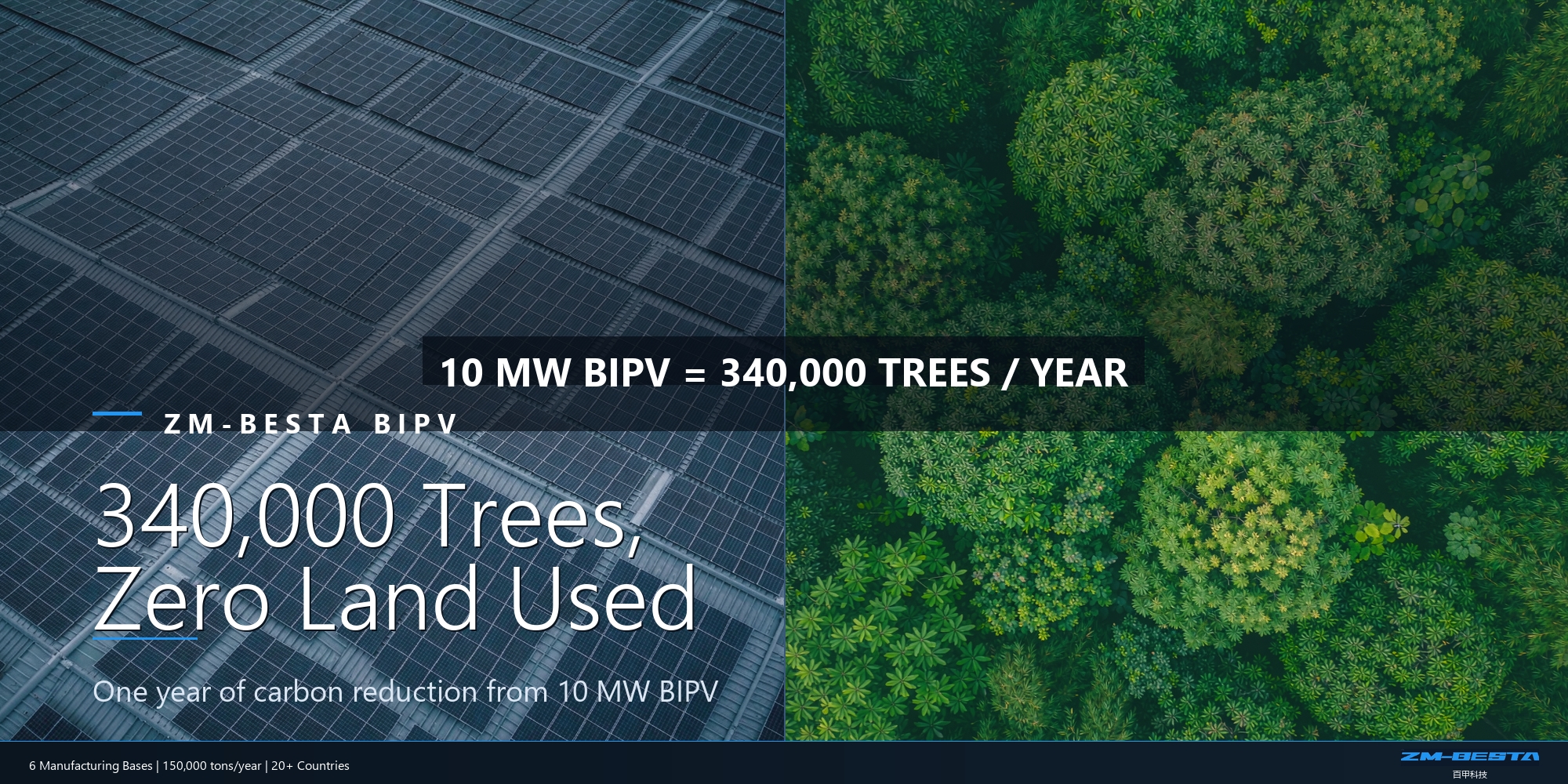
Let’s start with one number: 6,300 tonnes. This is the annual carbon reduction from Xuzhou Zm-Besta’s delivered BIPV project portfolio. To put it in terms everyone understands — it is equivalent to planting about 340,000 trees every year. A whole forest, without taking up a single acre of land.
Anyone in steel structure engineering knows that overseas owners have been talking about nothing but three things over the past two years: quality, delivery, and ESG. The third one is getting harder and harder to brush off.
Annual Total Carbon Reduction: 6,300 Tonnes of CO₂ — How It’s Calculated
Installed Capacity
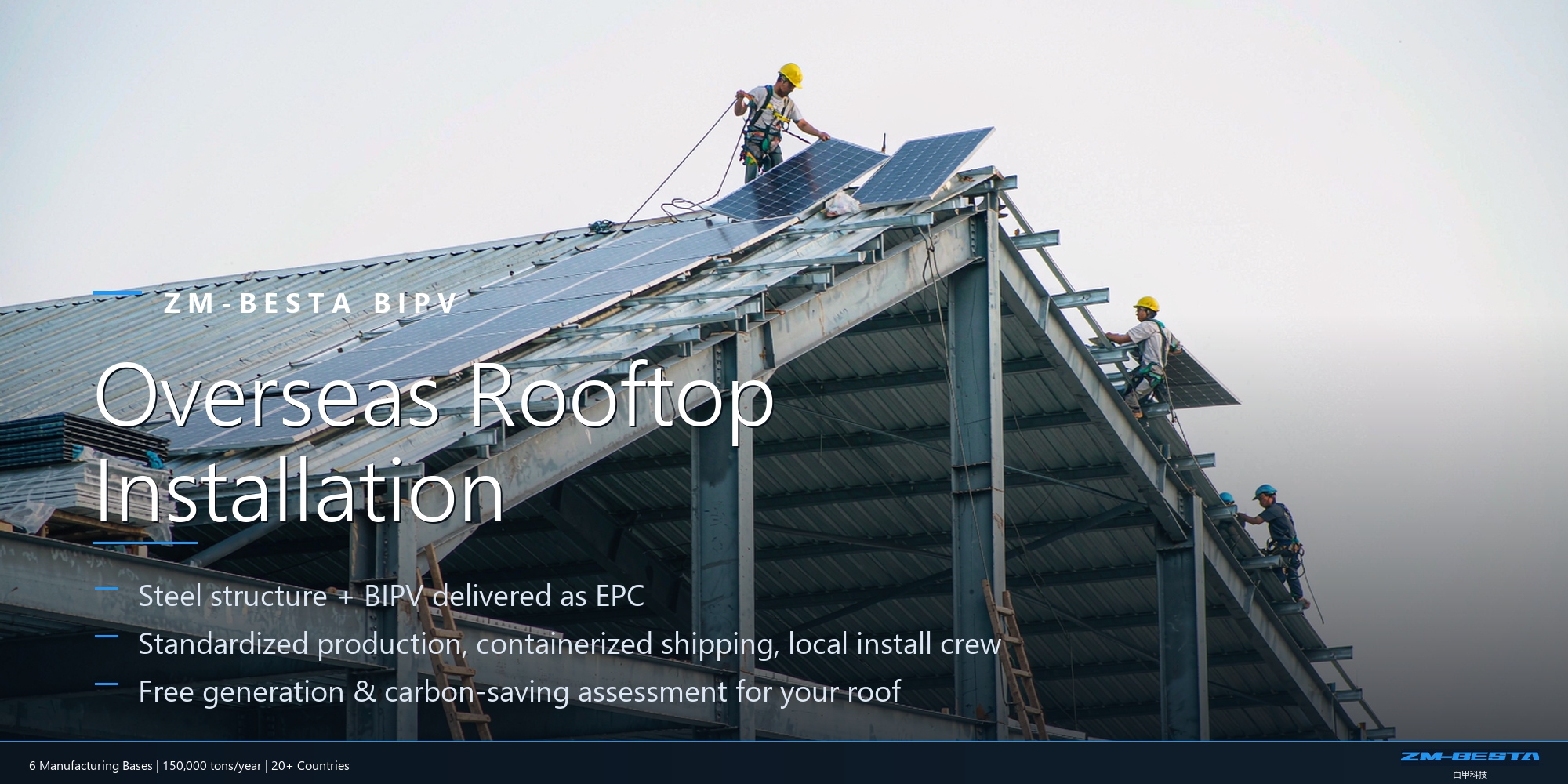
Xuzhou Zm-Besta (stock code: 920057) entered the Building Integrated Photovoltaics (BIPV) field in 2021. In 2023, it achieved a from-zero-to-one breakthrough in distributed PV EPC, with nearly 10 MW sold and completed that year; in 2024, completed and in-hand orders exceeded 10 MW. The calculations below are based on approximately 10 MW of delivered capacity, using 1,100 equivalent full-load hours per year for rooftop PV in Jiangsu.
Calculation Method
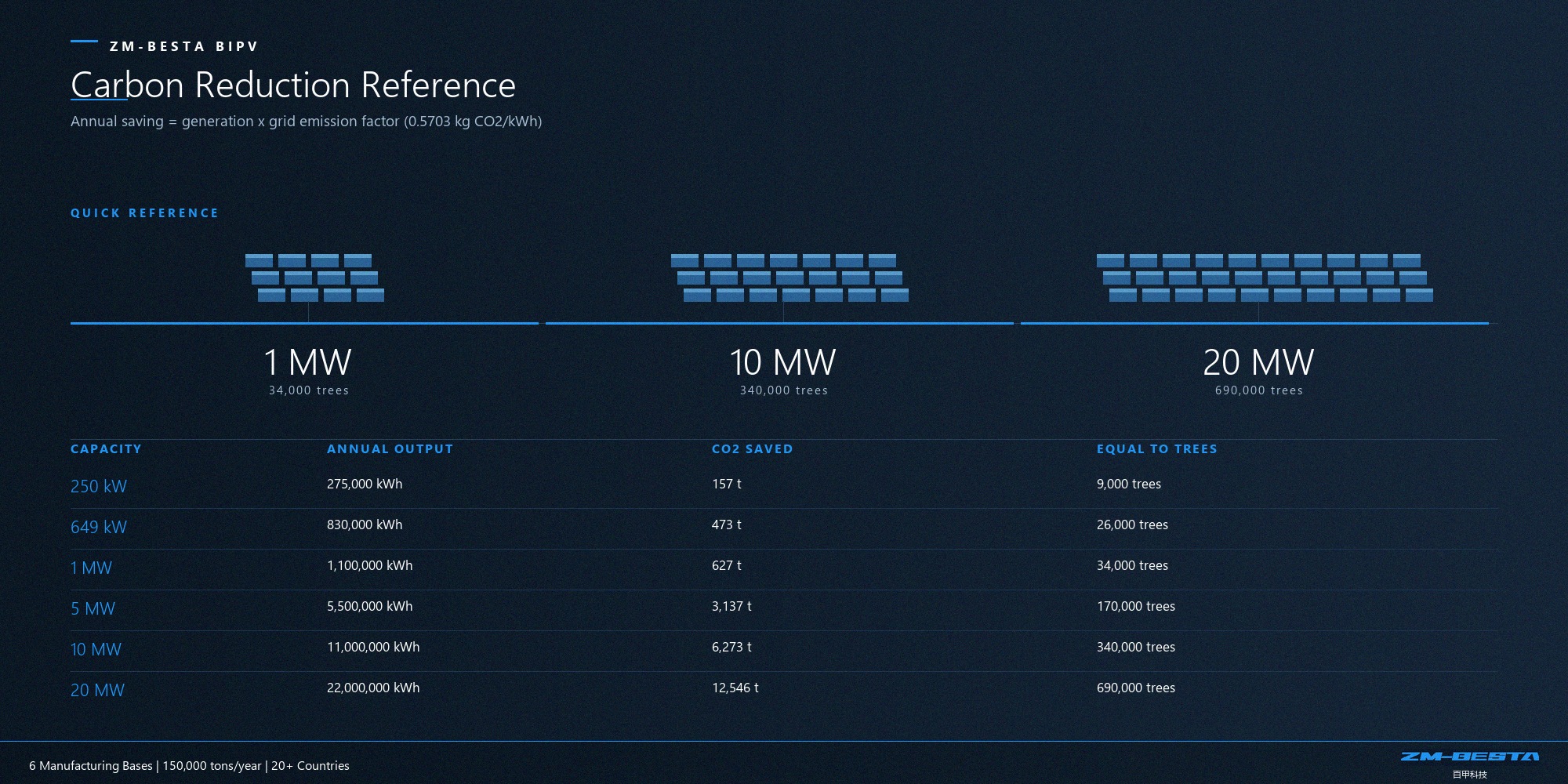
Annual carbon reduction = annual power generation (kWh) × grid emission factor (0.5703 kg CO₂/kWh)
- 10 MW × 1,100 h ≈ 11 million kWh/year
- 11 million kWh × 0.5703 kg ≈ 6,273 tonnes of CO₂/year, rounded to approximately 6,300 tonnes
Equivalent Data: 340,000 Trees Speak Louder Than Abstract Numbers
Multiple Conversion Bases
A mature tree absorbs 18.3 kg of CO₂ per year.
- An annual reduction of 6,300 tonnes ≈ the annual carbon absorption of 340,000 trees
- Equivalent to reducing approximately 2,200 tonnes of standard coal per year(at about 20 tonnes of standard coal per 10,000 kWh)
Quick-Reference Conversion Table
250 kW, ~275,000 kWh, ~157 tonnes of CO₂, 9,000 trees
649 kW, 830,000 kWh, ~473 tonnes of CO₂, 26,000 trees
1 MW, ~1.1 million kWh, ~627 tonnes of CO₂, 34,000 trees
5 MW, ~5.5 million kWh, ~3,137 tonnes of CO₂, 170,000 trees
10 MW, ~11 million kWh, ~6,273 tonnes of CO₂, 340,000 trees
20 MW, ~22 million kWh, ~12,546 tonnes of CO₂, 690,000 trees
Customer Carbon Reduction Contribution Ranking
| Rank | Customer/Project | Installed Capacity | Annual Carbon Reduction (tonnes of CO₂) | Equivalent Trees Planted |
| 1 | Suzhou Kunlun Green Building rooftop PV (EPC) | 0.8 MW | ~502 tonnes | ~27,000 trees |
| 2 | Huaibei Base (Anhui) BIPV demonstration project | 649.255 kW | ~473 tonnes | ~26,000 trees |
| 3 | Jiangsu Surun Seed Industry rooftop PV (EPC) | 250 kW | ~157 tonnes | ~9,000 trees |
Why Is Carbon Reduction Data Becoming the “Hard Currency” of Overseas Bidding?
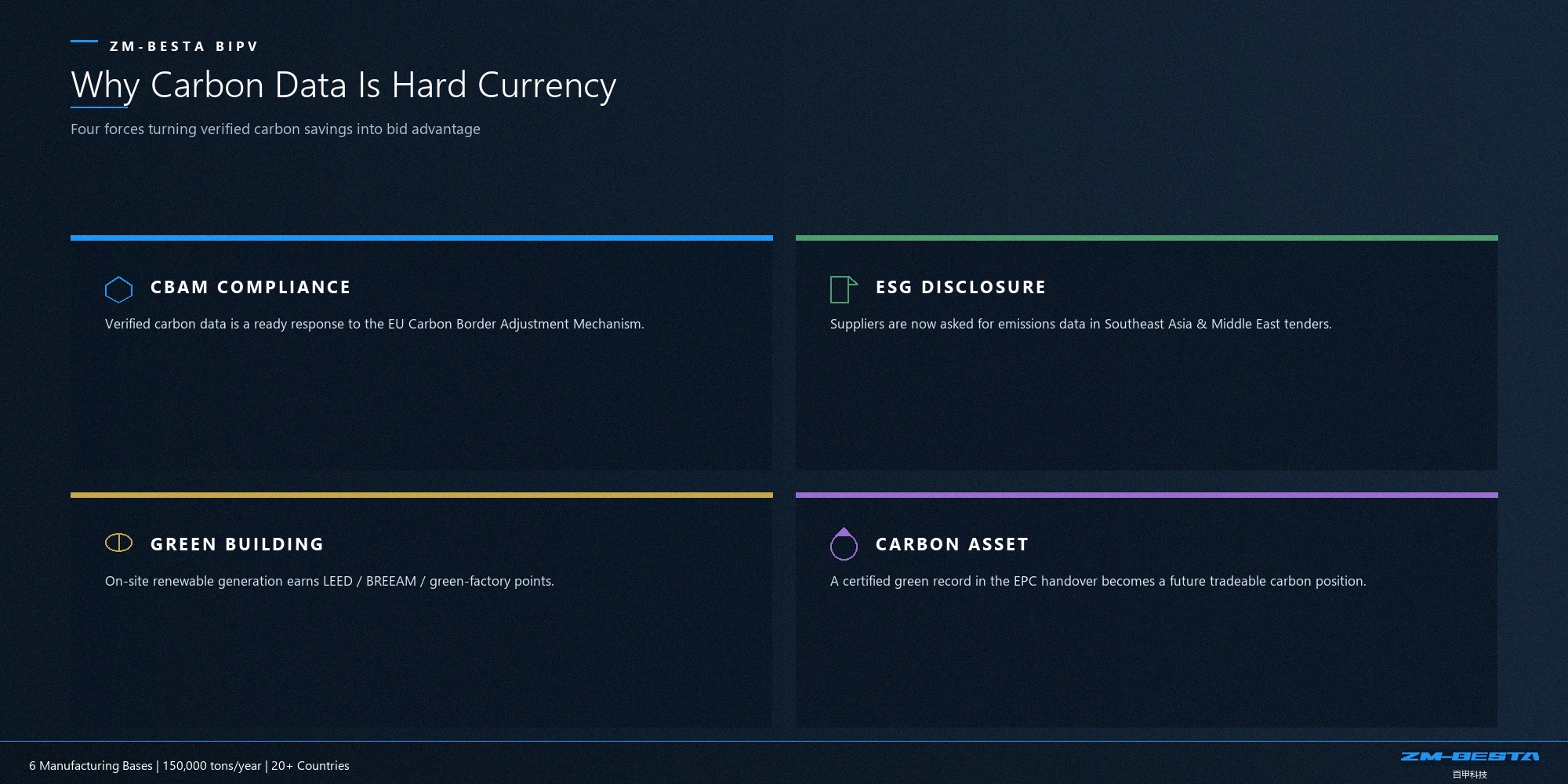
Carbon Tariff (CBAM) Is Approaching
Once the EU Carbon Border Adjustment Mechanism takes effect, the embedded carbon of export-oriented factories will be directly priced. A verifiable PV carbon reduction record is a ready-made bargaining chip.
ESG Reports Need to Be Filled In
When tendering, major groups in Southeast Asia and the Middle East already require suppliers to disclose carbon emission data, and BIPV carbon reduction can be counted honestly.
Green Building Certification Bonus Points
In LEED / BREEAM / green factory assessments, on-site renewable power generation is a hard bonus item.
A Second Stream of Income Beyond Electricity Bills
Once the carbon trading market matures, the carbon reduction itself can be monetized. Xuzhou Zm-Besta can include carbon reduction calculations in EPC deliverables, so the owner gets not only a roof that generates power but also an auditable green record.
Frequently Asked Questions
Q1: How is this carbon reduction data calculated? Why should it be trusted?
A1: The calculation formula is public: annual power generation × grid emission factor. Power generation is estimated based on installed capacity and local actual sunshine hours, and the emission factor is the 0.5703 kg CO₂/kWh value published by China’s Ministry of Ecology and Environment.
Q2: If I install BIPV on my factory roof, how much carbon can it reduce in a year?
A2: For a 1 MW roof, approximately 627 tonnes of CO₂ per year, equivalent to about 34,000 trees. The actual figure depends on the sunshine conditions at the project location; Xuzhou Zm-Besta can provide a free pre-assessment of power generation and carbon reduction.
Q3: Can the carbon reduction data be used for ESG reports or carbon tariff declarations?
A3: Yes, it can be used for ESG disclosure and supplier carbon emission declarations as enterprise-level carbon reduction evidence.
Q4: Is Xuzhou Zm-Besta a trader or a manufacturer?
A4: A manufacturer. Xuzhou Zm-Besta is listed on the Beijing Stock Exchange (stock code: 920057) and holds the Special Grade steel structure manufacturing qualification and EPC general contracting capability, with full-chain control over the integrated design, production, and installation of BIPV modules and steel structure roofs, exporting products to markets including India, Southeast Asia, the Middle East, and Africa.
Q5: How are overseas projects delivered?
A5: Steel structures + BIPV are delivered under EPC general contracting. Modules and structural components are produced with standardized manufacturing and containerized shipping, supported by local installation teams and remote monitoring. The delivery schedule and response mechanism can be confirmed in writing at the quotation stage.
Want to calculate the carbon reduction of your roof? Leave your project information (country, roof area, monthly electricity consumption) and get your tailored power generation and carbon reduction estimate.
Email: info@xzbesta.com