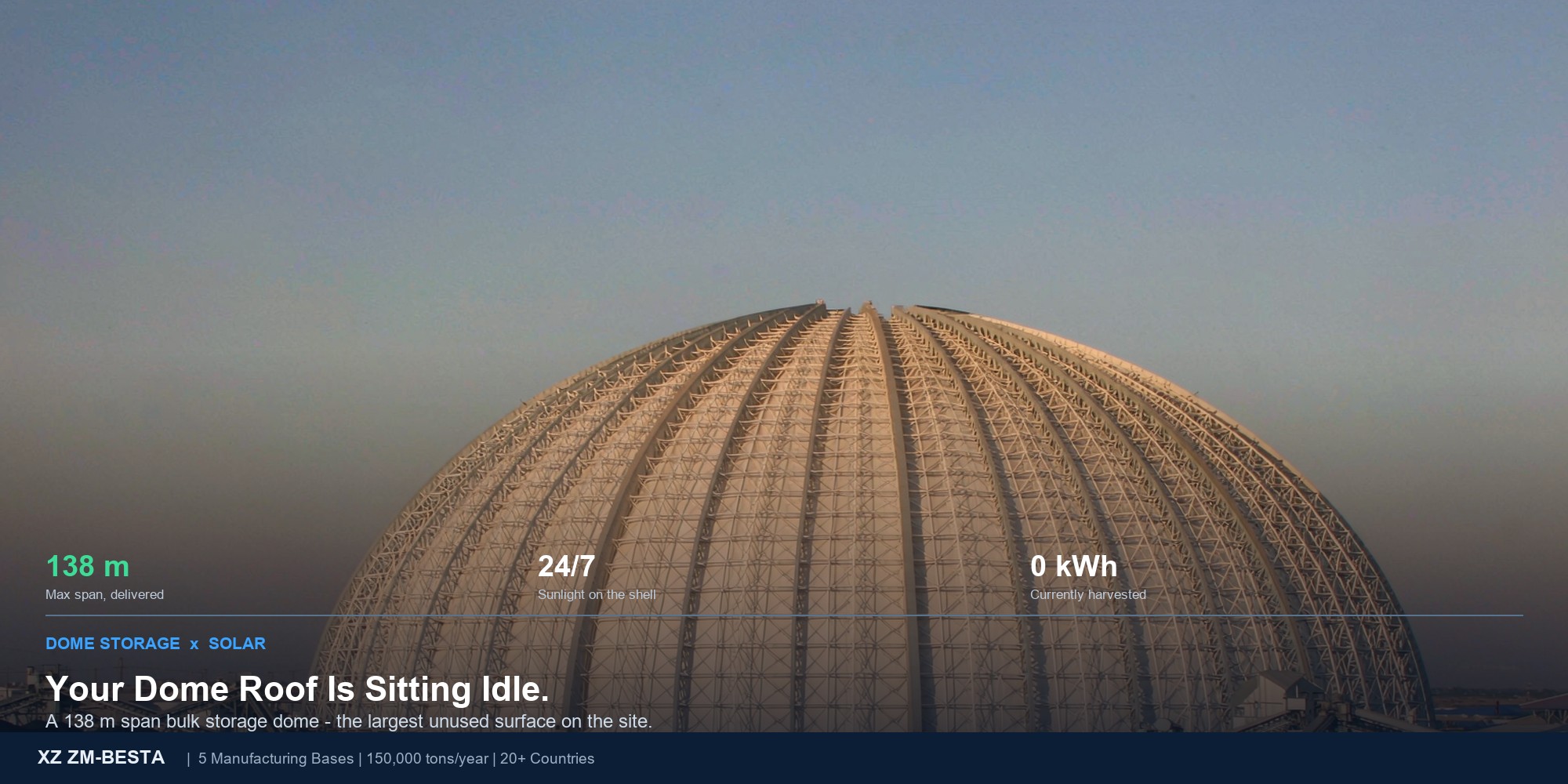
A fully enclosed dome storage silo with a 138-meter span — what can its roof do?
Most mine owners’ answer: nothing. Let it sit in the sun.
That may be the largest idle asset on a stockyard’s balance sheet.
This article runs three sets of numbers: the power-generation account, the structural account, and the ESG account — to show how a dome roof goes from “soaking up sun” to “printing money”.
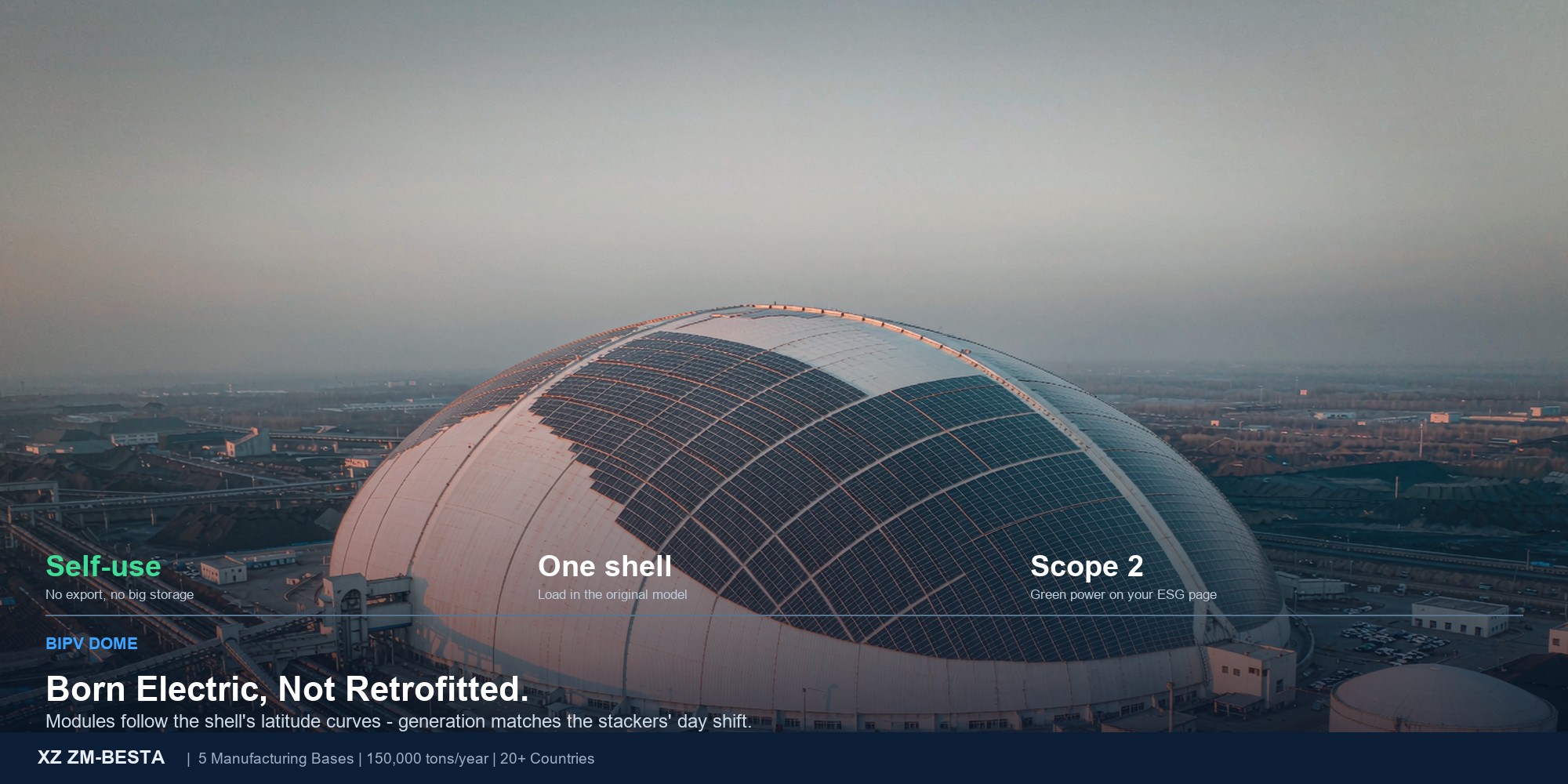
The Dome Storage Roof: A Sun-Facing Surface Going to Waste
The Natural Advantage of a Curved Surface
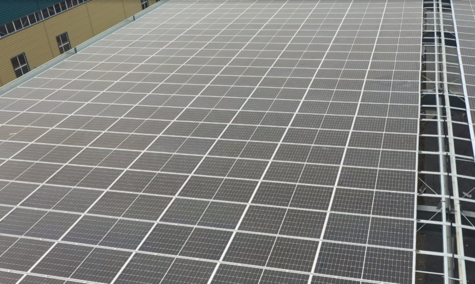
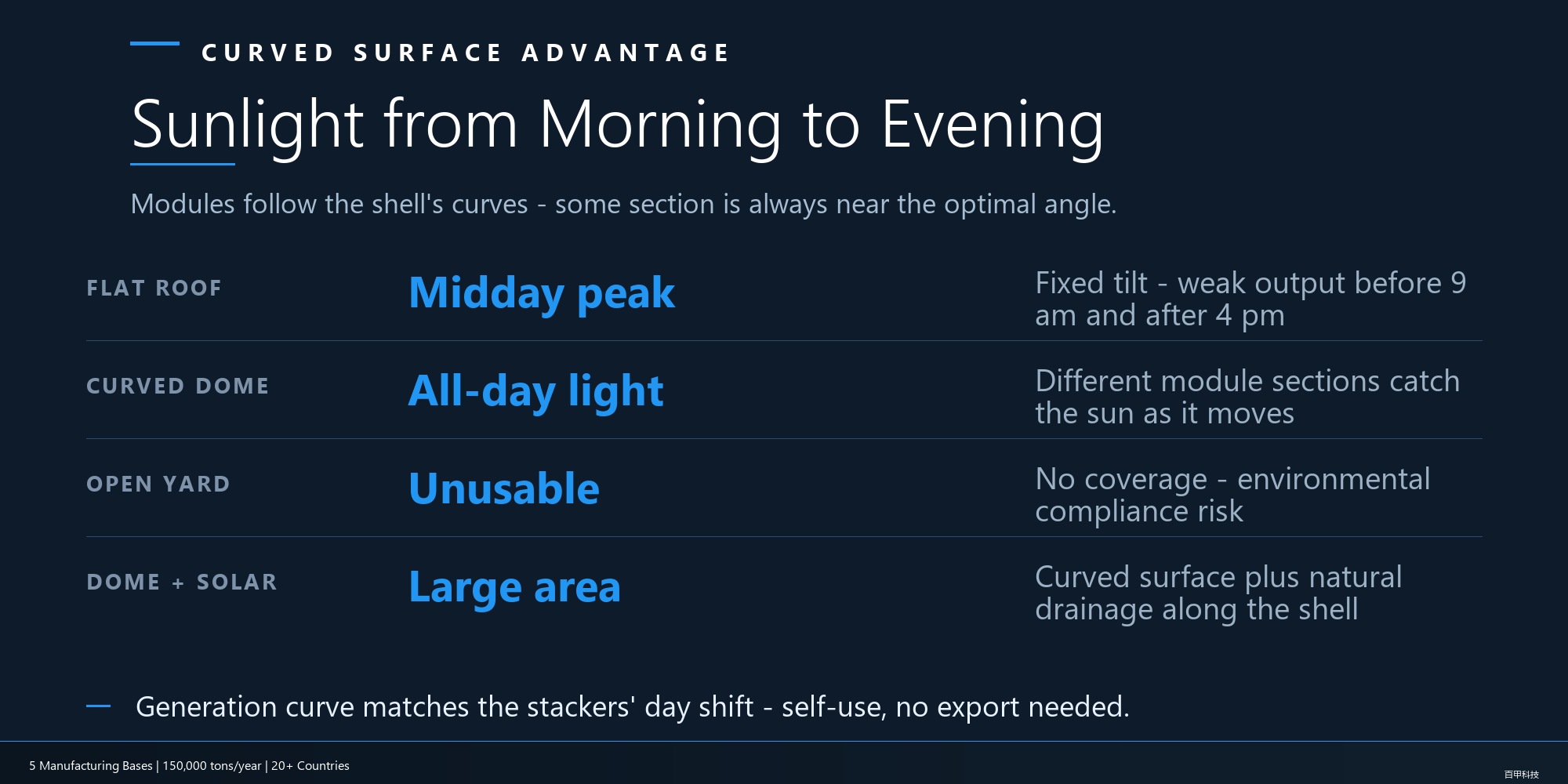
A dome roof is a huge curved surface facing the sun. Unlike a flat roof, curved (dome) solar panels follow the shell’s contours, with module angles changing continuously along the curve — all day long, from morning to evening, some modules are always in a good sun-facing position.
| Roof Type | Sun Exposure | Usable Area | Extra Value |
| Flat roof | Best around noon | 100% flat layout | None |
| Curved dome | Continuous sun all day | Large developed surface area | Natural drainage along the shell |
| Open stockyard | Not usable | 0 | Fails environmental standards |
Generation and Demand Curves Align Naturally
Stacker-reclaimer systems run continuously during the day, so the dome roof’s generation peak aligns with the demand peak. Generate for self-consumption on site — no export, no large-scale storage.
The Structural Account: Solar Enters the Load Model at the Design Stage
A dome is a space frame structure. If solar enters the load model at the design stage, the module weight transfers along the shell and is calculated together with wind, snow and lateral pressure from stored material.
| Design Route | Load Treatment | Outcome |
| Integrated design | Solar and shell loads calculated together | Curved layout, purlins and maintenance access resolved on one drawing |
| Retrofitted after completion | Post-hoc recheck + local strengthening | Strengthening costs 15%–25% of budget, possible production downtime |
That is the meaning of “dome + solar as one”: not patching a finished dome, but making it born with power.
The Third Account: Interior Temperature Drop and ESG
The Unexpected Benefit of Physical Shading
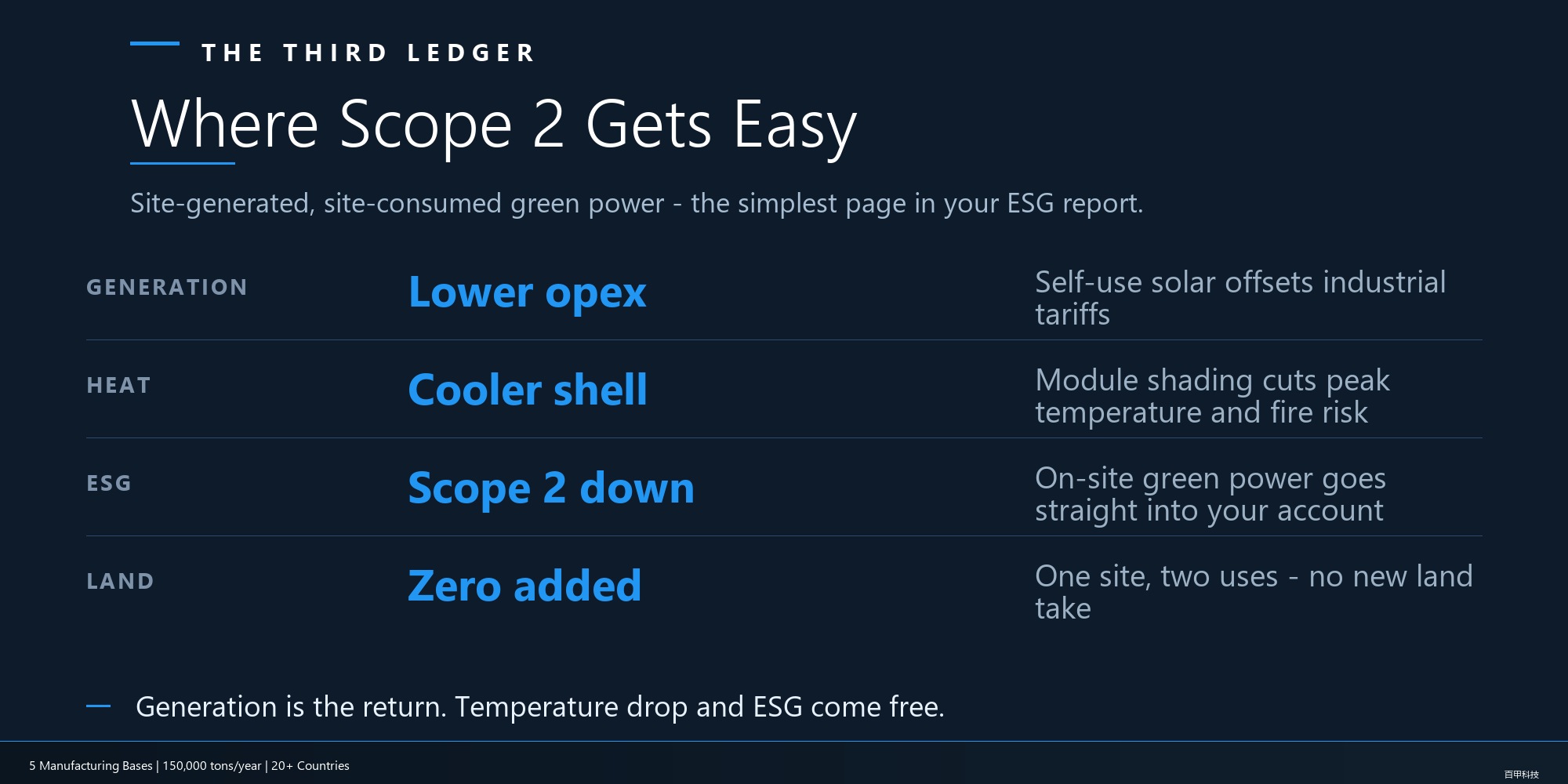
Cover the dome roof with modules and it gains a layer of physical shading. Interior temperature drops, which means lower spontaneous-combustion risk and a better working environment for stored coal and certain materials. Power generation is the gain; the temperature drop is a bonus.
Scope 2 in the ESG Report
For mining groups preparing ESG reports, the hardest part is Scope 2 — emissions from purchased electricity. Rooftop solar on a dome generates and is consumed on site, with the green power credited straight to your own account. A roof-top power station over a large stockyard is the easiest page of the ESG report to explain.
| Value Dimension | Benefit | Where It Shows Up |
| Power generation | Self-consumption, offsetting industrial electricity prices | Lower operating costs |
| Temperature drop | Better interior environment, lower spontaneous-combustion risk for stored coal | Safety + material quality |
| ESG | On-site green power, Scope 2 reduction | Compliance + financing ratings |
| Land | Zero additional land | One site, two uses |
Who Has the Capability to Deliver Dome Solar?
Dome solar requires two capabilities stacked together: the design and fabrication of long-span space structures, plus solar system integration.
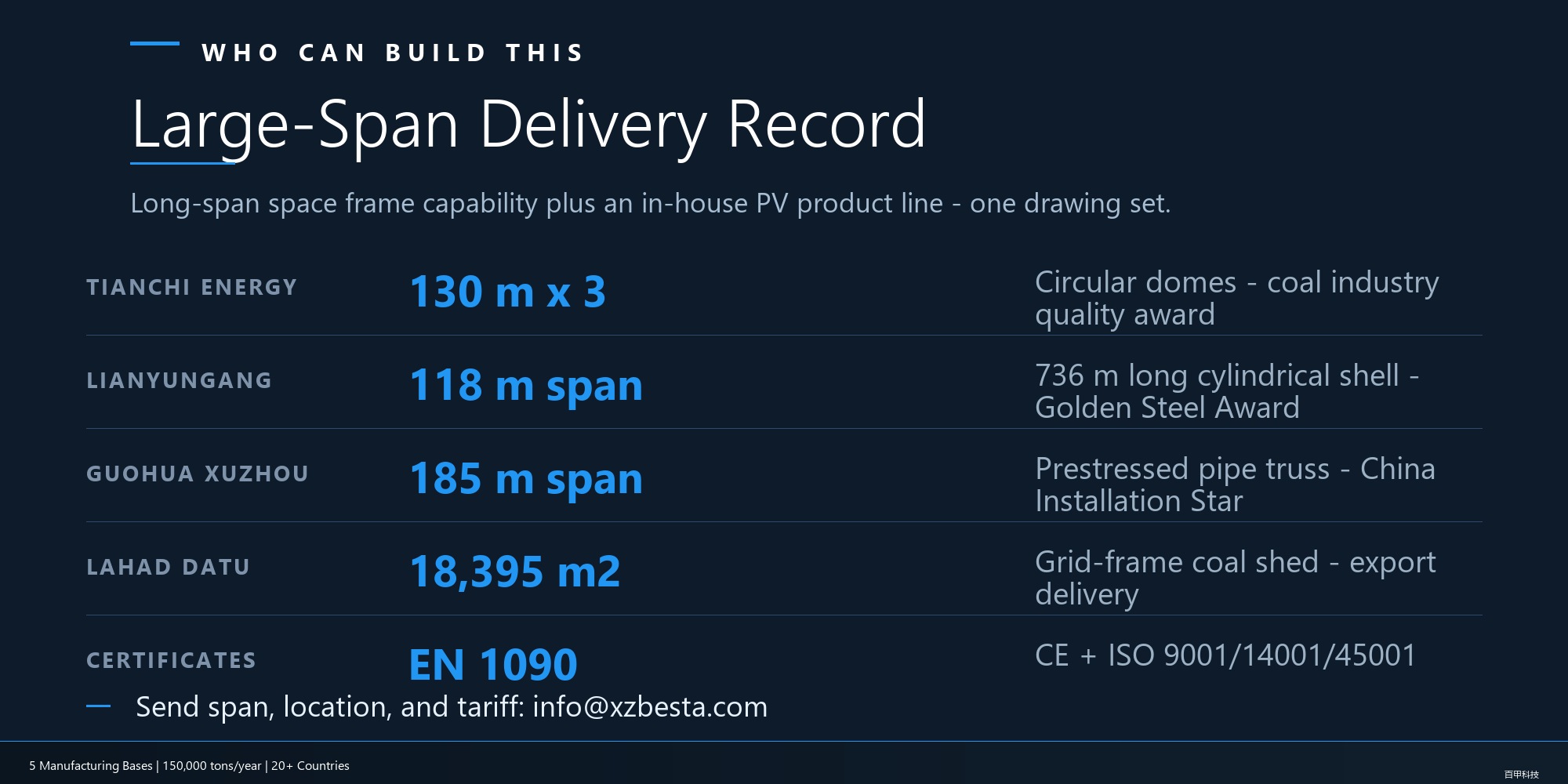
ZM-Besta’s long-span delivery record:
| Project | Structure/Span | Highlight |
| Xinjiang Tianchi Energy Circular Stockyard | 130 m diameter dome × 3 | Coal Industry Quality Project Award |
| Lianyungang Coal Supply Chain Base | 118 m span × 736 m long cylindrical shell | Golden Steel Award |
| Guohua Xuzhou Power Plant Coal Yard Enclosure | 185 m span prestressed tubular truss | China Installation Star Award |
| Indonesia Lapota Dry Coal Shed | Space-frame type, 18,395 m² | Export delivery |
We also have a self-developed solar product line, EN 1090 (CE) certification, and ISO 9001/14001/45001 certification, with a maximum span of 138 meters. Only when structure and solar are drawn by one company does dome solar become feasible.
FAQ
Q1: Does curved dome solar generate more than a flat roof?
A: A curved surface receives sun continuously all day, with better output in the early morning and late afternoon than a flat roof at a fixed tilt; the total depends on latitude and the dome’s orientation and needs project-level simulation.
Q2: Can solar be added to an existing dome silo?
A: A structural recheck is required first. Space frame systems usually have more margin for uniformly distributed loads than planar structures, but each case must be confirmed by assessment.
Q3: Will the modules affect the dome’s corrosion protection and maintenance?
A: In integrated design, module supports and roof joints are unified, and maintenance access and cabling are planned in one pass — the original protection system is not disturbed.
Q4: What about dome solar cost and payback?
A: It depends on the roof area, latitude and local electricity prices. Self-consumption industrial projects typically pay back in 2–5 years. Send us the project parameters and we will produce an estimate.
Q5: How much does the temperature inside a dome drop?
A: It depends on the materials and ventilation design. Roof shading can significantly reduce peak interior temperatures; exact figures come from project-level thermal calculations.
What are your stockyard’s span, location and local electricity prices? Send them to us and we will run the power-generation numbers for your dome roof:
Email: info@xzbesta.com