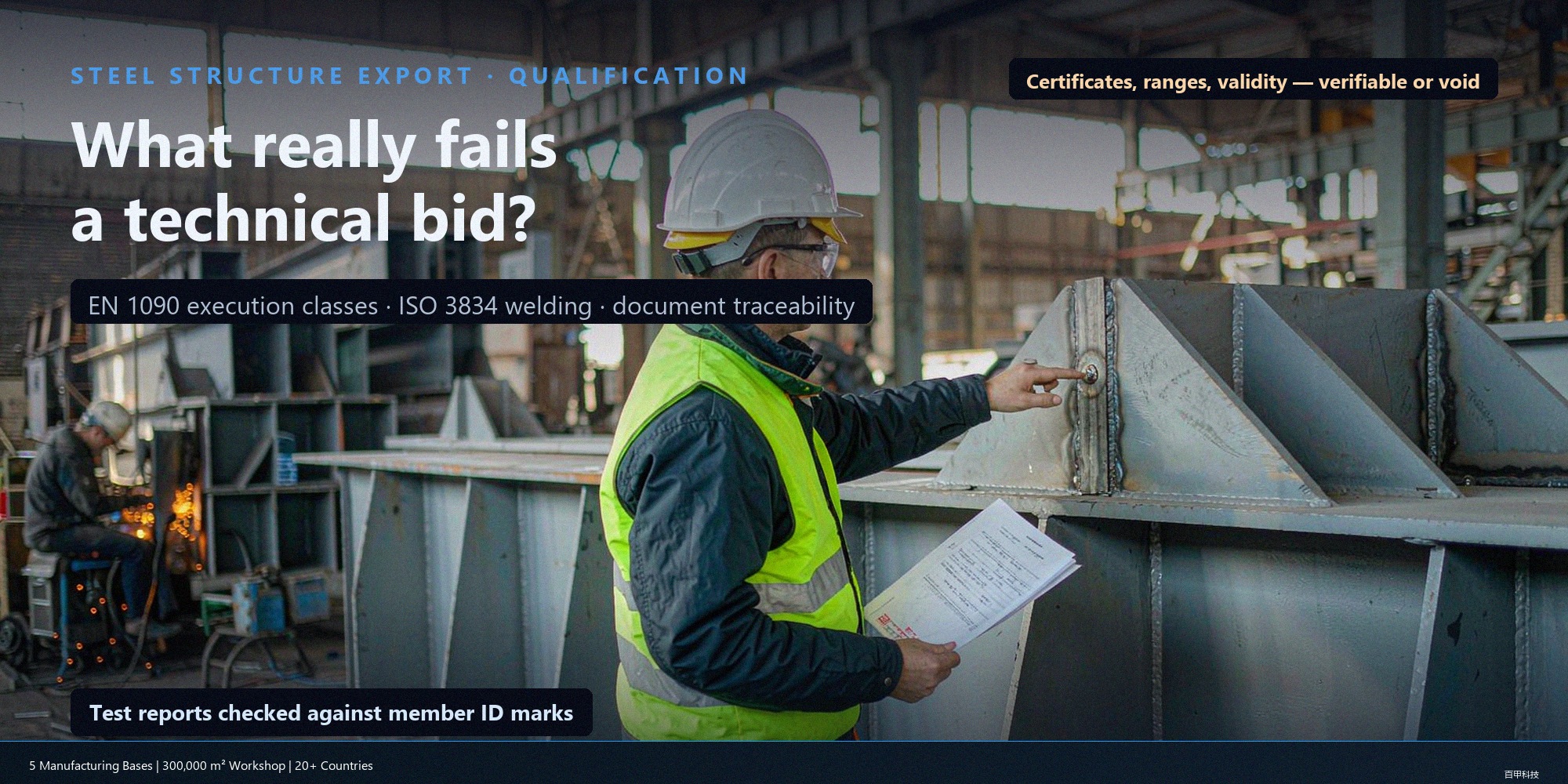
In overseas steel structure projects, a quotation may rank among the most competitive, but if the technical bid is found to have three discrepancies, all the previous efforts can go to waste. What gets questioned is usually not the price, but the qualification documents.
From a contractor’s perspective, this article explains the four categories of documents most frequently reviewed during technical bid evaluations: structural certifications, welding quality systems, welding procedure qualifications, and personnel qualifications.
It also provides a five-point verification checklist that buyers can use when evaluating any steel structure supplier.
If you need to verify certification coverage and welding procedure qualifications for a specific project, please provide the component types, material grades, and required Execution Class.
Email: info@xzbesta.com
The First Hurdle in a Technical Bid
What Gets Reviewed Is Documentation, Not Promises
During the technical bid evaluation stage, project owners and general contractors look for verifiable evidence: certificate numbers, scope of certification, validity periods, and traceability between inspection reports and structural components.
A verbal promise such as “We guarantee our quality” carries no weight at this stage.
Every qualification listed in a compliant bid must be traceable to its original documentation. If the supporting documents cannot be verified, the relevant qualification is generally treated as non-compliant by the evaluation team.
Three Common Reasons for Losing Points
The first is a mismatch in certification scope. A factory may hold a quality management system certificate, but its certified scope does not cover the types of components included in the bid.
The second is an insufficient execution class. The tender specifies a particular Execution Class, but the bidder submits documentation covering a lower class.
The third is a break in document traceability. Inspection reports and material certificates are available, but their records cannot be matched to the component identification numbers. As a result, there is no way to prove that the reports correspond to the actual components being supplied.
EN 1090 and Execution Classes
What Does EN 1090 Cover?
EN 1090 is a harmonized European standard for the execution of steel structures. It consists of two main parts:
EN 1090-1 covers factory production control and conformity assessment.
EN 1090-2 specifies the technical requirements for the execution of steel structures.
It provides the basis for CE marking. Under the EU Construction Products Regulation (CPR, No. 305/2011), CE marking for structural steel products has been mandatory in the EU since July 2014.
Reference: https://steelconstruction.info/CE_Marking
This is a mandatory requirement for structural components placed on the EU market, not an optional certification.
The Four Execution Classes
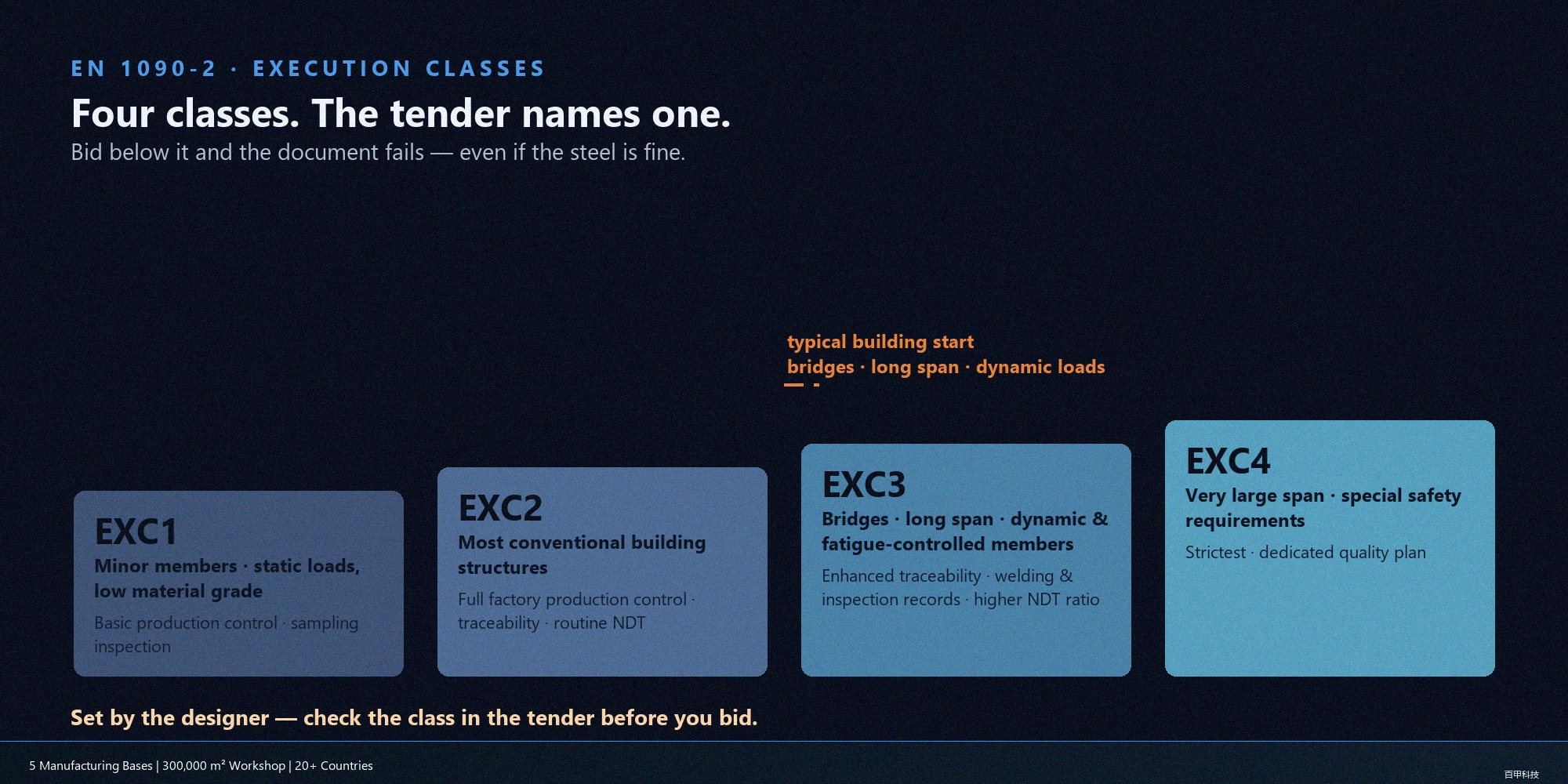
The Execution Class (EXC) is determined by the designer based on structural significance, loading characteristics, and consequence class. Bidders must comply with the Execution Class specified in the tender documents.
| Execution Class |
Typical Applications |
Documentation and Inspection Requirements |
| EXC1 |
Secondary components, static loads, and lower material grades |
Basic factory production control, mainly based on sampling inspections |
| EXC2 |
Most conventional building structures |
Complete factory production control, material traceability, and routine non-destructive testing |
| EXC3 |
Bridges, large-span structures, and components subject to dynamic loads and fatigue requirements |
Stricter material traceability, welding and inspection records, and increased non-destructive testing requirements |
| EXC4 |
Extremely large-span structures and structures with special safety requirements |
The most stringent requirements, including dedicated quality plans |
What Happens When the Execution Class Does Not Match?
If the tender specifies EXC3 but the bidder operates under an EXC2 system, the submission does not meet the documentary requirements, even if the actual components satisfy the required quality standards.
This type of discrepancy is generally treated as a non-compliance issue during bid evaluation, with no opportunity to submit supplementary documents afterward.
Therefore, the first step before bidding is to identify the Execution Class specified in the tender documents and confirm that the factory’s certification and production control system cover the required class.
Welding Quality: ISO 3834 and Three Essential Documents
ISO 3834 Is a Quality System Requirement, Not a Product Certification
ISO 3834 specifies quality requirements for fusion welding. It focuses on how a factory controls its welding processes, including personnel competence, welding procedures, equipment, inspection, documentation, and traceability.
It is a separate system from EN 1090.
EN 1090 covers execution requirements and conformity assessment for steel structures, while ISO 3834 focuses specifically on welding quality management.
The relationship between these two systems is explained in more detail in our guide to export project certifications:
https://www.xzbesta.com/news/steel-structure-bipv-certification-guide/
European-standard projects often require both systems to be satisfied.
ISO 3834 includes three quality requirement levels, with higher levels involving more stringent documentation and inspection requirements.
Three Documents That Must Not Be Confused
| Document |
Full Name |
What Does It Demonstrate? |
| WPS |
Welding Procedure Specification |
What welding parameters and procedures should be used for this weld? |
| WPQR |
Welding Procedure Qualification Record |
Has this welding procedure been tested, and have the results met the requirements? |
| Welder Qualification |
Welder Qualification (e.g. ISO 9606) |
Is this person qualified to perform this welding operation? |
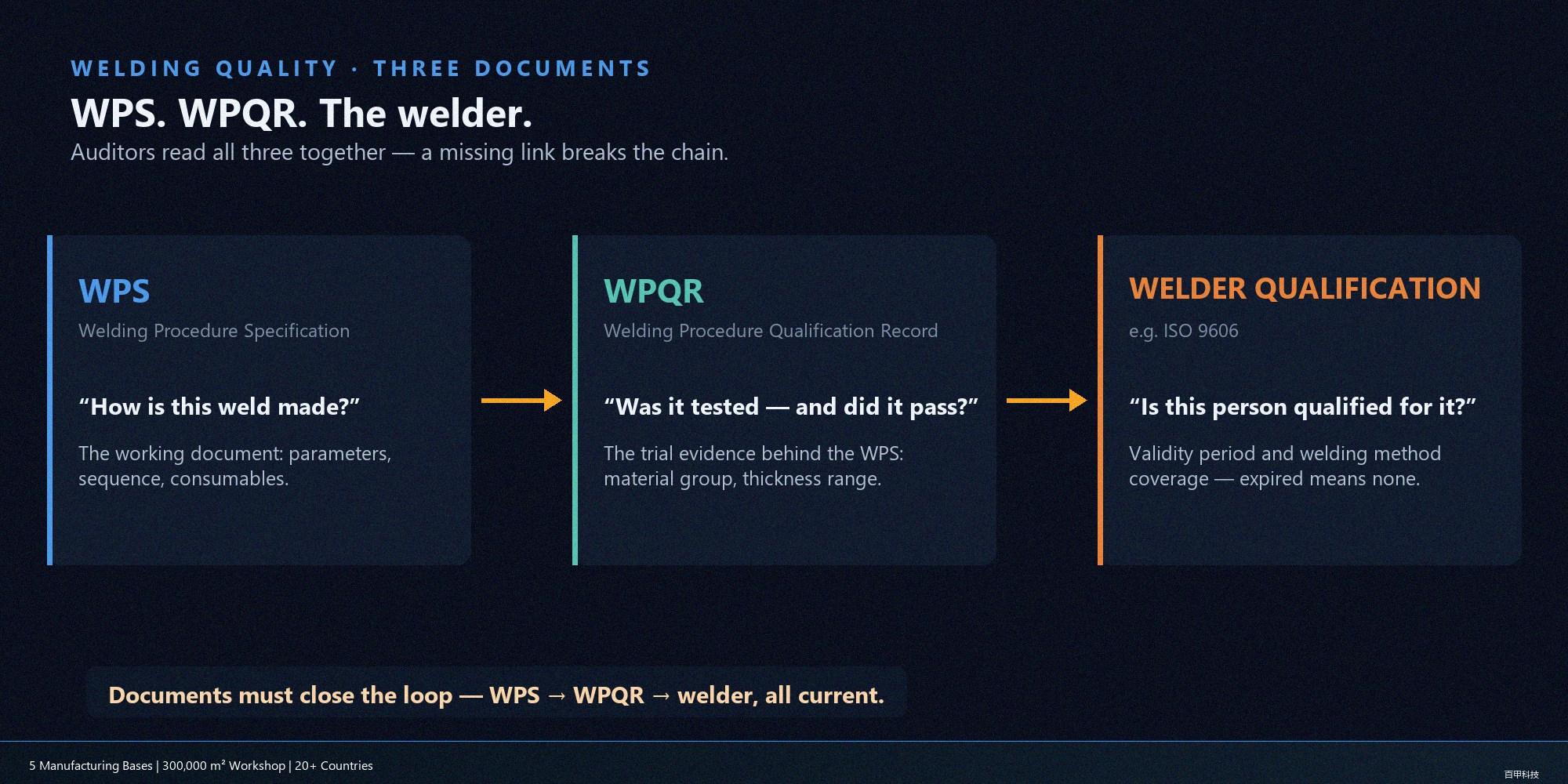
A WPS is a working procedure document. A WPQR provides the test evidence supporting that procedure. A welder qualification certificate proves the competence of the individual welder.
During bid evaluation, all three are reviewed together.
If a WPS is available but the corresponding WPQR is missing, it indicates that the welding procedure has not been properly qualified.
If a WPQR is available but the welder’s qualification certificate has expired, there may be no qualified personnel available to carry out the welding work on site.
Third-Party Inspection and CE Marking
CE marking is not simply a label that a factory can apply on its own.
It involves a Notified Body in the assessment and certification of Factory Production Control (FPC). Based on the applicable system, the manufacturer then issues the Declaration of Performance or other required conformity documentation and affixes the CE marking.
Four categories of documents must be traceable to the relevant component identification numbers: inspection reports, material certificates, heat treatment records, and non-destructive testing reports.
If these documents cannot be matched to the corresponding components, they are effectively treated as unavailable from the auditor’s perspective.
How Chinese Qualifications Correspond to European Requirements
Differences Between the Two Systems
China’s steel structure qualification system is administered by the Ministry of Housing and Urban-Rural Development (MOHURD). It includes qualifications for general construction contracting, specialized construction contracting, specialized design, and manufacturing enterprises.
The types of components and activities covered depend on the relevant qualification classification.
For details of our steel structure products, visit:
https://www.xzbesta.com/products/steel-structure/
The European system is governed by EN 1090 and the Construction Products Regulation (CPR), focusing on factory production control and CE marking.
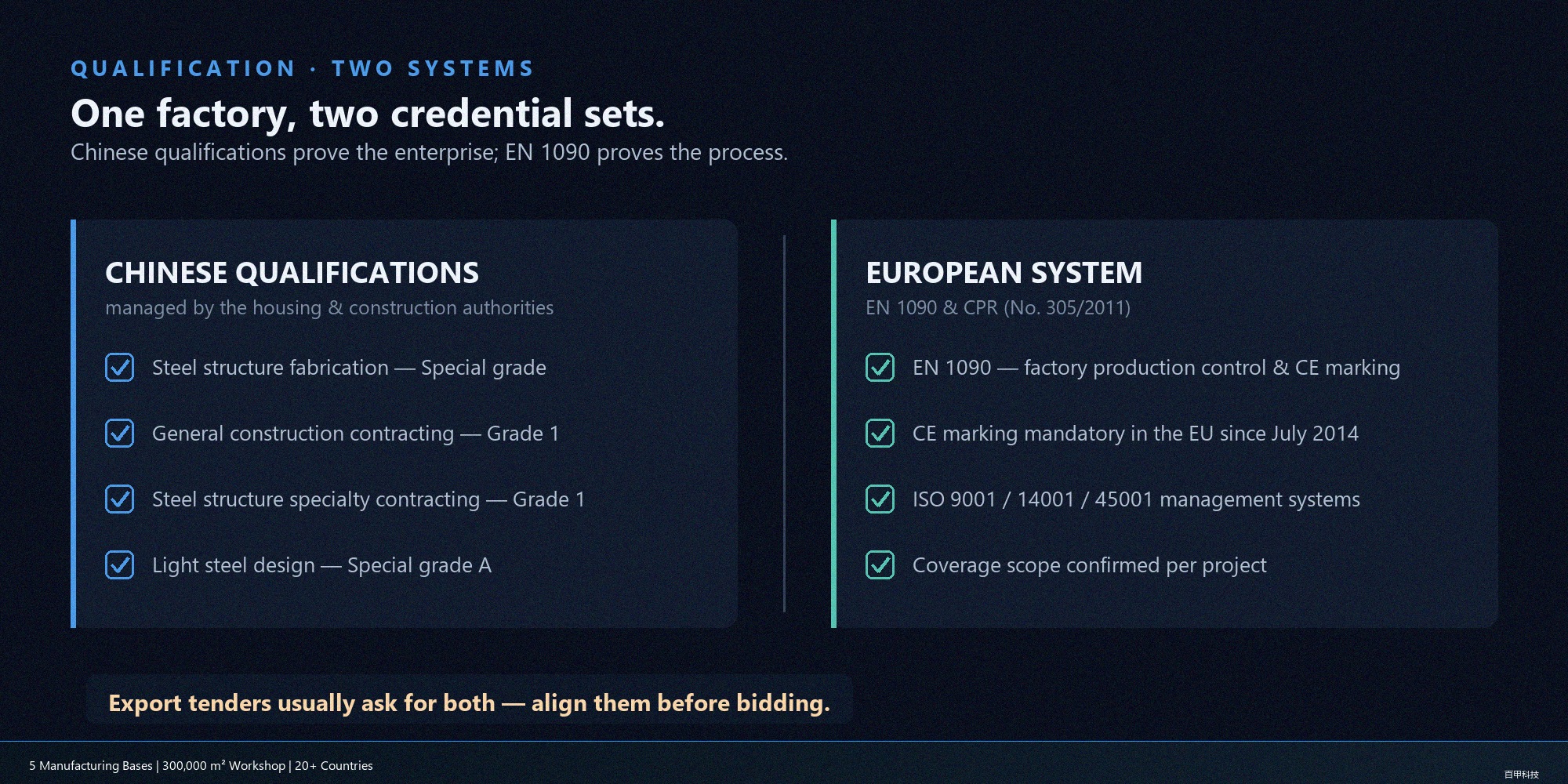
The two systems are not interchangeable. Chinese qualifications demonstrate that an enterprise is qualified to undertake the corresponding construction or engineering activities, while EN 1090 demonstrates that the factory’s manufacturing processes comply with the applicable European requirements.
Overseas Projects Often Require Both Systems
For Chinese manufacturers participating in EU export projects or overseas projects requiring European standards, tender documents often require both domestic enterprise qualifications and EN 1090 certification.
ZM-Besta currently holds the following qualifications and certifications:
- Special Grade Qualification for Steel Structure Manufacturing Enterprises
- Grade I Qualification for General Contracting of Building Construction
- Grade I Qualification for Specialized Contracting of Steel Structure Engineering
- Grade A Qualification for Specialized Design of Lightweight Steel Structures
- ISO 9001 Quality Management System Certification
- ISO 14001 Environmental Management System Certification
- ISO 45001 Occupational Health and Safety Management System Certification
- EN 1090 Certification
The required Execution Class varies from project to project. The actual certification scope must be confirmed against the specific project requirements.
For overseas steel structure projects, design codes and manufacturing certifications are two separate areas that must both be aligned before bidding.
For more information, see our guide to overseas steel structure design codes:
https://www.xzbesta.com/news/steel-structure-design-codes-en-aisc-gb/
Five Key Checks for Technical Bid Evaluation
Five Items That Must Be Verified
- The Execution Class specified in the tender documents.
- The scope of the factory’s certification and production control system, including whether it covers the component types and thickness ranges required for the bid.
- Whether the welding processes, material groups, and thickness ranges covered by the WPQR match the requirements of the project.
- The validity period of welder qualification certificates and whether they cover the welding methods required.
- Whether third-party inspection reports can be traced to the corresponding component identification numbers.
How to Use This Checklist
This checklist applies to any steel structure supplier.
For buyers, checking each item during the supplier prequalification stage is much more efficient than discovering discrepancies during the technical bid evaluation.
For bidders, the same checklist is equally useful. Conducting an internal review before submission helps identify missing documents and mismatched certification scopes in advance, allowing issues to be addressed or clarified before the bid is submitted.
For more information about product selection and project delivery, visit our FAQ page:
https://www.xzbesta.com/faq/
Frequently Asked Questions
Q1: Is ISO 9001 certification sufficient for steel structure export projects?
No. ISO 9001 is a general quality management system and does not cover specialized welding capabilities or EU market access requirements. European-standard projects generally also require EN 1090 certification. Projects with stringent welding requirements may additionally require compliance with ISO 3834.
Q2: Are there different levels of EN 1090 certification?
Certification scope is related to the applicable Execution Classes. A factory may only be certified for certain classes. Before submitting a bid, buyers should verify that the scope indicated on the certificate matches the requirements of the project.
Q3: Can a WPQR cover all material thicknesses?
No. A WPQR qualifies a welding procedure within specified material group and thickness ranges. If the project requires thicknesses outside the qualified range, additional welding procedure qualification may be necessary.
Q4: Who issues the CE marking?
A Notified Body assesses and certifies the Factory Production Control system where required. On this basis, the manufacturer issues the applicable Declaration of Performance or other required conformity documentation and affixes the CE marking in accordance with the applicable requirements. The list of Notified Bodies can be checked through the official EU database.
Q5: Are Chinese qualifications recognized in overseas projects?
This depends on the project location and the owner’s requirements. European-standard projects generally focus on EN 1090, while some projects in Southeast Asia and Africa may accept Chinese qualifications together with third-party inspection reports. Before submitting a bid, it is advisable to confirm the list of acceptable qualifications directly with the project owner.