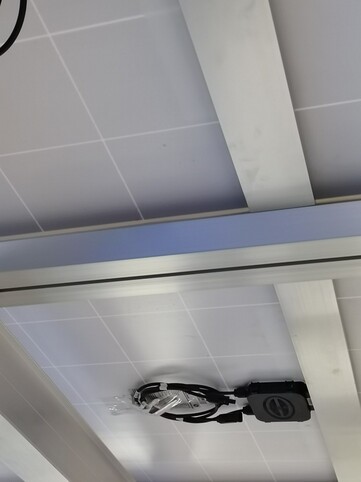
Remote islands are plagued by the lack of access to public power grids.
Diesel transportation incurs high costs while power supply remains unstable.
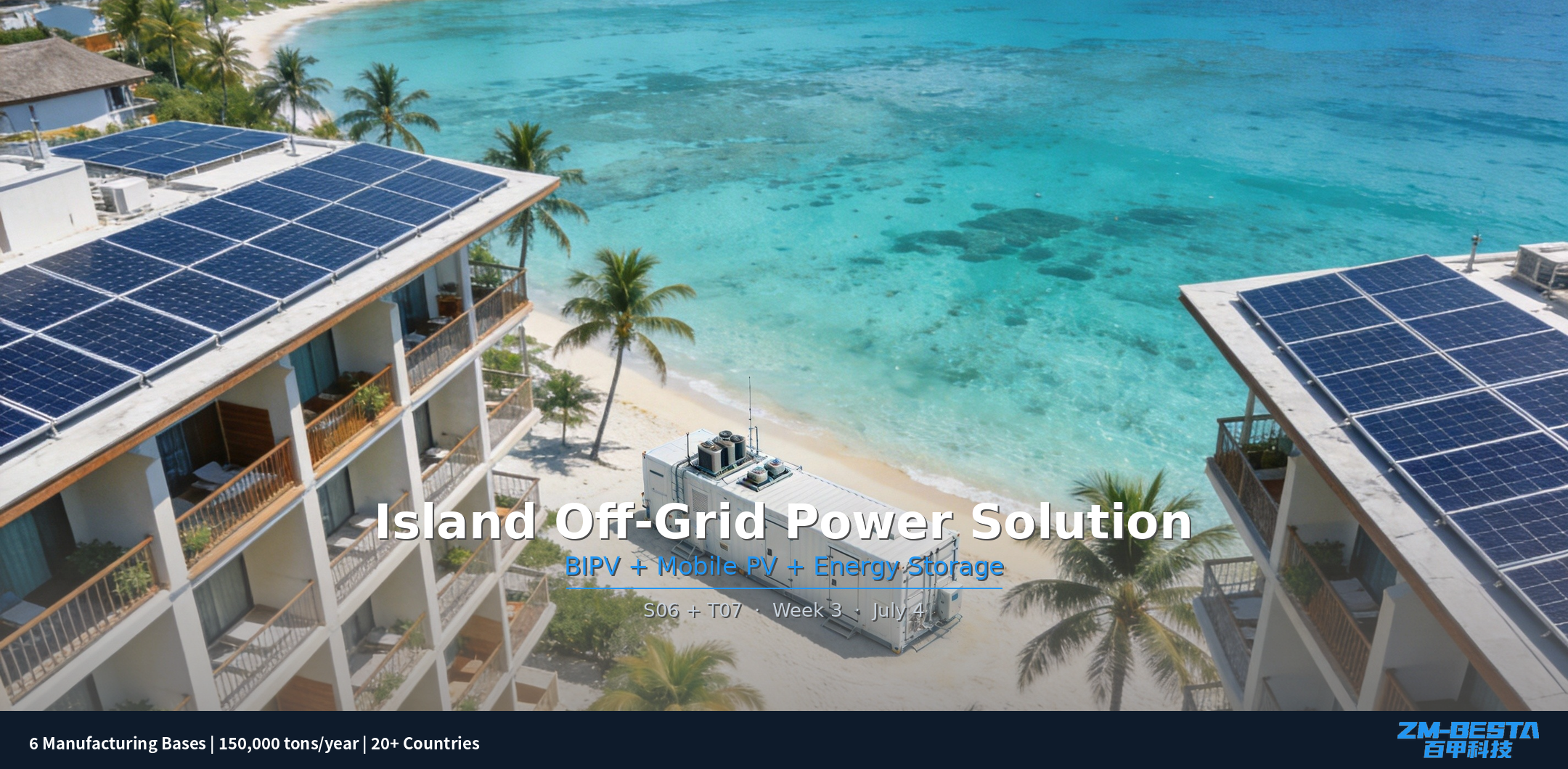
The core logic to tackle this issue is to generate electricity via BIPV and mobile PV stations first, then determine the required energy storage capacity based on local power consumption patterns.
Basic Solution: BIPV Buildings + Mobile PV Stations
Islands consume 240–400 kWh of electricity daily with drastic load fluctuations across 24 hours and distinct peak & off-peak periods.
Power demand mainly goes to cooling, daily living and equipment operation in the daytime, while nighttime loads only cover entertainment, lighting and basic communications.
This daytime-heavy load profile makes PV power generation an ideal fit.
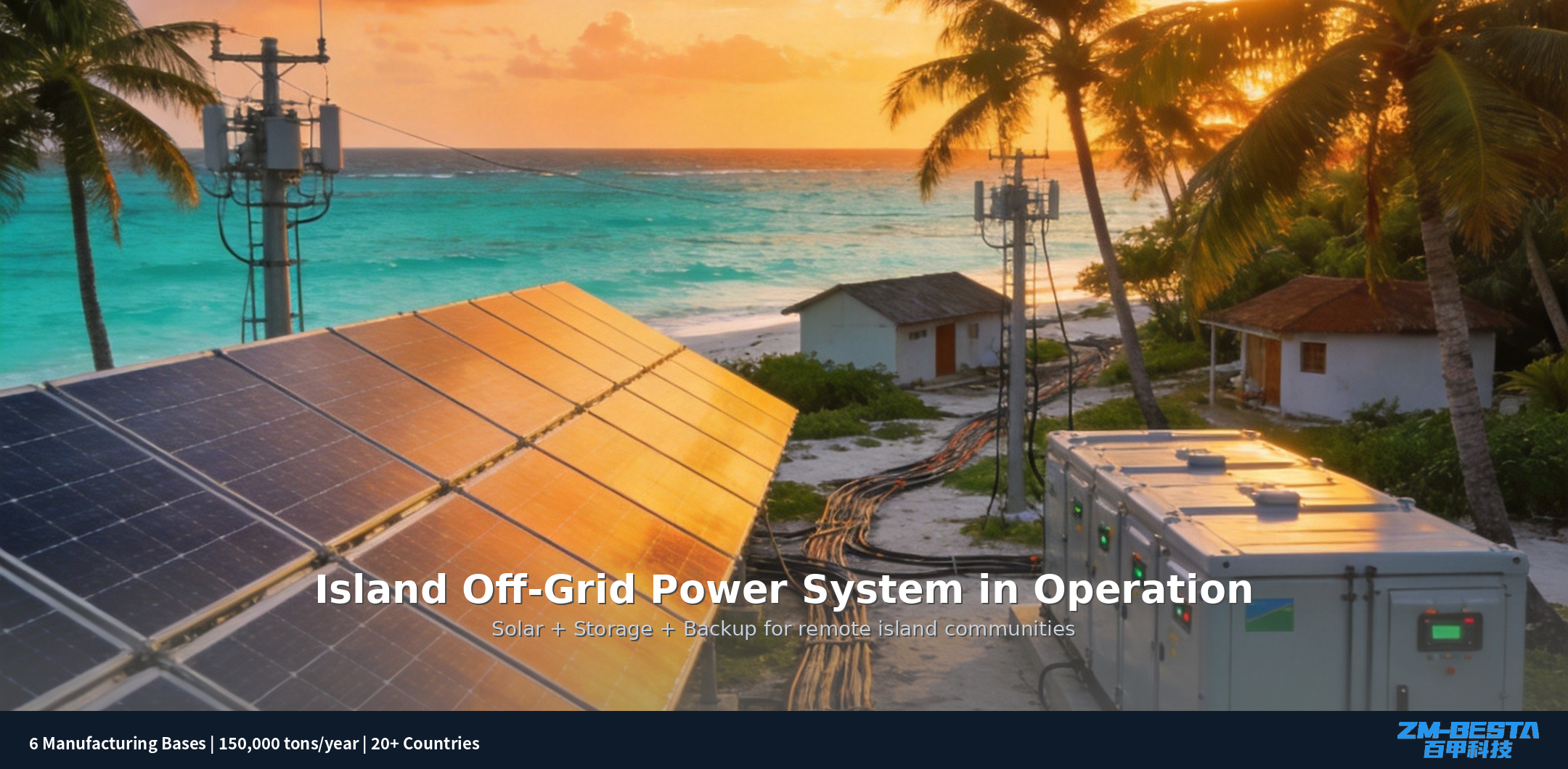
Below is the recommended basic power generation unit combination tailored for island environments:
Hybrid Power Supply Scheme: BIPV Buildings + Mobile PV Stations + Energy Storage
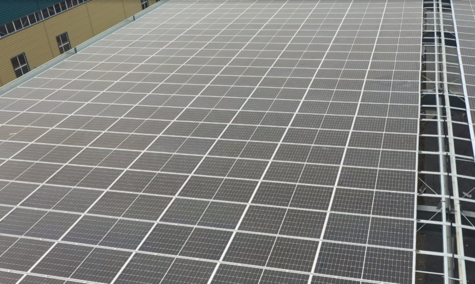
Building Integrated Photovoltaics (BIPV)
PV modules are mounted on the roofs and walls of island observatories, warehouses and homestays without occupying extra land, featuring excellent wind resistance.Specifications: 182 pieces of 550W monocrystalline modules, conversion efficiency ≥22.5%, IP67 protection rating, total installed capacity 100.1kWp, annual power generation around 110,000 kWh.
Foldable Containerized Mobile PV Station
Developed for islands with rugged terrain and inconvenient transportation. The station can be unfolded and connected to the grid within 20–30 minutes after arriving at the port. Equipped with hydraulic outriggers and a solar tracking system, it boosts power output by 15%–30% compared with fixed mounting racks.Standard container configuration: 60kWp PV modules, 50kW/200kWh lithium iron phosphate (LFP) battery.
Energy Storage Battery
Its core function is peak shaving and valley filling.Standard sizing formula: Storage Capacity = Daily Power Consumption × 1.5 (Safety Margin Factor) ÷ 0.85 (Maximum Depth of Discharge, DoD). This is merely a baseline value; the exact required capacity depends on your actual power consumption scenarios.
1 set of off-grid inverter + 1 unit of 50kW diesel generator (for emergency backup)
Energy Storage Configurations for Three Power Consumption Scenarios
After confirming the power generation capacity of the BIPV + mobile PV station system, energy storage can be configured into the following three schemes according to the actual power demand of islands:
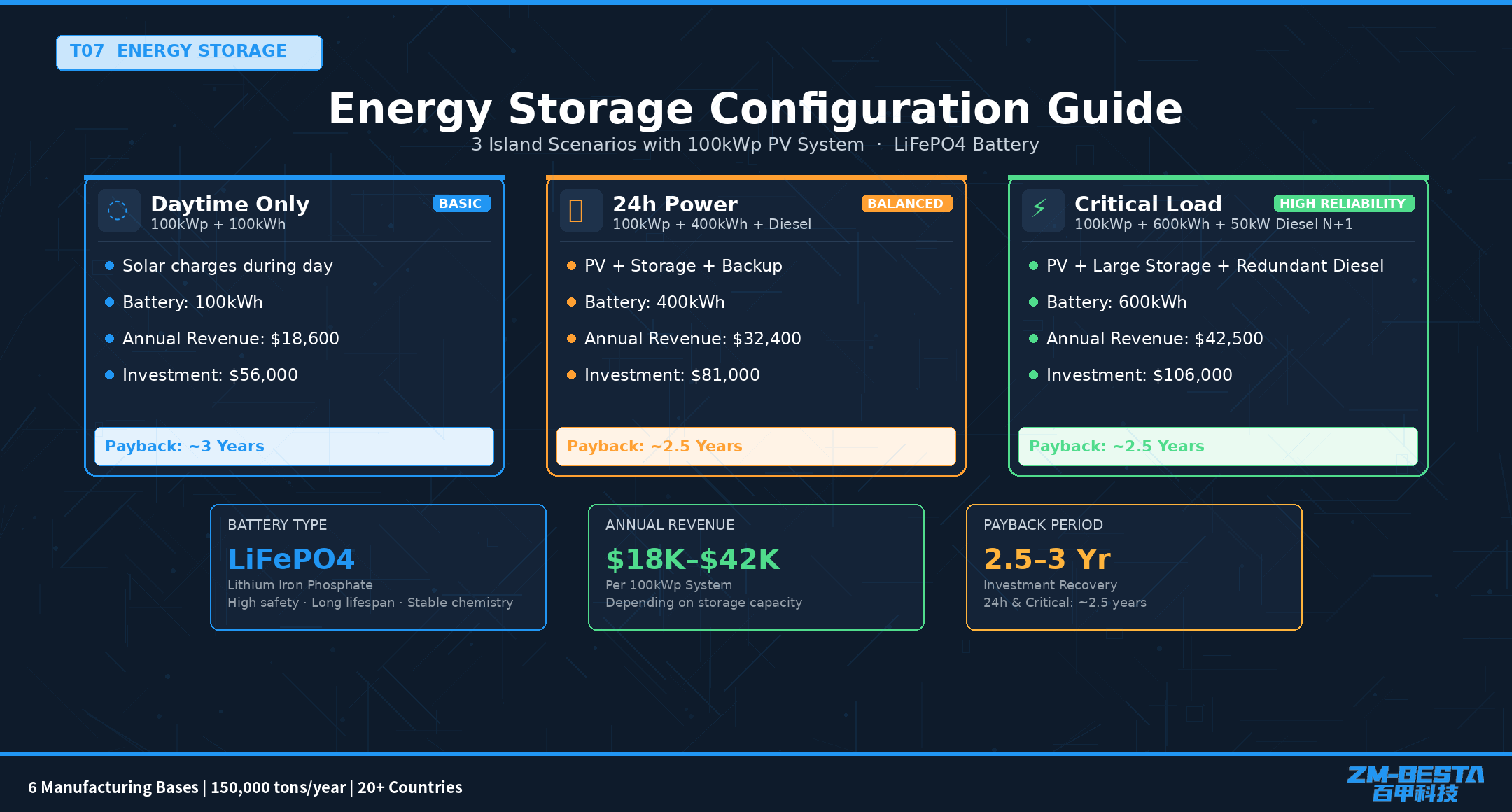
Scenario 1: Daytime-Only Power Consumption (Production, Office Work, etc.)
- Consumption Characteristics:Operations start at sunrise and cease at sunset.
- Storage Configuration:100kWp PV + 100kWh energy storage, total cost: $56,000
- Annual Benefit:$18,600 from diesel fuel replacement
- Payback Period: Approximately 3 years
Scenario 2: 24-Hour Continuous Power Consumption (Villages, Camps, etc.)
- Consumption Characteristics:Power loads exist day and night; surplus power generated during daytime needs to be stored for nighttime use.
- Storage Configuration: 100kWp PV + 400kWh energy storage + standby diesel generator for rainy days, total cost: $81,000
- Annual Benefit: $32,400
- Payback Period:Approximately 2.51 years. Although extra investment is required for batteries, this setup completely eliminates diesel generators and delivers the highest long-term benefits.
Scenario 3: Emergency Power Supply for Critical Loads (Communication Base Stations, Hospitals, etc.)
- Consumption Characteristics: Low regular power draw, yet zero tolerance for power outages.
- Storage Configuration: 100kWp PV + 600kWh energy storage + 50kW diesel generator with N+1 redundancy, supporting over 7 consecutive days of emergency power supply, total cost: $106,000.
- Annual Comprehensive Benefit: $42,500 (diesel cost savings plus emergency power guarantee value)
- Payback Period: Approximately 5 years. The core value of such projects lies in guaranteed power supply reliability, rather than merely cutting energy expenses.
For island off-grid projects, the combination of BIPV buildings and mobile PV stations serves as the standard baseline power generation setup.
The required energy storage capacity is entirely determined by your power consumption duration. Insufficient storage will lead to power outages, while oversized storage will generate unnecessary extra costs.
Unsure of the proper energy storage capacity for your island project?
👉 Click to contact the engineering team of Xuzhou Zm-Besta for a free microgrid configuration list and quotation.
Email: info@xzbesta.com