Why Does the Power Bill for Mining Camps Hurt More and More?
A mining camp is a typical off-grid, high-energy-consumption environment: dormitories, canteens, sewage treatment and equipment maintenance all demand uninterrupted power 24/7.
The traditional solution had only one option – diesel generators.
The diesel bill adds up painfully. Fuel costs typically account for 60%-80% of the total operating cost of diesel power generation; in remote mining areas, diesel-generated power can cost 3-4 times the grid electricity price.
According to Xuzhou Zm-Besta’s statistics on mining applications: a single mine portal averages 200-400 kW of load, 12-16 hours of daily operation and 0.8-2 million kWh of annual electricity consumption; a 10,000 m² construction camp averages 50-80 kW of load and 15,000-29,000 kWh of monthly electricity consumption.
At an approximate diesel generation cost of 6.71 US cents/kWh, a single mining camp can spend from hundreds of thousands to over one million US dollars on diesel every year – before even counting the noise, emissions and fuel-tanker transport risks.
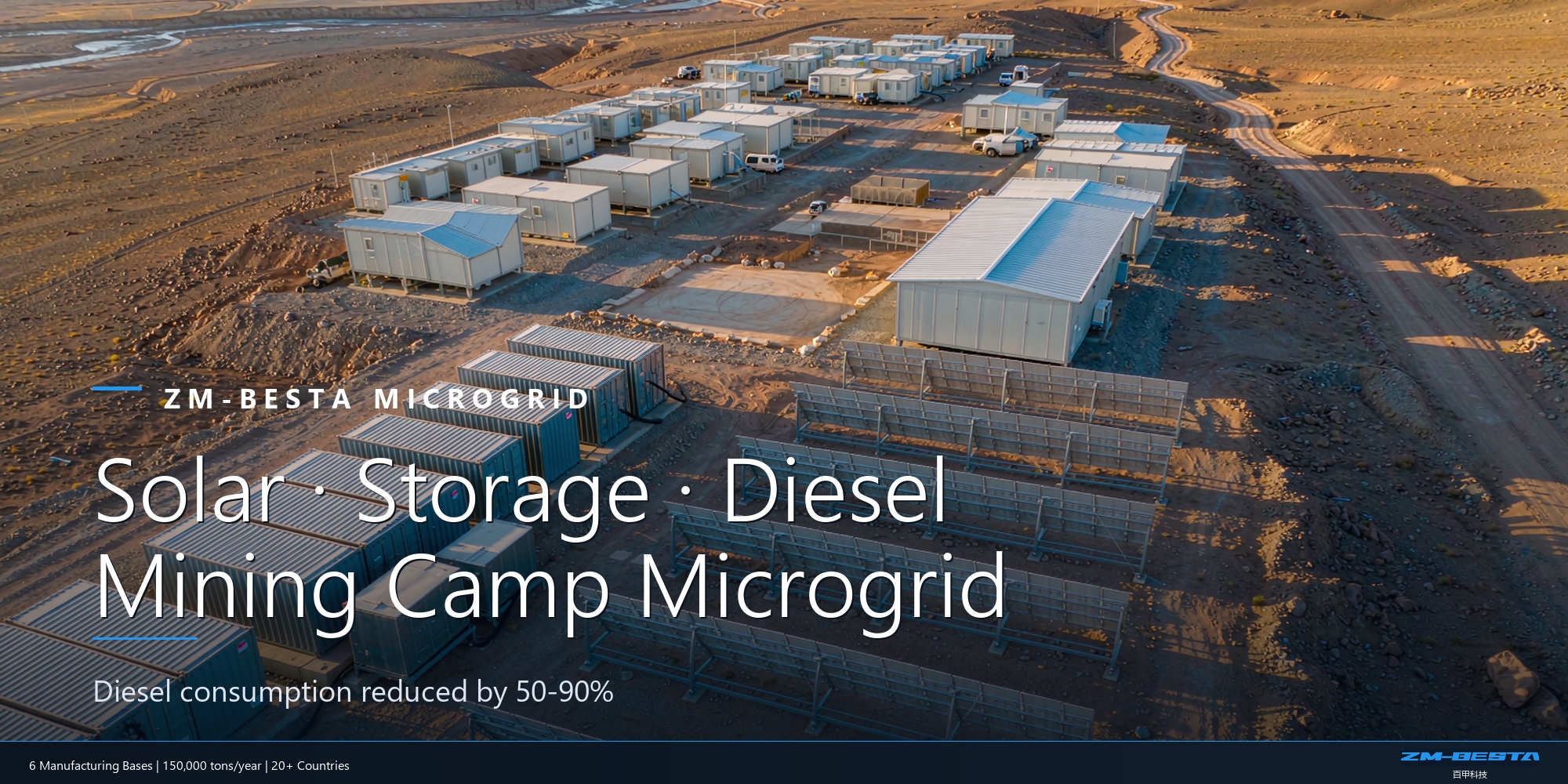
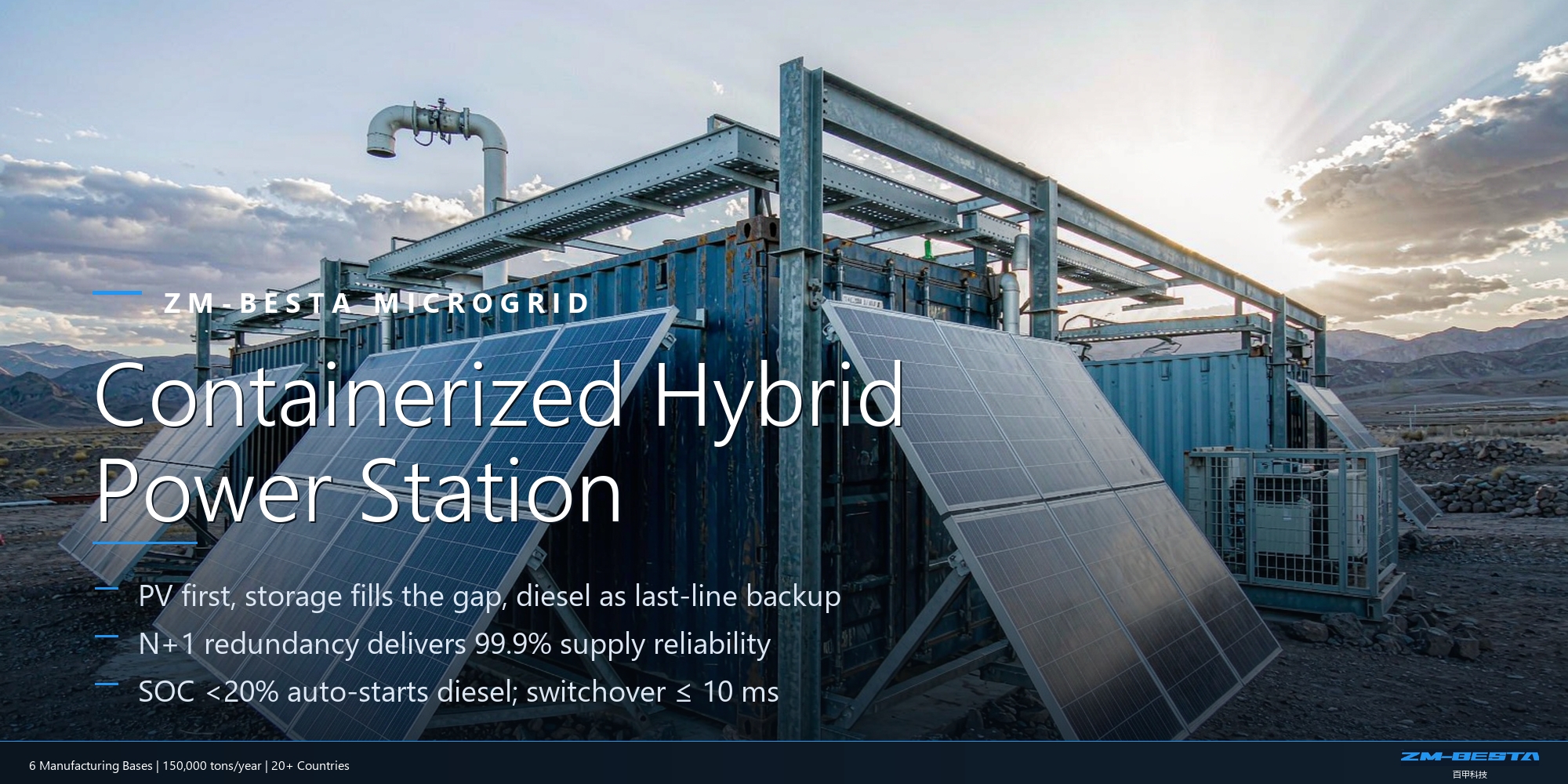
The solution of a solar diesel hybrid microgrid for mining camps (also referred to as a mine site microgrid) is: solar power supply, energy storage for peak shaving, and diesel generators relegated to “the last backup.” This off-grid mining power solution achieves diesel generator replacement solar storage.
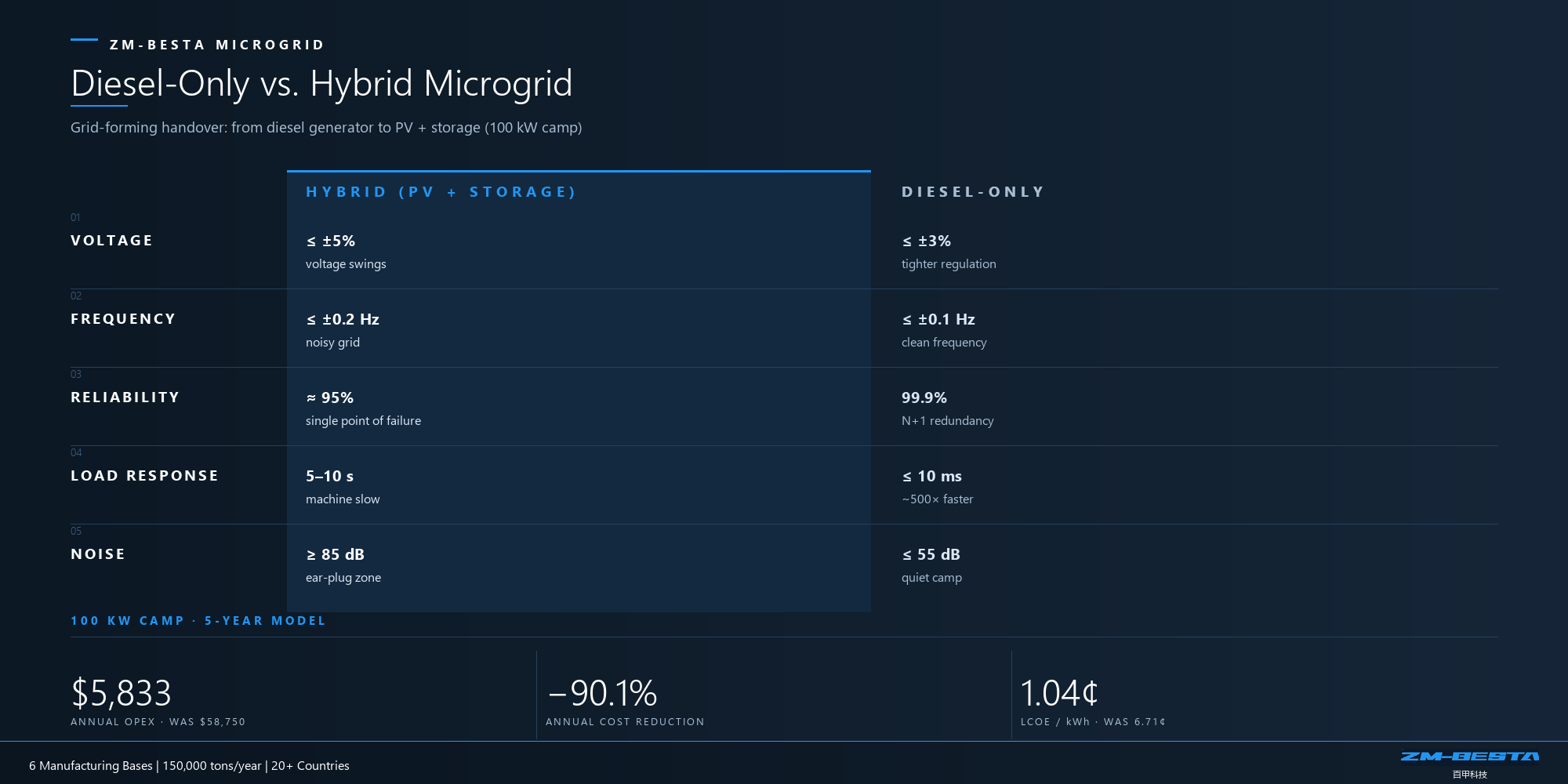
From Diesel Grid-Forming to Solar Diesel Hybrid Microgrid Grid-Forming: Key Metrics from Switchover Tests
“Grid-forming” refers to which source defines the system voltage and frequency. In the all-diesel era, the diesel generator was the only grid-forming source; after switching to solar diesel hybrid microgrid grid-forming, the inverter takes over voltage/frequency control while the diesel generator auto-starts and stops as backup.
Xuzhou Zm-Besta’s technical comparison in a 100 kW camp scenario:
The key switching strategy follows “solar priority, storage supplement, diesel backup“: surplus solar power is stored in the battery; during extreme cloudy/rainy weather or when storage SOC falls below 20%, the diesel generator automatically starts and synchronizes, with a switchover time of ≤10 ms for seamless power delivery.
Solar Diesel Hybrid Microgrid System Diesel Savings: Up to 90%
This is the number buyers care about most.
Xuzhou Zm-Besta’s calculation (100 kW camp, 5-year cycle, 24-hour continuous operation):
| Item | Diesel-Only Solution | Solar Diesel Hybrid Microgrid Solution |
| Annual operating cost | USD 58,750 (diesel: USD 55,000; maintenance: USD 3,750) | USD 5,833.33 (routine O&M: USD 1,666.67; battery replacement provision: USD 2,777.78; emergency diesel: USD 1,388.89) |
| Annual savings | – | USD 52,916.67, a reduction of 90.1% |
| Cost per kWh (derived from RMB conversion) | Approx. 6.71 US cents/kWh | Approx. 1.04 US cents/kWh, a reduction of 84.5% |
Across the industry, diesel consumption is reduced by 50%-90%.
Case study: After a solar diesel hybrid microgrid for a Zimbabwe mining operation went into service, annual diesel consumption fell by over 90%, saving about USD 6.948 million in fuel costs per year; at a Chilean mine, a solar diesel hybrid microgrid cut diesel consumption from 980,000 liters to 468,000 liters in its first year, a reduction of 52.2%.
System Stability: How 99.9% Continuous Power Supply Is Achieved
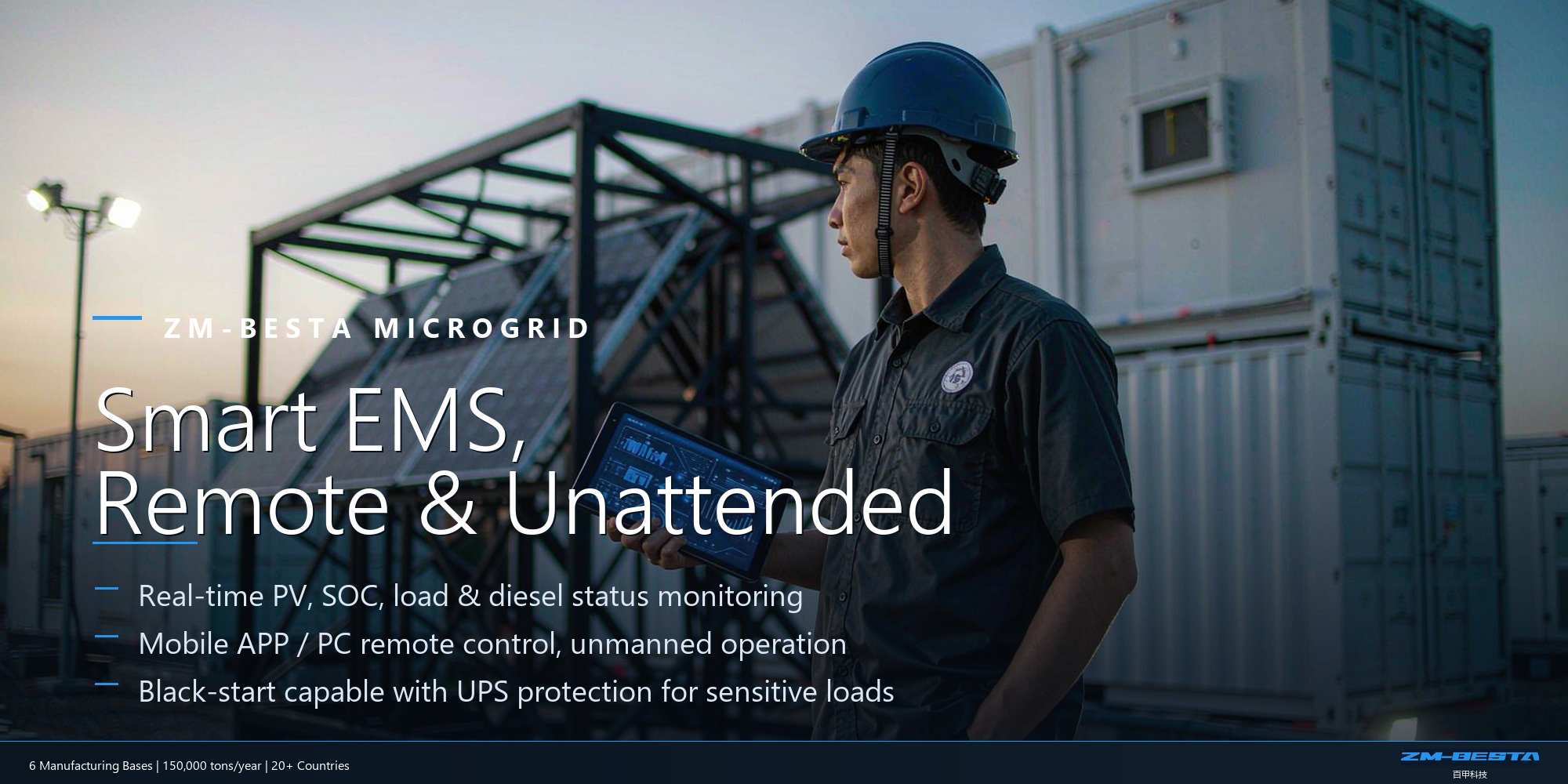
Mining camps have zero tolerance for power outages. The reliability of the solar diesel hybrid microgrid rests on a five-layer design:
N+1 Redundant Architecture
Solar, storage and diesel generators back each other up; a single point of failure does not affect the overall power supply, with a reliability target of 99.9%.
Intelligent EMS Energy Management
Real-time monitoring of solar output, storage SOC, load and diesel generator status with automatic dispatch; supports remote monitoring via mobile app/computer and unattended operation.
Black Start Capability
After a complete system shutdown, it can recover quickly on its own without any external power source.
UPS Uninterruptible Power Supply
Provides uninterrupted protection for sensitive loads during power switchover, eliminating data loss and equipment downtime.
Storage and Equipment Tolerance
Lithium iron phosphate (LiFePO4) batteries with a cycle life of 5,000-8,000 cycles and SOC estimation accuracy ≤3%; inverter efficiency ≥95% and MPPT tracking efficiency ≥99%; the containerized solar power station units are IP55 rated, deploy to resist level 9 winds when deployed, and operate from -20°C to +50°C, making it suitable for harsh mining environments.
Industry example: a solar diesel hybrid microgrid at a gold ore processing plant in Western Australia achieved 98.7% availability over 18 months of operation; solar diesel hybrid microgrids generally reach a supply reliability of over 99.9%.
Frequently Asked Questions
Q1: What power range of mining camps is a solar diesel hybrid microgrid suitable for?
A: 20kW–200kW containerized solar power station units cover from project living areas to large mines; 100-500 kW configurations serve large open-pit mines, generating about 600,000 kWh per year and replacing approximately 150 tons of diesel.
Q2: Will switching from diesel to solar storage cause equipment outages?
A: Our switchover time is ≤10 ms, far below the threshold that equipment can perceive; a UPS also backs up critical loads, so there is no power interruption during the switchover.
Q3: What about consecutive cloudy or rainy days?
A: Storage capacity is normally sized for 3-7 consecutive cloudy/rainy days; when storage SOC falls below 20% or in extreme weather, the diesel generator automatically starts to top up the power.
Q4: How much diesel savings can you actually guarantee?
A: Generally 50%–90%. Xuzhou Zm-Besta’s ideal-condition upper limit is 90.1%; actual depends on sunshine and load curve.
Q5: How long does it take to deploy a containerized solar power station?
A: Pre-assembled and pre-commissioned at the factory, it can be deployed to generate power in as little as 1 hour after arrival on site. For example, a 20-foot container takes about 80 minutes for a 6-person crew to fully deploy.
Q6: Can the system be managed remotely?
A: Yes. The intelligent EMS supports remote monitoring and device start/stop control via mobile app/computer, enabling unattended operation and maintenance.
If you are planning an off-grid mining power solution or a remote camp power system for mining areas, construction sites, or remote camps, welcome to contact Xuzhou Zm-Besta.
Click to send an inquiry, and let us design a power solution for your camp with “Solar first, diesel as the ultimate backup”.
Email: info@xzbesta.com