High latitude, long winters, heavy snow — can projects like this still go solar?
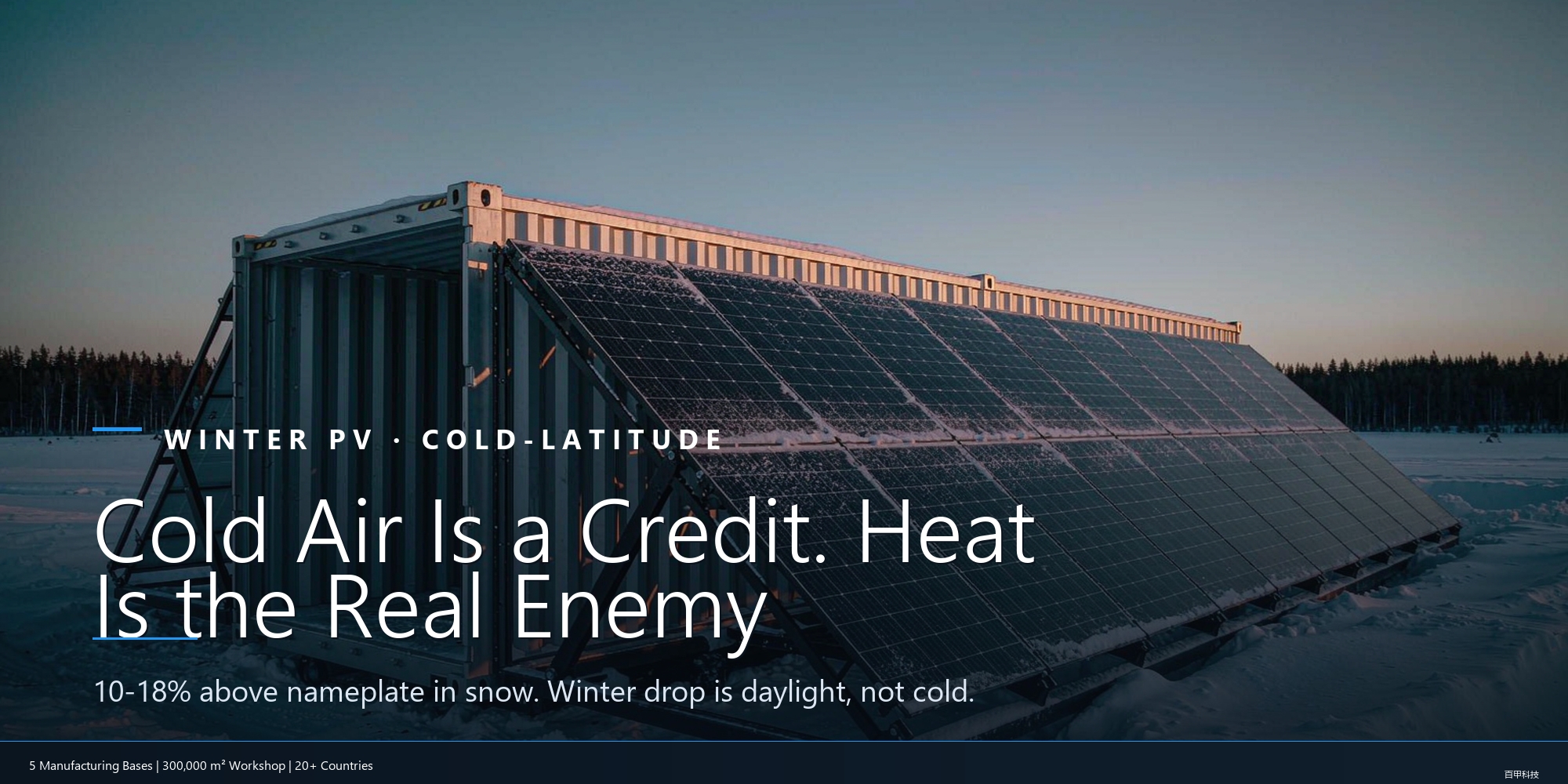
Yes. And low temperature itself is a bonus. Crystalline silicon modules are rated at 25°C; for every 1°C drop in temperature, output rises by roughly 0.3%-0.35%. The reason winter generation is lower is not temperature — it’s shorter daylight hours and snow cover. Both can be solved through design.
Cold Boosts Output: Counterintuitive, but Backed by Data
Temperature Coefficient Is the Key Parameter
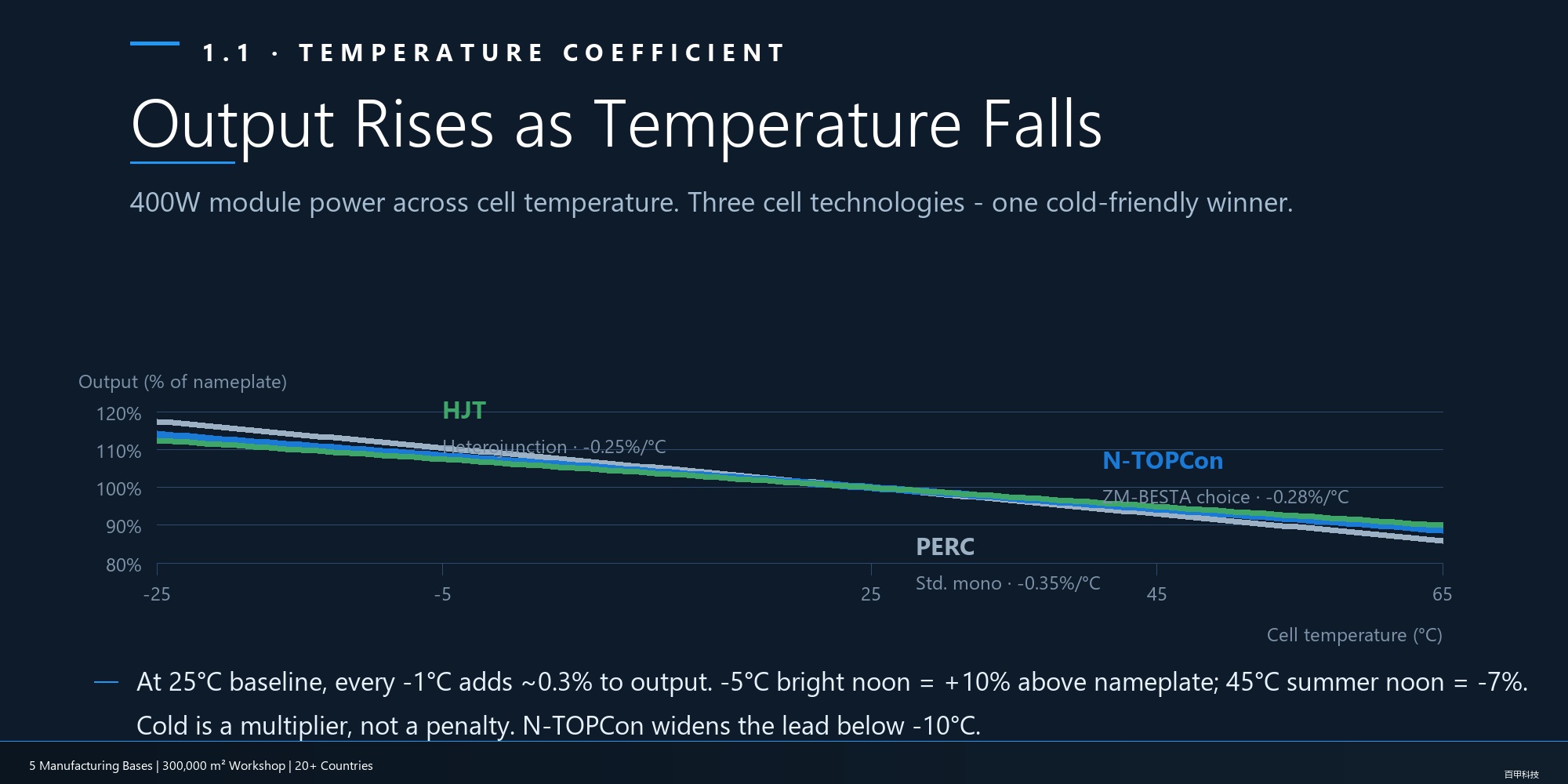
The power temperature coefficient of crystalline silicon modules is negative — the lower the temperature, the higher the output:
| Cell technology | Power temperature coefficient | Low-temperature performance |
| Conventional monocrystalline PERC | Approx. -0.30% to -0.35%/°C | ≈ +10% output on a clear -5°C day |
| N-type TOPCon | Approx. -0.25% to -0.30%/°C | Loses 0.05%-0.1% less per degree under the same conditions |
| HJT | Approx. -0.24% to -0.26%/°C | Greater low-temperature gain |
Take a 400W module as an example: at a cell temperature of -5°C, actual output is about 442W, 10.5% above rated; on a midsummer afternoon at a cell temperature of 45°C, output is only 372W, 7% below rated.
Snow reflection (the albedo effect) adds another boost: snow surfaces reflect 80%-90% of light, while ordinary ground reflects only 10%-20%. In clear, cold, snowy conditions, output can exceed rated power by 18%.
Why It Feels Like Solar Doesn’t Generate in Winter
Because the astronomy changes. At latitude 42°N, a June day lasts about 15 hours, but a December day only about 9. In mid-latitude regions, monthly winter generation is typically 25%-50% of July’s.
For reference: Germany sits at latitude 50°N, and in 2023 about 12% of its national electricity came from PV (Fraunhofer ISE). High latitude doesn’t mean PV is unworkable — it just means higher design requirements.
Snow: It’s the Snow You Manage, Not the Cold
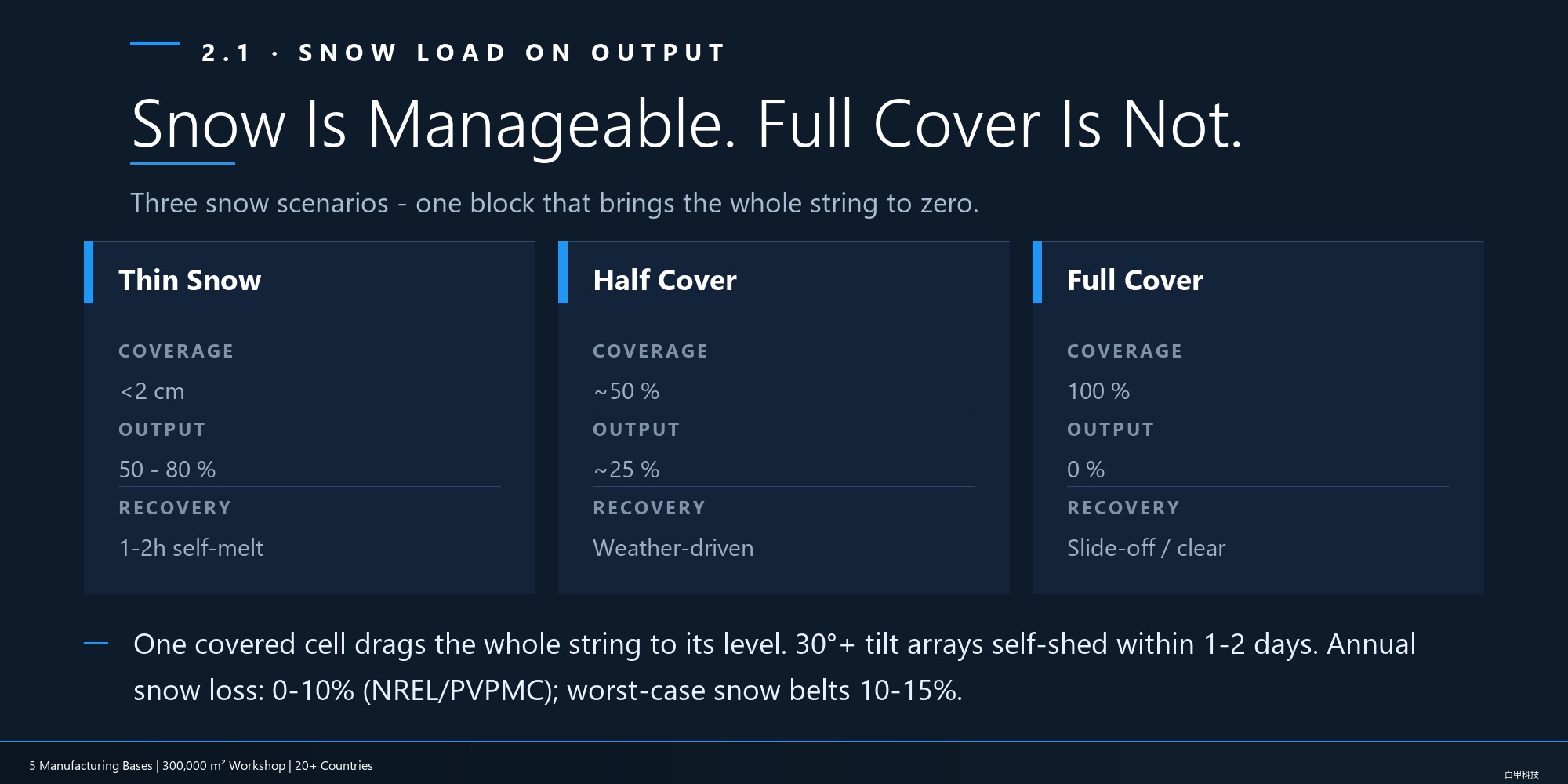
Output Under Different Snow Conditions
| Snow condition | Output impact | Recovery time |
| Light snow (<2cm) | Translucent — still 50%-80% output | Dark module surface absorbs heat; melts off in 1-2 hours |
| Partial coverage (~50%) | Drops to about 25% (a covered string limits the whole string) | Depends on weather |
| Full coverage | 0% | Slides off or needs manual removal |
| Snow-free, clear and cold | 10%-18% above rated | — |
Three Design Essentials
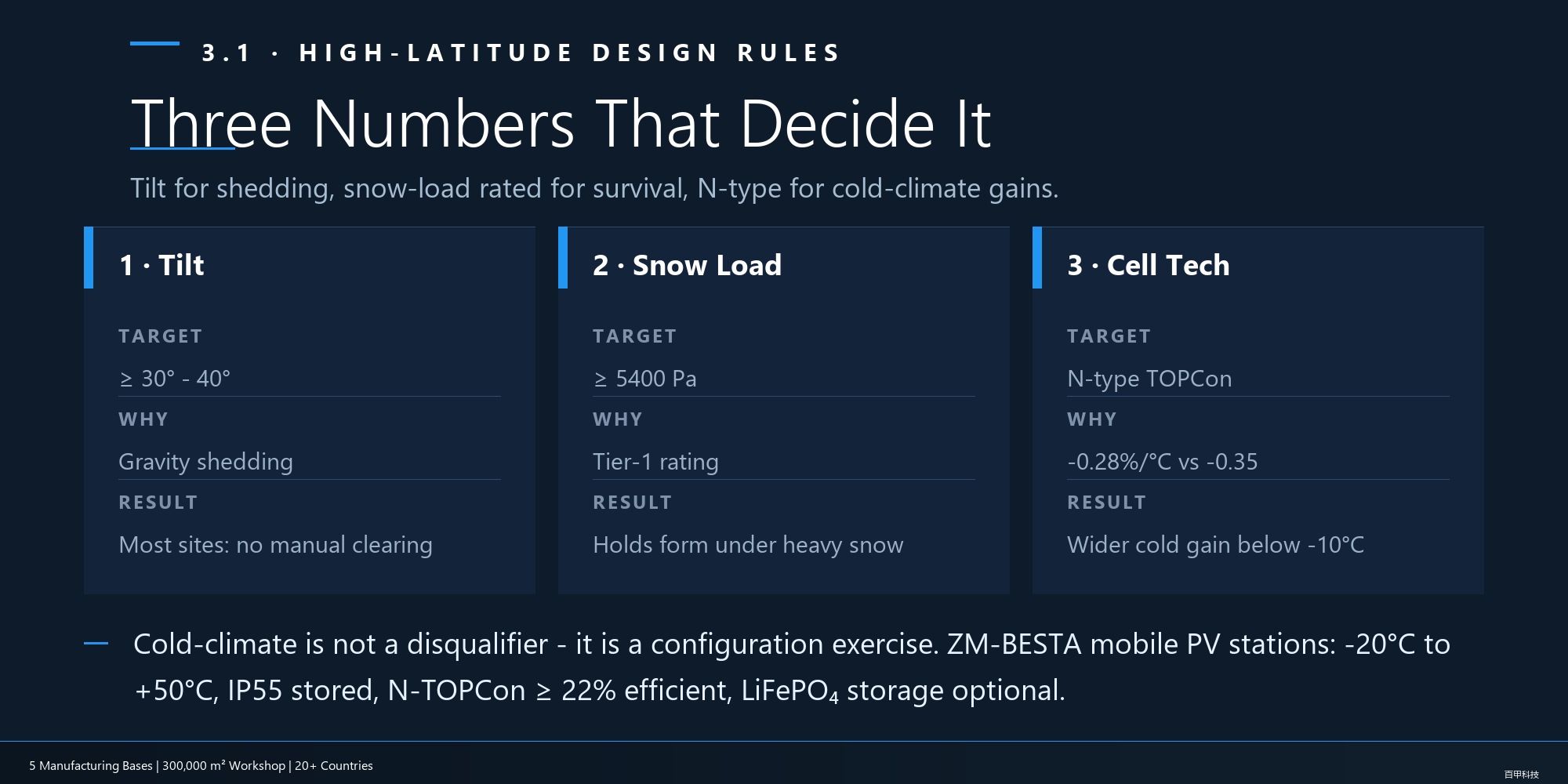
- Tilt angle ≥30°-40°: the smooth tempered-glass surface plus tilt lets snow slide off on its own within 1-2 days — no manual snow removal needed in most scenarios
- Module snow-load rating ≥5400 Pa: the snow-load rating of mainstream Tier 1 modules — holds up under heavy snow without deformation
- Choose N-type cell technology: a superior low-temperature coefficient means less winter loss
According to US NREL and PVPMC statistics: most plants lose 0-10% of annual generation to snow, and the worst case in persistently snowy regions is 10%-15%. Manual snow removal is generally not recommended — the roof-access and module-scratch risks outweigh the electricity costs it recovers.
Complete System Design Logic for High-Latitude Projects
PV Side
The low-temperature gain is real, and so is the shorter daylight. The sizing logic:
- Run the economics on annual generation, not the winter season alone
- Use storage for nights and overcast/snowy days; PV takes priority during the day
- In heavy-snow regions, err on the steeper side for array tilt — trade a little summer irradiance for winter snow shedding
Storage Side
| Configuration item | High-latitude recommendation | Reason |
| Battery chemistry | LFP (lithium iron phosphate) | Operating range down to -20°C, long cycle life |
| Capacity strategy | Size for the longest run of consecutive overcast/snowy days | Long intervals between solar recharge in winter |
| Temperature control | Insulated enclosure + heating management | Low-temperature charging requires active temperature control |
Diesel Comparison
Below -15°C, diesel generators risk fuel gelling, cold starts need preheating, and maintenance intervals run 250-500 hours. Winter is exactly when diesel is most vulnerable. A PV + storage combo has no gelling problem, and storage batteries retain discharge capability at low temperatures (LFP rated to -20°C).
For winter power supply at high-latitude mines, the total cost of a diesel solution (fuel transport + cold-weather maintenance + emissions compliance) deserves to be recalculated.
ZM-Besta’s Cold-Climate Products
ZM-Besta’s mobile solar power stations are engineered for low-temperature operation:
| Parameter | Value |
| Operating temperature | -20°C to +50°C |
| Protection when stowed | IP55 |
| Cell technology | N-type TOPCon, conversion efficiency ≥22% |
| Wind resistance when deployed | Beaufort Force 9 |
| Energy storage | LFP, standard with optional expansion |
| Deployment | Rail deployment in 4-20 hours; motorized expansion in ≤30 minutes |
Models range from 20kW (3.6m container body, unloaded by forklift) to 150-200kW (40ft container). Projects in cold regions are specifically configured across three items: impact toughness, module snow load, and storage temperature control.
On the steel structure side: for high-latitude workshops and dome storage sheds, steel is specified to Q355D/S355J2 impact grades based on local minimum temperature, and roof systems are designed for snow load. Structural design and PV configuration close the loop within a single accountable entity.
FAQ
Q1: How much power can solar panels actually generate in winter?
A: It depends on two variables: latitude and snow conditions. In mid-latitude regions, monthly winter generation is about 25%-50% of July’s; on clear, cold, snow-free days, daily output can be 10%-18% above rated (low-temperature gain + snow reflection). Annual figures are what matter for economic decisions.
Q2: Does PV still work in -20°C regions?
A: Modules actually perform better at low temperatures. What you need to verify is the system-level configuration: storage battery temperature control, racking snow load, and cable cold-temperature rating. ZM-Besta mobile power stations cover -20°C to +50°C.
Q3: Does snow need to be removed manually?
A: Generally no. Arrays with tilt angles above 30° shed snow on their own within 1-2 days, and annual snow losses are typically 0-10%. The work-safety and module-damage risks of manual removal usually outweigh the electricity recovered. Persistent heavy-snow regions are the exception and need a dedicated snow-management strategy.
Q4: How do you cover the winter power shortfall?
A: Size LFP storage for the longest run of consecutive overcast/snowy days. PV takes priority during the day, storage covers the night, and diesel gensets are kept as backup for extreme weather — that’s the hybrid logic most high-latitude mines use.
Q5: How significant are the advantages of N‑type TOPCon in winter?
A: Its temperature coefficient is about -0.25% to -0.30%/°C, losing 0.05%-0.1% less per degree than conventional PERC. The low-temperature advantage widens at -20°C, so N-type delivers steadier overall output in severe cold.
Want to size the winter generation and storage configuration for your high-latitude project?
Email: info@xzbesta.com