You’re buying a steel structure factory building from a Chinese supplier. You’re happy with the drawings and the quotation. Then, before you sign, the local drawing review authority says one thing: the drawings won’t be accepted.
This isn’t a quality failure — it’s a code failure. Design codes are the regional language of engineering. Design the same building to different codes and you get different steel tonnage, member sizes, drawing depth and pricing. Choose the wrong code, and rework starts all over again from the design stage.
This article clarifies four things: where each of the four major code systems applies, how material grades map to each other, the one item cold-climate projects most often miss, and what to write into your RFQ.
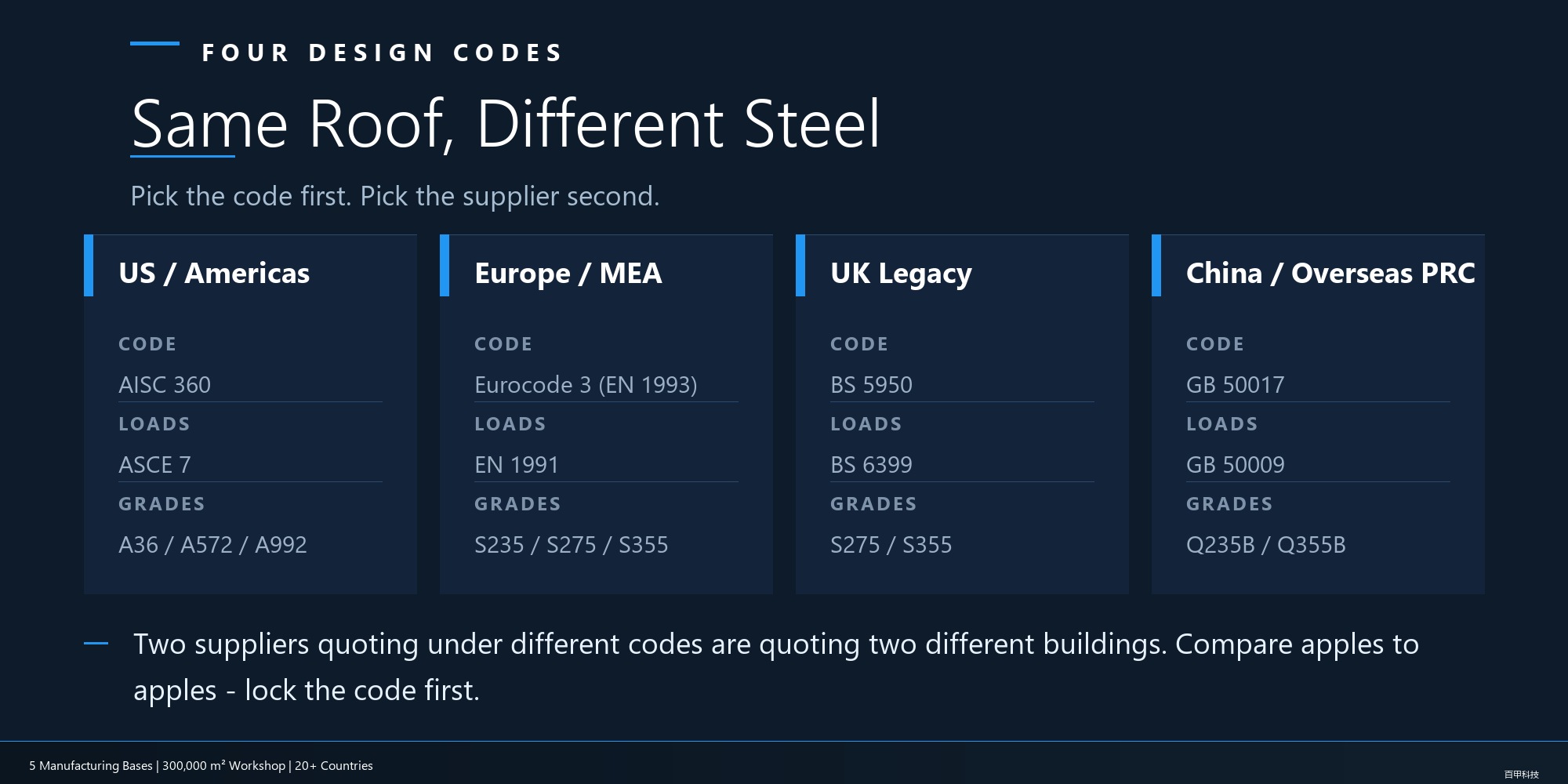
The Four Major Code Systems: See Where Each Applies at a Glance
Design Codes by Region
| Region / project type | Design code system | Load code | Common steel grades |
| US / Americas | AISC 360 | ASCE 7 | A36 / A572 Gr.50 / A992 |
| Europe, the Middle East and most of Africa | Eurocode 3 (EN 1993) | EN 1991 | S235 / S275 / S355 |
| UK (legacy projects) | BS 5950 | BS 6399 | S275 / S355 |
| China and Chinese-led overseas projects | GB 50017 | GB 50009 | Q235B / Q355B |
| Other countries | Usually Eurocodes or local codes | Depends on the country | To be confirmed with local engineers |
Two notes:
- BS 5950 has been superseded by the Eurocodes and only appears in some legacy project specifications. New UK projects actually follow the Eurocodes plus the UK National Annex.
- Australia/New Zealand use AS 4100, which some Pacific island projects encounter. Most international projects choose between the Eurocodes and US standards.
Why the Same Building Gets Different Prices
Each system differs in load combinations, safety factors and buckling curves. AISC uses LRFD resistance factors; the Eurocodes use partial safety factors γM. With the same 355 MPa grade steel, the allowable stresses come out close on both sides, but member sections and steel tonnage differ visibly. In high-wind regions, ASCE 7 and EN 1991 treat wind pressure coefficients differently, and the tonnage difference shows up directly in the price.
So two suppliers working to different codes are quoting two different buildings. Comparable quotations require consistent codes.
Material Grade Mapping: Approximate Does Not Mean Equivalent
Common Grade Equivalents
| China GB/T 1591 | Europe EN 10025 | US ASTM | Yield strength |
| Q235B | S235JR | A36 | 235/250 MPa |
| Q355B | S355JR | A572 Gr.50 | 355/345 MPa |
| Q355C | S355J0 | — (per supplementary requirements) | 355 MPa |
| Q355D | S355J2 | — (per supplementary requirements) | 355 MPa |
Q355B ≈ S355JR ≈ A572 Gr.50. The yield strengths are in the same range. But the “approximation” only holds on the strength dimension.
The Item Cold-Climate Projects Most Often Miss: Impact Toughness
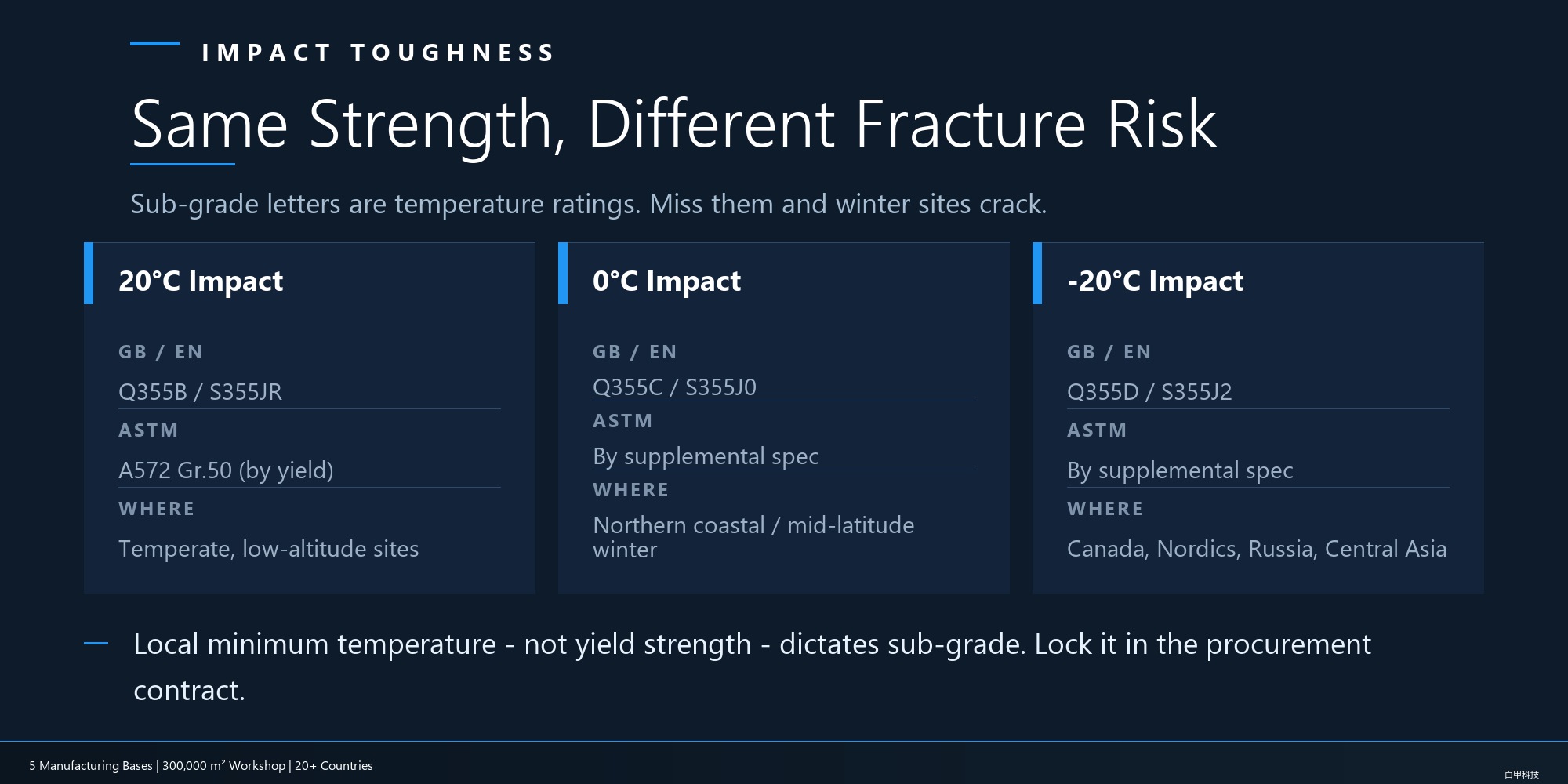
The suffix letter denotes the impact test temperature:
- B / JR: 20°C impact test(normal climates)
- C / J0: 0°C impact test
- D / J2: -20°C impact test(high-latitude, cold-winter regions)
In projects in Canada, Northern Europe, Russia and parts of Central Asia, local minimum temperatures can drop below -20°C. In these cases you must purchase Grade D / J2 steel. Substituting Grade B steel by strength conversion balances the strength account but not the toughness account — and the risk of low-temperature brittle fracture is passed on to the owner.
The purchase contract must specify the impact test grade based on the minimum design temperature at the project site.
Welding and Bolts Follow the Code
| Item | Eurocode system | US standard system |
| Steel structure execution / welding | EN 1090 / EN ISO 15614 / 9606 | AWS D1.1 |
| High-strength bolts | Grade 10.9 (ISO 898-1) | F3125 A325/A490 |
| Material certificates | EN 10204 Type 3.1/3.2 | Mill Test Report |
Bolts can’t simply be swapped by converting inches to millimeters. US-standard A490 requires higher installation pretension than the conventional torque for Chinese 10.9S. For the slip coefficient of friction surfaces: sandblasting plus inorganic zinc-rich paint per Chinese practice gives about 0.45-0.5, while US standards use Class A (0.30)/Class B (0.50). Without connection verification against the corresponding system, you’ll be held up at acceptance.
Four Things to Write Down in the RFQ Stage
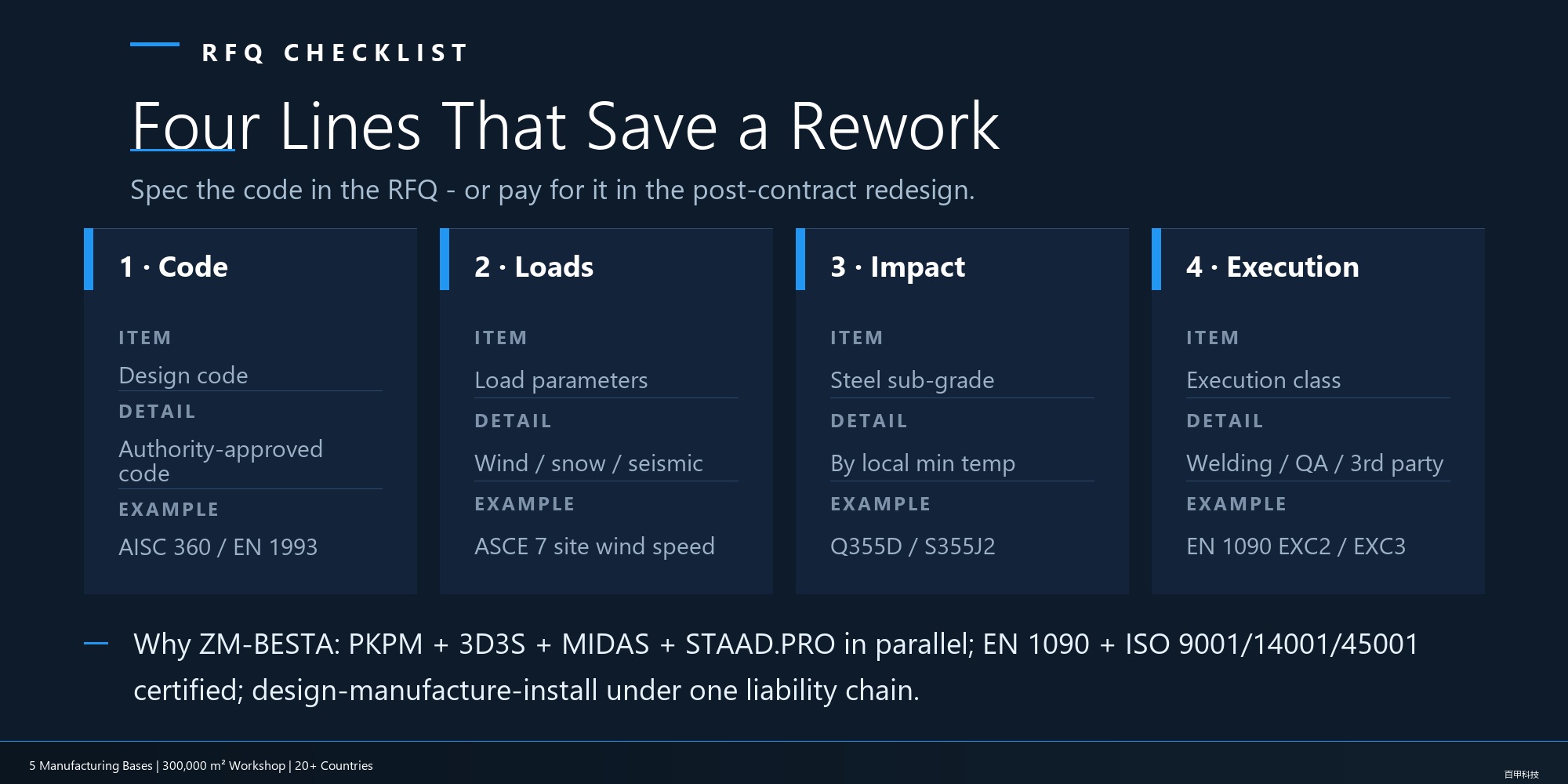
- Design code: the code recognized by the project country — put it in the RFQ
- Load parameters: local wind pressure, snow load and seismic category (e.g., ASCE 7 site wind speed)
- Steel impact grade: based on the local minimum temperature, state B/C/D or JR/J0/J2
- Execution & acceptance standards: EN 1090 execution class (EXC), welding system, third-party supervision requirements
Getting the code right at the inquiry stage costs nothing; getting it wrong at acceptance costs a full rework.
Why Choose ZM-Besta
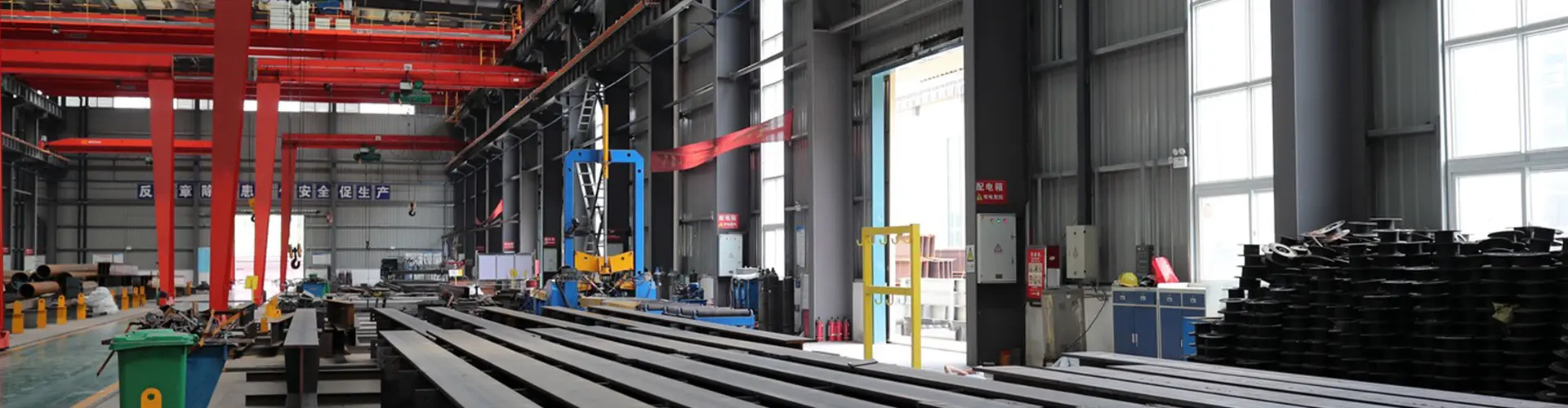
Founded in 2006, ZM-Besta is a Beijing Stock Exchange-listed company and ranks among the Top 50 in China’s building steel structure industry, with five manufacturing bases and 300,000 m² of factory building area.
Multi-Code Design Capability
- Multiple design software packages run in parallel — PKPM, 3D3S, MIDAS, STAADPRO, etc.
- Design and consulting services for overseas clients under multiple foreign code systems
- Mature experience in material grade mapping (e.g., Q355B vs S355JR)
Certification System
- EN 1090 European certification
- Triple-system certification: ISO 9001 / ISO 14001 / ISO 45001
- Class-A specialty qualification for light steel structure engineering design; Grade-1 qualification for steel structure engineering contracting
Design-fabrication-installation under one accountable entity. Codes, materials, welding and acceptance close the loop within a single system, with the fewest interfaces.
FAQ
Q1: Can steel structure design codes be mixed?
A: Not recommended. Load combinations, material definitions, connection design methods and deflection limits must all come from one system. Mixing codes can cause connection failures or hold-ups at acceptance. If cross-referencing is truly necessary for a specific project, all limit states must be re-verified with the actual material properties.
Q2: Can Q355B directly replace S355JR?
A: In normal climates, the strength and impact grades (20°C) are comparable, so the substitution is generally acceptable. But for cold-climate projects (-20°C class), you need Q355D/S355J2, and carbon equivalent and welding procedures must be re-verified against the project code. The substitution decision should be confirmed in writing by the design team.
Q3: Is EN 1090 certification the same as Eurocode design?
A: No. EN 1090 governs fabrication execution and factory production control (a prerequisite for CE marking); the design code is EN 1993 Eurocode 3. They’re independent, and Eurocode projects usually require both.
Q4: What special care is needed when selecting steel for high-latitude projects?
A: Two points: select D/J2 impact grades based on local minimum temperature; and impose stricter weld quality grades and carbon equivalent control to avoid low-temperature brittle fracture. We lock the impact test requirements into the purchase contract based on the project’s temperature conditions.
Need your steel structure solution assessed against your country’s codes? Send us the project location and load conditions:
Email: info@xzbesta.com