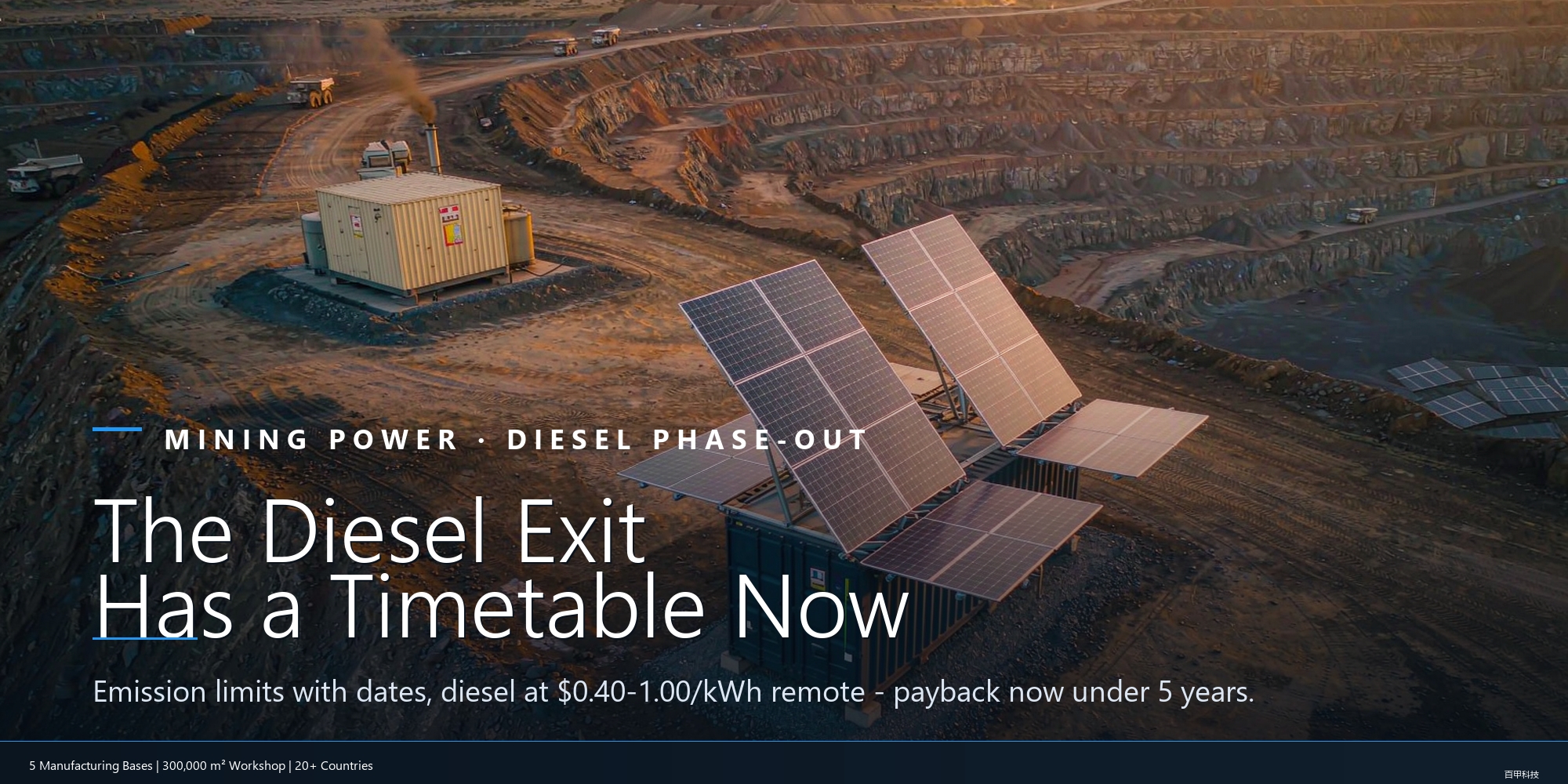
Still running diesel generators at your mine? The tightening path of emissions regulations has already set the phase-out timeline.
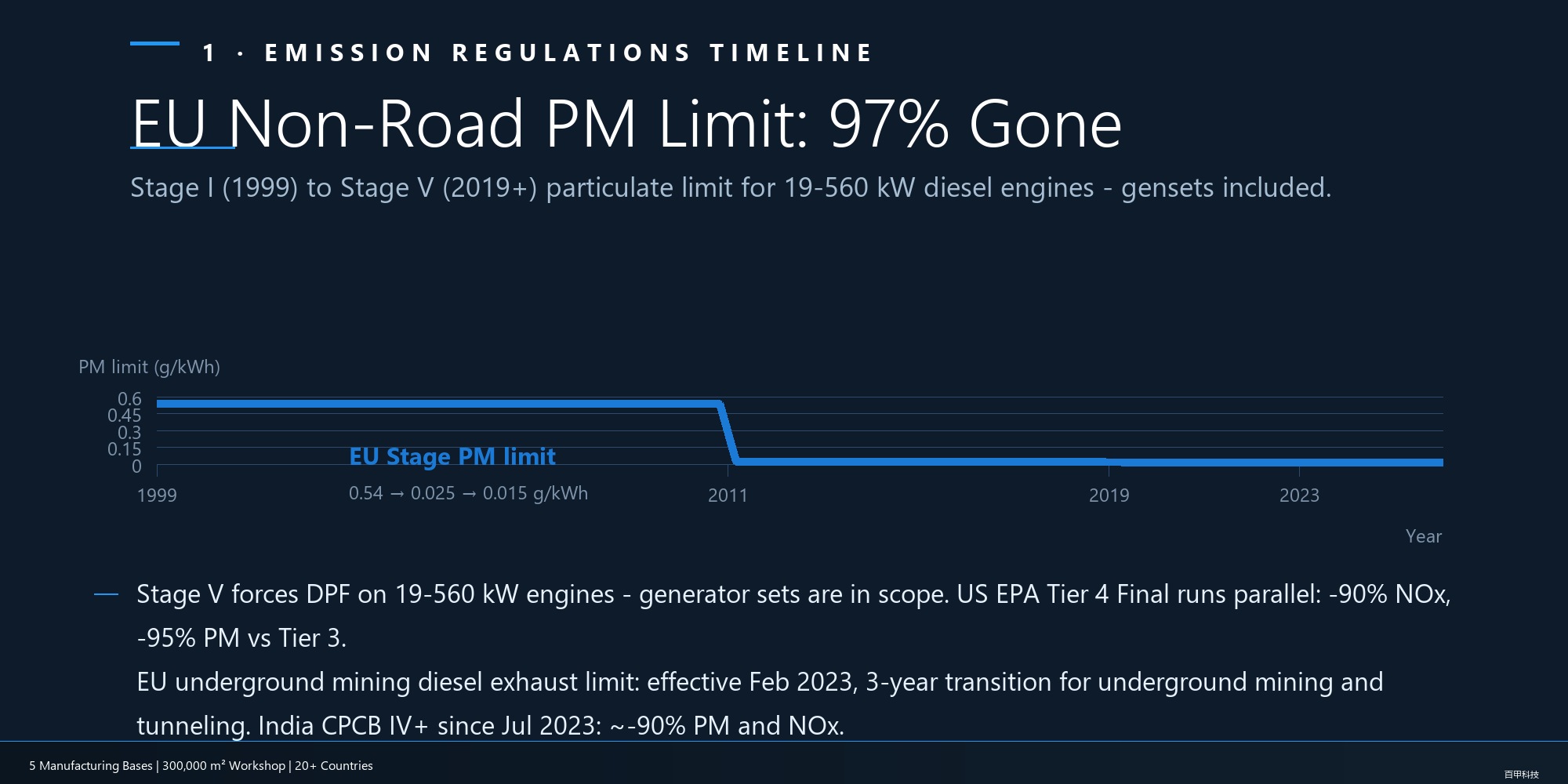
The EU Stage V standard cuts the particulate matter limit for non-road machinery to 0.015 g/kWh — 97% lower than 1999. US EPA Tier 4 Final cuts NOx a further 90% and PM 95% versus Tier 3. The EU’s occupational exposure limits for diesel exhaust in underground mines took effect in 2023. Regulations are no longer just a direction — they’re hard constraints with dates.
At the same time, diesel costs up to $0.40-1.00/kWh at remote mine sites, and payback periods for alternatives have entered the 3-5-year range.
This article lays out three things: the regulatory timeline, diesel’s full cost curve, and the economics of alternatives.
Emissions Regulations Tighten: Three Timelines
EU Non-Road Machinery Stage Evolution
| Parameter |
Stage I (1999) |
Stage IIIB (2011) |
Stage V (2019+) |
Cumulative reduction |
| NOx (g/kWh) |
9.2 |
3.4 |
0.4 |
-96% |
| PM (g/kWh) |
0.54 |
0.025 |
0.015 |
-97% |
| HC (g/kWh) |
1.3 |
0.19 |
0.19 |
-85% |
| Particle number PN |
Not limited |
Not limited |
1×10¹²/kWh |
New limit introduced |
Stage V mandates diesel particulate filters (DPF) for diesel engines from 19-560 kW, and generator sets fall within scope. Mobile and semi-stationary units fall under the NRE category; permanently installed emergency units are currently outside the scope.
The US and Other Markets
- EPA Tier 4 Final: 90% lower NOx and 95% lower PM than Tier 3 — the de facto threshold for buying new units in the North American market
- EU underground operations: occupational exposure limits for diesel exhaust took effect in February 2023, with a 3-year transition for underground mining and tunnel construction — after which DPF + SCR aftertreatment becomes the standard for compliance
- India CPCB IV+(from July 2023): generator set PM and NOx cut a further ~90% versus the old standard
The direction is consistent: limits keep dropping, aftertreatment keeps getting more expensive, and the market space for older units keeps shrinking.
The Other Hand: ESG
Beyond regulations, mining ESG disclosure requirements are tightening in parallel. Global mining consumes roughly 125 billion liters of diesel a year. On-site power generation is the biggest share of miners’ Scope 1 emissions. A hybrid microgrid can cut emissions by 70%-90% — and that goes straight onto the ESG report.
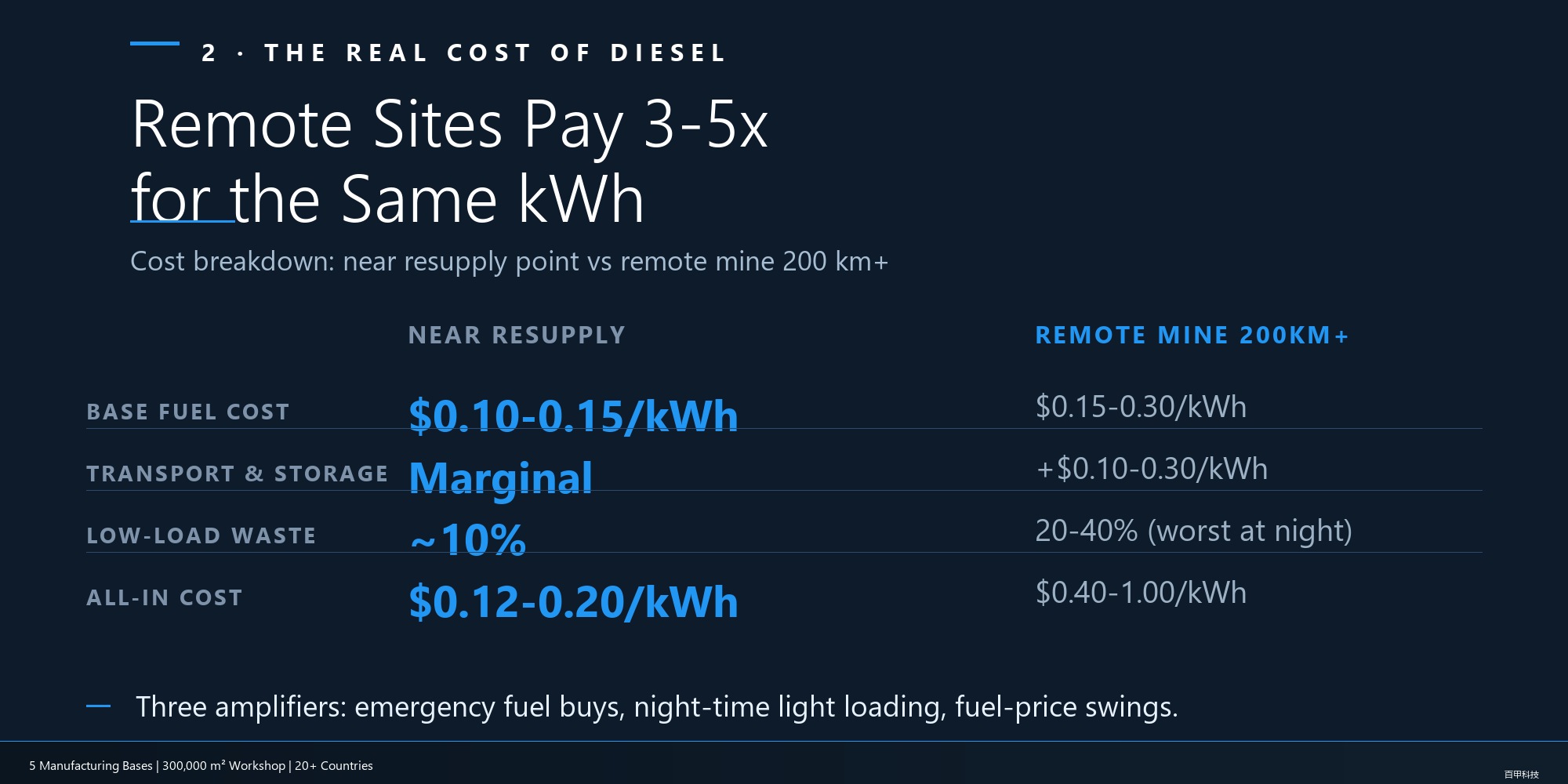
Diesel’s Hidden Bill: The Real Cost per kWh at Remote Mine Sites
Cost Structure
| Cost item |
Near supply points |
Remote mine sites (200km+) |
| Base fuel price equivalent |
$0.10-0.15/kWh |
$0.15-0.30/kWh |
| Transport / handling / storage |
Minimal |
+$0.10-0.30/kWh |
| Low-load waste |
~10% |
20%-40% |
| All-in cost per kWh |
$0.12-0.20/kWh |
$0.40-1.00/kWh |
Remote mines pay 3-5 times more than grid-connected projects. Three cost multipliers: emergency fuel purchases when rainy-season road closures cut supply; night-time light loading (a 100kW unit carrying a 10kW load, with most fuel turned into heat and wear); and oil price and exchange-rate volatility.
Compliance Costs Are Rising
Stage V/Tier 4 units cost more than older ones: DPF + SCR aftertreatment, sensor arrays and more complex routine maintenance; SCR requires exhaust temperature to be kept in the 200-450°C window, so units must hold a minimum load and sometimes need a load bank added. The money spent buying new units is itself pushing users to redo the math on alternatives.
The Economics of Alternatives: Payback Inside 5 Years
Hybrid Microgrid Data
| Indicator |
Value |
| Fuel reduction: diesel + PV + storage |
40% on average, 83% in the best case |
| Typical 10MW/80MWh system |
3-5-year payback |
| IRR with carbon credits |
>25% |
| Overall mining electrification ROI window |
3-7 years |
| Achievable emission reduction |
70%-90% |
Diesel’s role in a hybrid system changes: from primary power source to backup for extreme weather. Generator operating hours drop 40%-60%, maintenance intervals extend 30%-50%, and fuel logistics shrink accordingly.
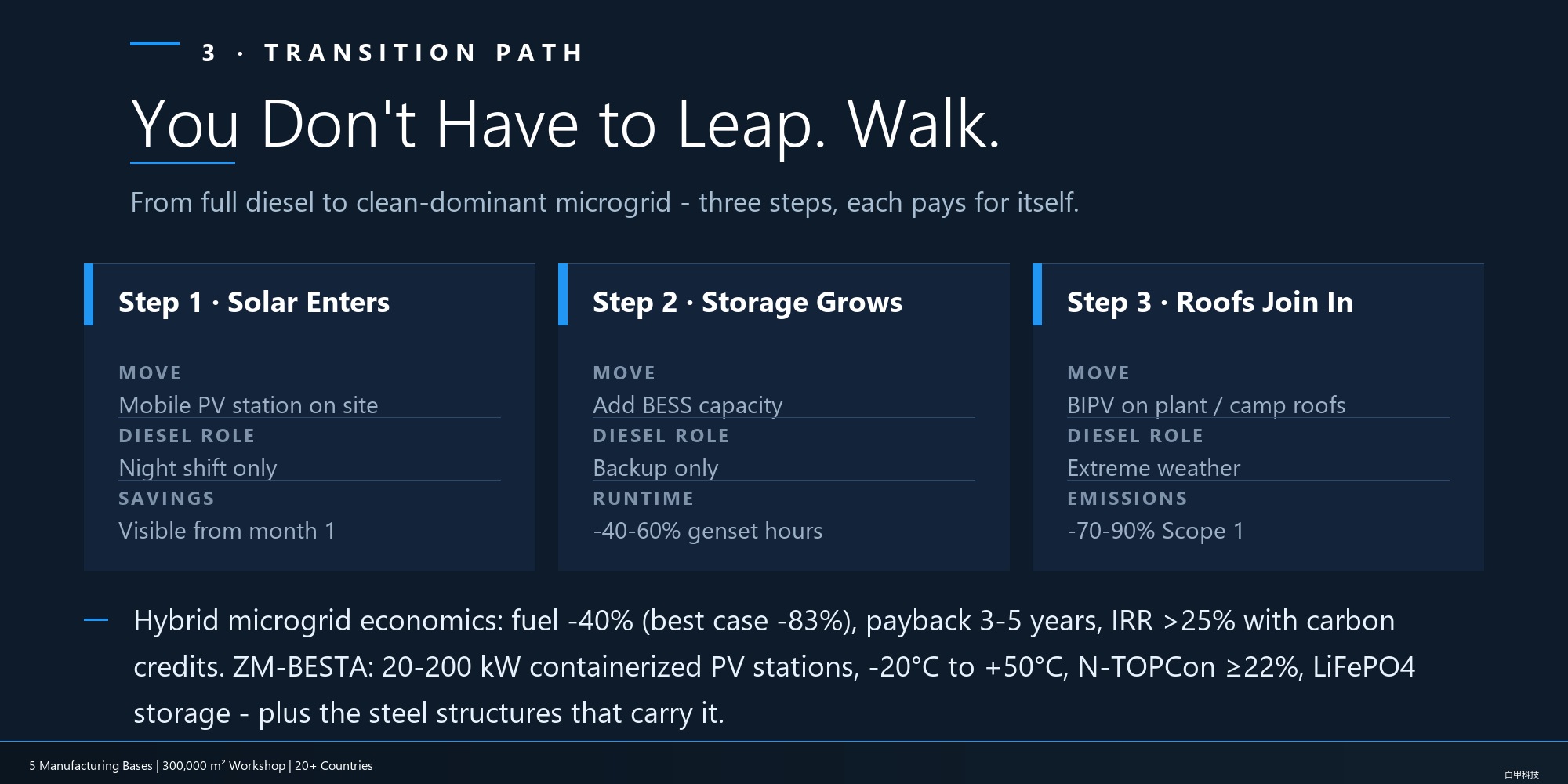
Transition Path: You Don’t Have to Do It All at Once
From all-diesel to all-clean, there’s a path you can walk in steps:
- Step 1: mobile solar power stations arrive; daytime load shifts to PV + storage, diesel gensets run at night
- Step 2: expand storage to cover nights and overcast days; diesel drops to backup
- Step 3: add BIPV on camp and workshop roofs; site maintenance and living loads integrate into the microgrid
Each step pays for itself independently, with fuel savings visible from day one.
What ZM-Besta Offers
A product portfolio for mine sites, construction sites and camps:
- Mobile solar power stations: 20kW-200kW containerized design, standard units shipped via container logistics; -20°C to +50°C operating range; N-type TOPCon modules with ≥22% conversion efficiency; LFP storage as standard, expandable as an option; rail deployment in 4-20 hours, motorized expansion in ≤30 minutes
- BIPV roofs: integrated PV roofs for steel structure workshops and dome storage sheds — structure and PV designed in one pass
- Structural support: steel structure systems for mine buildings and storage facilities, providing mounting and load conditions for microgrid equipment
Product lines cover industrial workshops, logistics warehouses, large-span dome storage sheds and EPC turnkey delivery, backed by five manufacturing bases with 300,000 m² of factory building area.
FAQ
Q1: Do diesel generator emissions regulations have retroactive effect on equipment already purchased?
A: Most emissions regulations govern type approval and market access for new models; existing equipment follows local transition arrangements. However, ESG disclosure and customer audits do affect the real cost of operating legacy diesel assets. Country-specific compliance advice should be reviewed by legal counsel.
Q2: What exactly is the all-in cost of diesel generation at a mine?
A: About $0.12-0.20/kWh at sites near supply points; $0.40-1.00/kWh at remote mines beyond 200km. Transport, low-load waste and oil price volatility are the three main multipliers.
Q3: Can mobile solar power stations fully replace diesel?
A: It depends on the load profile. For mine operations concentrated in daylight hours, PV + storage covers the bulk, with diesel dropping to night and extreme-weather backup. In regions with long stretches of overcast and snowy days, keeping diesel as backup is the more robust configuration.
Q4: How long is the payback period for alternatives?
A: A typical hybrid microgrid pays back in 3-5 years; the overall mining electrification ROI window is 3-7 years. The specifics depend on local diesel delivered prices, solar resources and load structure.
Q5: What about extreme-cold mines in winter?
A: Besta mobile power stations operate from -20°C to +50°C. PV output actually improves at low temperatures (negative temperature coefficient), and LFP storage with temperature control handles the rest. For winter details, see our other article on cold-weather operation analysis.
Want us to run the diesel-replacement math for your mine? Send us the project location, load and current power supply:
Email: info@xzbesta.com