Why Does BIPV Cross-Border Delivery Always Fail at the Last Mile?
Your BIPV modules have rolled off the factory line, but the customer’s real anxiety is only just beginning.
After the shipment arrives by sea, customs clearance documents are incomplete. Local installation crews cannot read Chinese drawings. Grid-connection approvals are repeatedly rejected by the power utility. Generation data is inaccessible, and the customer keeps calling: “Is the power station broken?”
This is not an equipment problem — it is a broken delivery chain.
How Xuzhou Zm-Besta Delivers BIPV Equipment to 20+ Countries
As a leading BIPV manufacturer China, Xuzhou Zm-Besta has years of experience in building integrated photovoltaics export and steel-structure overseas projects.
Our products have entered more than 20 countries along the Belt and Road. We break BIPV cross-border delivery into four closed loops: logistics, customs clearance, local installation, and after-sales O&M.
Every link requires standard operating procedures and fallback solutions.
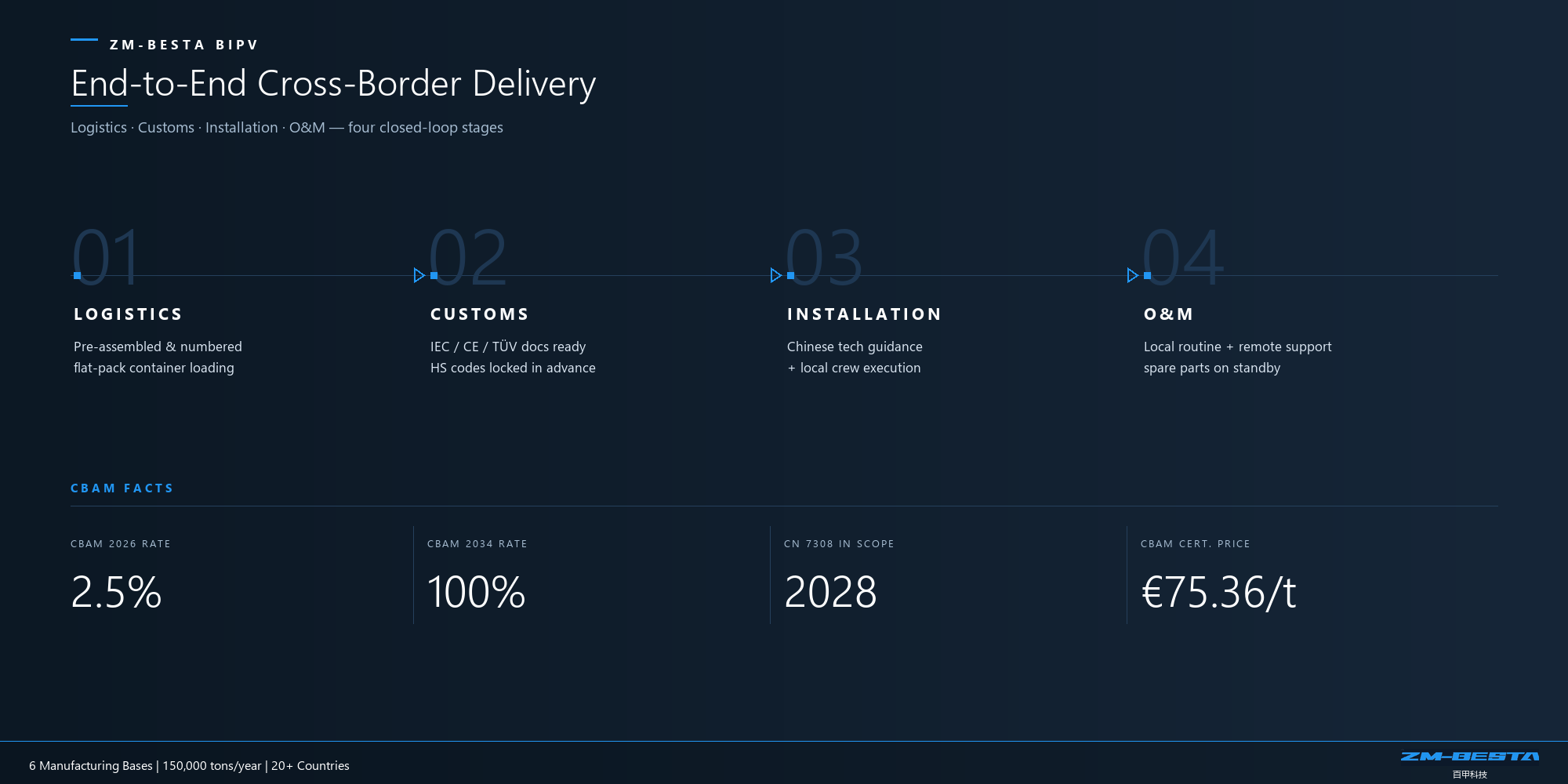
Logistics: Numbered Packing, Turning Components into “Lego”
BIPV is not a single piece of equipment, but a complete building-materials system: PV modules, steel purlins, water-drainage troughs, inverters, and grid-connection cabinets. The challenges are fragile glass modules, heavy steel components, and easily lost small parts.
Our solution is to design for assembly from the outset:
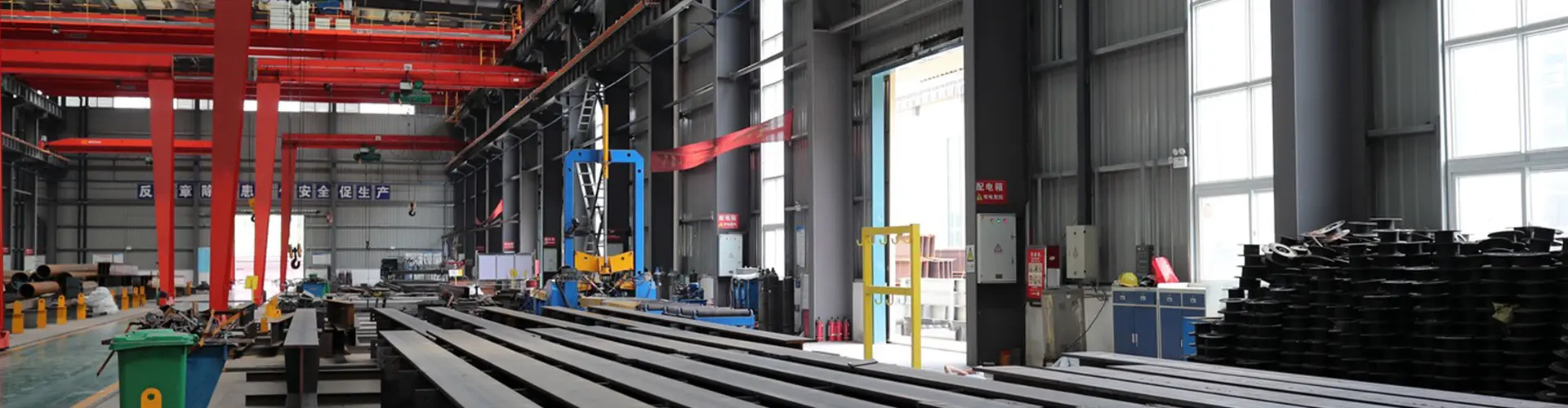
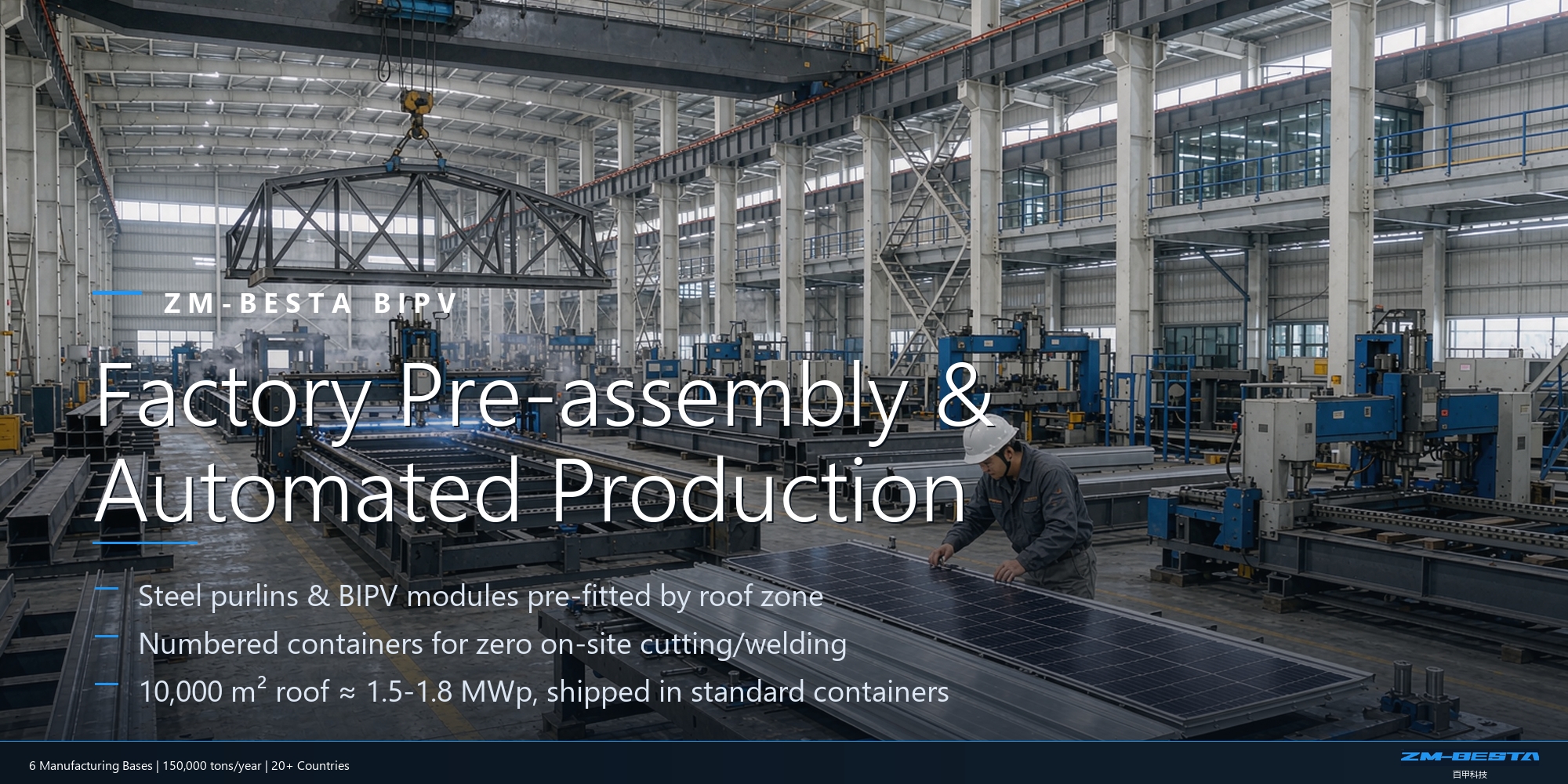
①Modules and steel purlins are pre-assembled in the factory, numbered by roof zone, and hoisted directly by number on site —zero cutting, zero welding.
②For a 10,000 m² steel-structure factory roof, theBIPV roofing system capacity is approximately 1.5–1.8 MWp. Components are packed into standard containers and managed by shipment batch.
③Steel components are flat-packed to improve loading rates; modules are individually packed to prevent glass breakage; small parts such as drainage troughs and connectors are included per container with a BOM list.
④Multi-modal transport is coordinated, with full document tracking from factory loading to port declaration to overseas customs clearance.
This turns overseas “assembly” into “fitting together,” dramatically reducing dependence on local construction skills and transport conditions.
Customs Clearance: Certification First, Documents Closed-Loop
90% of customs hold-ups happen because certification and documents are not aligned.
BIPV projects require two layers of certification:
Product layer: PV modules provide IEC 61215 and IEC 61730 test reports per target-market requirements; inverters and grid-connection equipment provide CE, TÜV, and other certification documents; where energy storage is included, lithium batteries separately require UN38.3 and MSDS.
Project layer: Xuzhou Zm-Besta holds GB/T 50430 (construction enterprise quality management), GB/T 45001 (occupational health and safety), and GB/T 24001 (environmental management) system certifications, and can support the general contractor in completing structural and grid-connection approvals for overseas projects.
Modules and steel products are classified by destination-country HS codes, and import tax rates and certification checklists are locked in the commercial contract in advance.
Our customs-clearance checklist includes:
√ Confirm destination-country HS codes and import tax rates in advance;
√ Prepare certificate of origin, packing list, commercial invoice, bill of lading, and certification documents;
√ For lithium-battery energy storage systems, separately apply for UN38.3, MSDS, and dangerous-goods packaging certificates;
√ For steel-structure components, provide material certificates, welding records, and hot-dip galvanizing test reports.
Local Installation: From Site Arrival to Grid Connection
The biggest fear in overseas projects is “goods on site, no one who knows how to install.”
Xuzhou Zm-Besta adopts a hybrid model of “Chinese technical supervision + local construction crew.” Key milestones include:
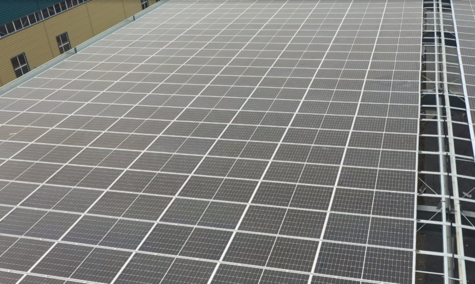
- Roof load-bearing review: A steel structure solar roofreplacing traditional roofing can reduce roof load by 15%–20%, but the existing structure must still be verified.
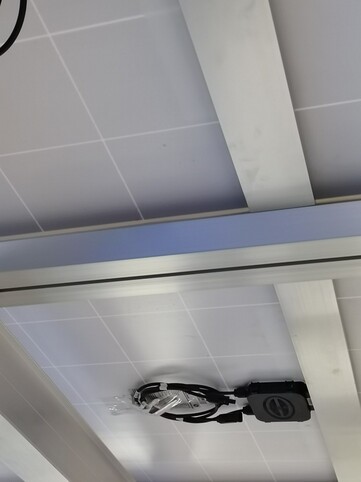
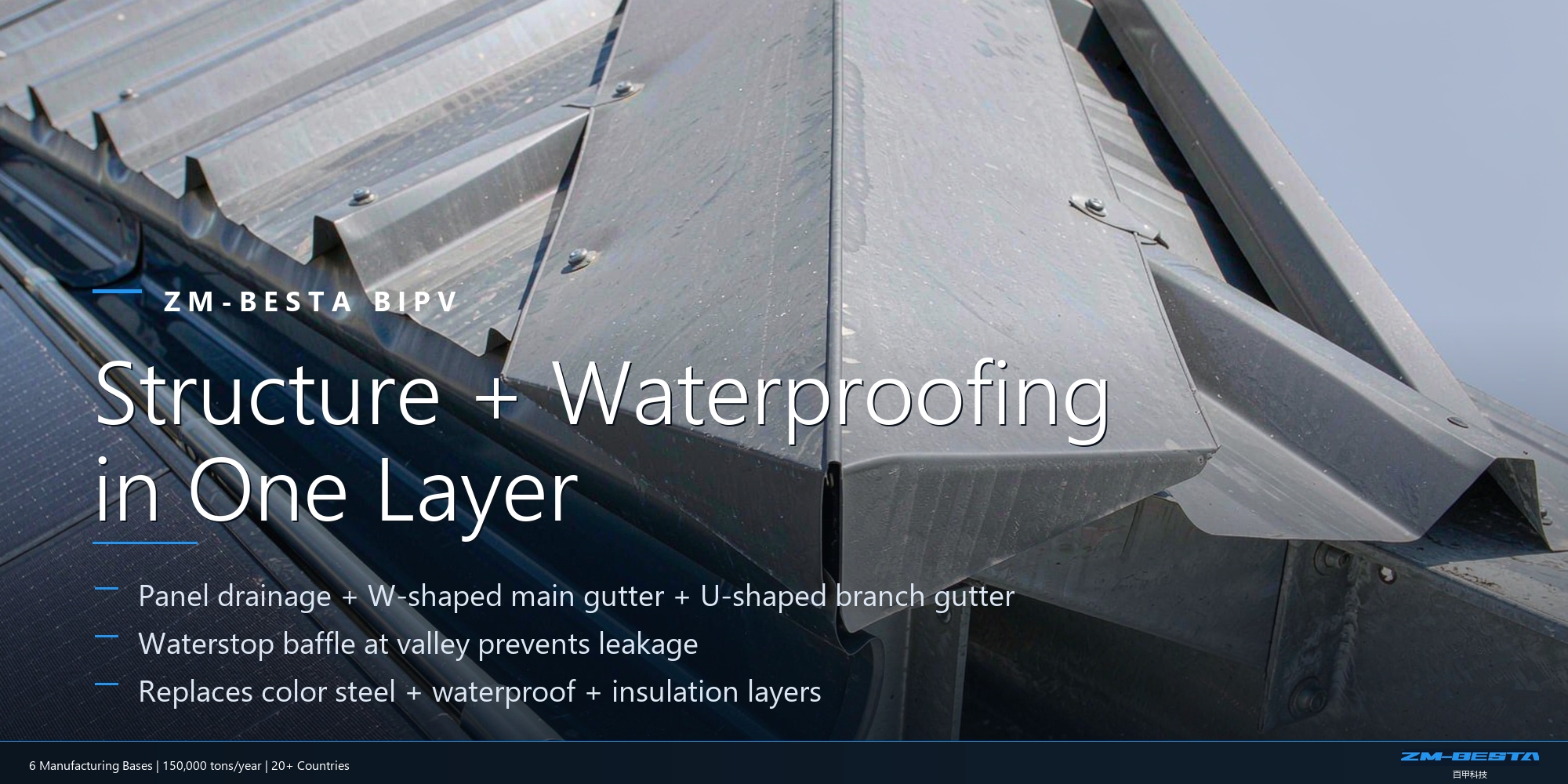
- Waterproof-joint control: Module downstream drainage + W-type main trough + U-type branch trough, with water baffles added to gutters — this is the core of preventing BIPV leakage.
- Electrical grid-connection interface: Submit single-line diagrams, protection settings, and power-quality reports per local grid requirements.
- Local personnel training: Complete O&M training before acceptance, and deliver operation manuals and spare-parts lists.
Taking a 10,000 m² portal-frame factory roof as an example, a typical BIPV project takes about 90 days (for a 3,000 m² carport project), while large-scale projects can reach 730 days.
Because modules and purlins are pre-assembled in the factory, only three steps remain on site: hoisting, wiring, and grid connection. Both schedule and labor are clearly superior to traditional “on-site cutting + loose-part installation.”
After-Sales O&M: Continuous Support After Handover
Grid connection is not the finish line — power-generation revenue is.
The biggest fear in overseas projects is “losing contact after delivery”: dirty modules no one cleans, generation degradation no one monitors, faults no one handles.
Xuzhou Zm-Besta’s approach is “local O&M + Chinese remote support”:
- Daily O&M routines are standardized:regular module cleaning and generation-efficiency-degradation monitoring, written into the handover manual.
- Critical issues are handled remotely:Chinese engineers provide remote guidance, and the local team executes accordingly.
- Spare parts are kept in stockper the delivery spare-parts list, shortening fault downtime.
- O&M data is recorded and archived periodically, supporting revenue accounting and project review.
This model makes overseas power-plant revenue sustainable, rather than everyone going their own way after grid connection.
With the EU Carbon Tariff Taking Effect, What Three Cards Must Exporters Hold?
Card 1: Understand the CBAM Mechanism
CBAM (Carbon Border Adjustment Mechanism), commonly known as the EU carbon tariff.The transition period runs from October 1, 2023 to December 31, 2025, requiring only quarterly reporting of embedded carbon emissions in imported products. From January 1, 2026, the full implementation phase begins: EU importers must purchase CBAM certificates for six product categories — steel, cement, aluminum, fertilizers, electricity, and hydrogen.
In April 2026, the EU announced the first CBAM certificate price at EUR 75.36 per tonne CO₂. The actual collection ratio in 2026 is only 2.5%, but it will rise to 100% by 2034.
For Chinese manufacturers, the 2028 expansion deserves even closer attention.
Steel structures (CN 7308) and 180 other downstream steel and aluminum products will be brought into the CBAM scope.
Industry estimates show that if EU default values are used instead of measured values, 1,000 tonnes of steel-structure exports to the EU could incur over 55% more carbon border adjustment mechanism costs by 2030.
Card 2: Quantify BIPV’s Carbon-Reduction Contribution
BIPV is not just power-generation equipment — it is a carbon asset.
- Every 1 kW of BIPV capacity generates approximately 1,200 kWh per year, corresponding to an annual CO₂ reduction of about 0.96 tonnes.
- A 100 kWBIPV roofing system can reduce carbon by approximately 50–75 tonnes per year.
- Xuzhou Zm-Besta’s prefabricated steel building with solarsolutions can deliver annual carbon reduction of over 100 tonnes per project, with payback controlled at 5–7 years and overall costs 20%–30% lower than traditional solutions.
BIPV can further reduce carbon through “building-material integration”: replacing traditional color-steel tiles + waterproof layer + insulation layer, reducing roof load by 15%–20% and cutting steel consumption by 8%–12%. A 10,000 m² factory can save 5–10 tonnes of steel.
These are not slogans. They can be written into carbon-footprint reports, EPDs, and green-finance materials, helping customers achieve lower CBAM costs in the EU market.
Card 3: Prepare Carbon Assets and Data in Advance
CBAM is essentially a battle over CBAM compliance data. Exporters should do three things as early as possible:
- Build an MRV system: Monitoring, Reporting, Verification. From raw-material procurement and manufacturing to transport and installation, every link must leave verifiable carbon data.
- Obtain third-party certification: CBAM accepts emission reports issued by verification bodies accredited by EU member states. TÜV, SGS, DNV, and BV are preferred choices.
- Engage upstream suppliers: Request per-tonne carbon-emission-intensity data from steel and aluminum mills, and insert carbon-data-provision obligation clauses into procurement contracts. Without upstream data, you can only pay tax based on EU default values.
Delivery-Model Comparison: Traditional Path vs. Xuzhou Zm-Besta One-Stop Path
| Dimension |
Traditional BIPV Export Path |
Xuzhou Zm-Besta One-Stop Delivery Path |
| Product Design |
Modules, brackets, and inverters purchased separately |
Integrated design: steel structure + BIPV + energy storage |
| Logistics Organization |
Multiple suppliers ship separately; on-site assembly |
Factory pre-assembly; full-container/batch shipment |
| Customs Clearance & Certification |
Company independently handles certifications per country |
Project-system certifications upfront + product documents prepared per target country |
| Overseas Installation |
Reliance on local general contractor; quality uncontrollable |
Chinese technical supervision + local crew + remote support |
| Carbon Data |
No systematic accounting |
Carbon footprint data and EPD support provided |
| After-Sales Response |
Long fault-feedback cycle |
Local O&M + Chinese remote support; spare parts in stock |
Conclusion: BIPV Export Is Not Freight — It Is a Systems Project
The difficulty of BIPV cross-border delivery lies not in the equipment itself, but in how to string design, manufacturing, logistics, customs clearance, installation, O&M, and carbon compliance into a controllable chain.
Xuzhou Zm-Besta’s solution is straightforward:
√ Use assembly-oriented pre-assembly and numbered packing to reduce overseas on-site risk.
√ Use multi-country certification and document checklists to clear customs bottlenecks.
√ Use local teams + Chinese remote monitoring to achieve sustainable O&M.
√ Use carbon-footprint data and EPDs to help customers address the carbon border adjustment mechanism.
The EU carbon tariff is not a distant risk — it is a cost item already in effect in 2026.
Fail to prepare data now, and you will pay for default values three years from now.
If you are planning a building integrated photovoltaics export project, contact Xuzhou Zm-Besta for:
- Full-scope BIPV cross-border deliveryplanning
- Target-country certification and customs-clearance checklists
- CBAM complianceand carbon-footprint assessment support
Click to inquire, and let our team customize a complete factory-to-grid-connection solution for your project.
Email:info@xzbesta.com
FAQ
Q1: Which countries does Xuzhou Zm-Besta‘s BIPV mainly export to?
A: Xuzhou Zm-Besta products have entered more than 20 Belt-and-Road countries, with key markets including Southeast Asia, South Asia, Central Asia, the Middle East, and Africa. Typical projects cover the Philippines, Indonesia, Kazakhstan, India, and more.
Q2: Does CBAM directly tax PV modules now?
A: PV modules themselves are not in CBAM’s first six covered categories, but upstream raw materials such as aluminum frames and steel supports in modules are already affected by CBAM. From 2026, certain PV products are also brought into reporting and verification requirements, so preparing carbon-footprint data in advance is recommended.
Q3: What is the payback period for a BIPV project?
A: Based on Xuzhou Zm-Besta’s actual project data, the steel structure solar roof BIPV solution for steel-structure factories has a payback period of about 5–7 years, with an own-funds IRR of over 20%.
Q4: How is after-sales O&M handled for overseas projects?
A: Xuzhou Zm-Besta adopts a “local O&M + Chinese remote support” model. Operation manuals and spare-parts lists are delivered at acceptance. Daily module cleaning and generation-efficiency monitoring are performed by the local team, while critical issues are handled under remote guidance from Chinese engineers.
Q5: Can Xuzhou Zm-Besta provide CBAM-related carbon-data support?
A: Xuzhou Zm-Besta can assist customers in compiling BIPV project carbon-reduction data and carbon-footprint information for EPDs, green certification, and CBAM declarations. Specific third-party verification is performed by EU-accredited bodies.