Environmental fines, wind and rain losses, and wasted land from open stockyards — owners of mining and power plant projects around the world are answering with the same solution: large-span, fully enclosed dome storage.
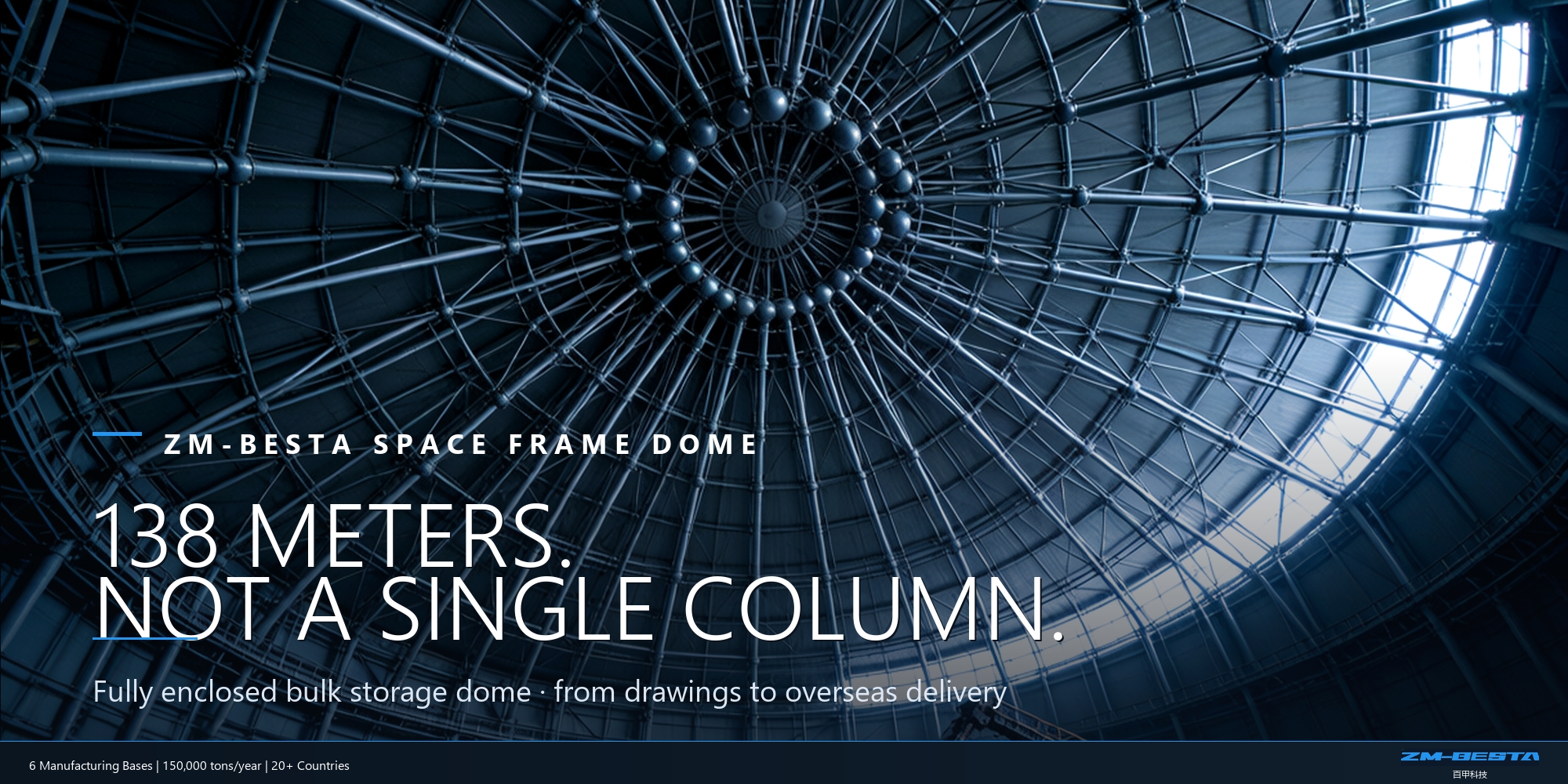
But a 138-meter column-free span isn’t “built” — it’s “assembled.” This article explains two things: why the dome is the optimal structure for large-span bulk storage, and how an export project goes from drawings to a dome standing on an overseas site.
Why Choose a Dome for Large-Span Bulk Storage?
Structural Efficiency: The Larger the Span, the Greater the Advantage
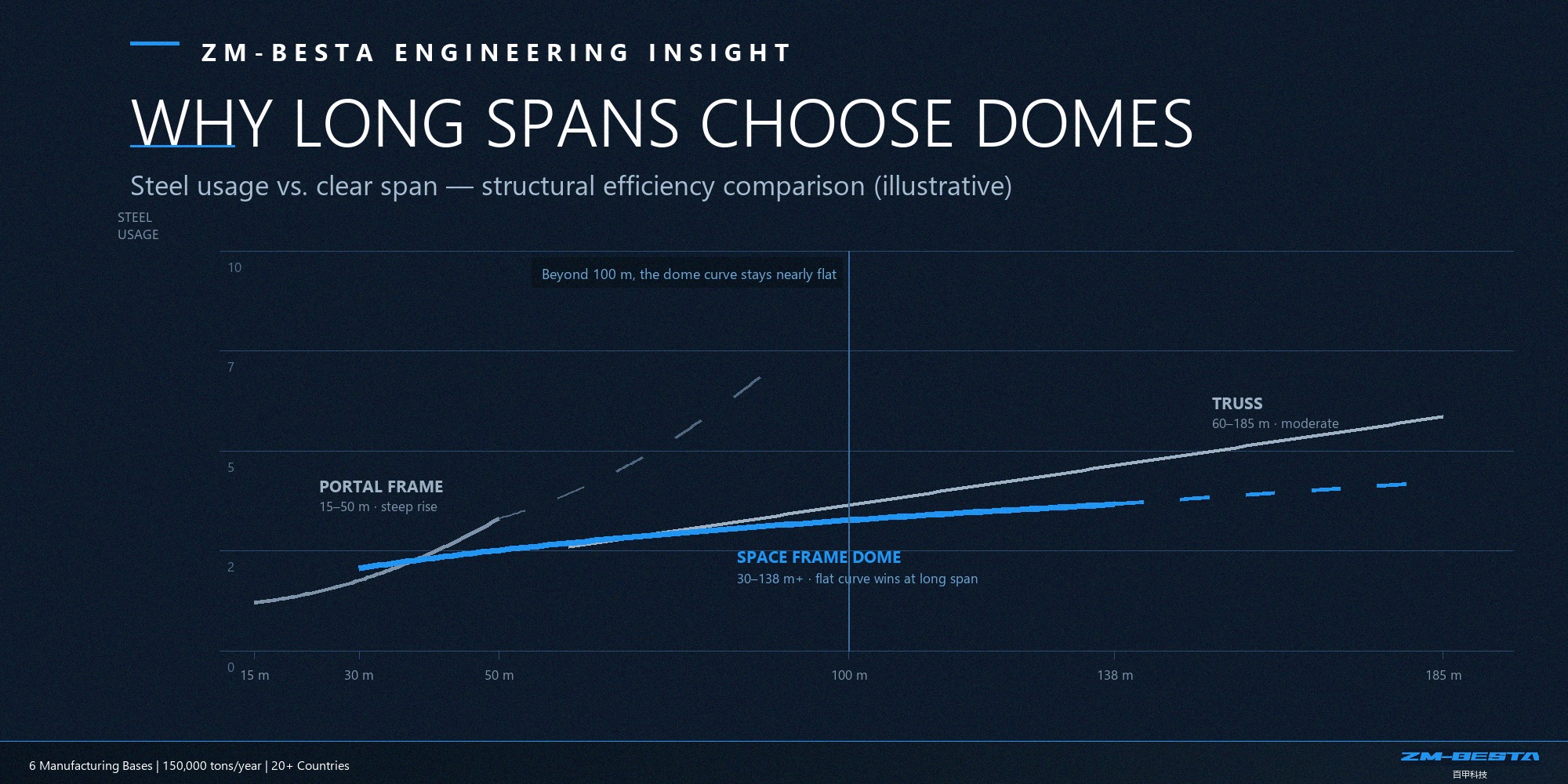
There is a well-recognized rule in structural mechanics: the larger the span, the steeper the rise in steel consumption of planar structures (rigid frames, trusses). A space frame dome is a spatial load-bearing system — loads travel along the shell to the ring beam foundation, so its steel consumption curve is far gentler.
| Structure Type | Applicable Span | Steel Consumption Trend | Bulk Storage Scenario Fit |
| Portal Frame | 15-50 m | Steep rise with span | Small & medium warehouses |
| Tubular Truss | 60-185 m | Moderate | Dry coal sheds / barrel shells |
| Space Frame Dome | 30-138 m+ | Gentle curve | First choice for large circular bulk storage |
Once spans reach the hundred-meter level, the per-square-meter steel advantage of domes becomes clear. That is why they are the mainstream answer for large bulk storage facilities worldwide.
The Environmental & Economic Case for Full Enclosure
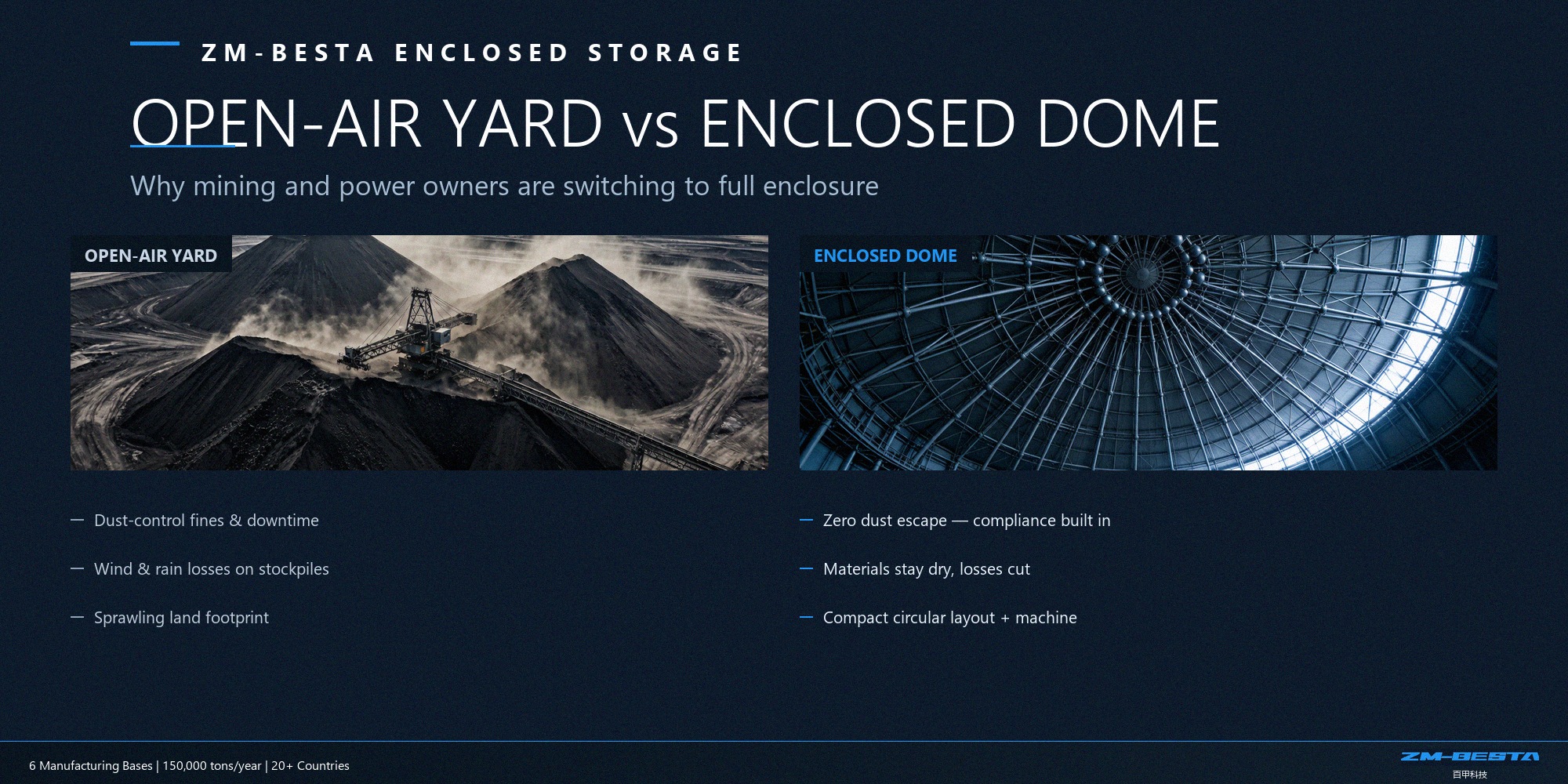
- Open stockyard: dust control pressure, wind and rain losses, environmental penalty risk
- Fully enclosed dome: zero dust escape, environmental compliance, significantly reduced material loss
- Land efficiency: a circular stockyard with a stacker-reclaimer takes less land per unit of storage
For mining groups and power plants, a dome is not just an environmental investment — it is an asset that turns fines and losses into savings.
The Complete Delivery Process for an Export Dome
Design Stage: Disassembling the Entire Dome
The entire dome is broken down into thousands of members and bolt-sphere joints, each with its own number. Key design decision: bolt-sphere joints mean no on-site welding. All precision work is completed in the factory; the site only does assembly — especially important for overseas projects, as it greatly reduces reliance on local labor skills.
Fabrication & Shipping
Members and sphere joints are packed in sections and shipped with item numbers. With sea freight taking weeks, the packing list and the physical goods must match one-to-one. (For specific shipment batches and schedule data of export projects, please confirm the publishable figures with our technical team.)
On-Site Erection: High-Level Loose Assembly
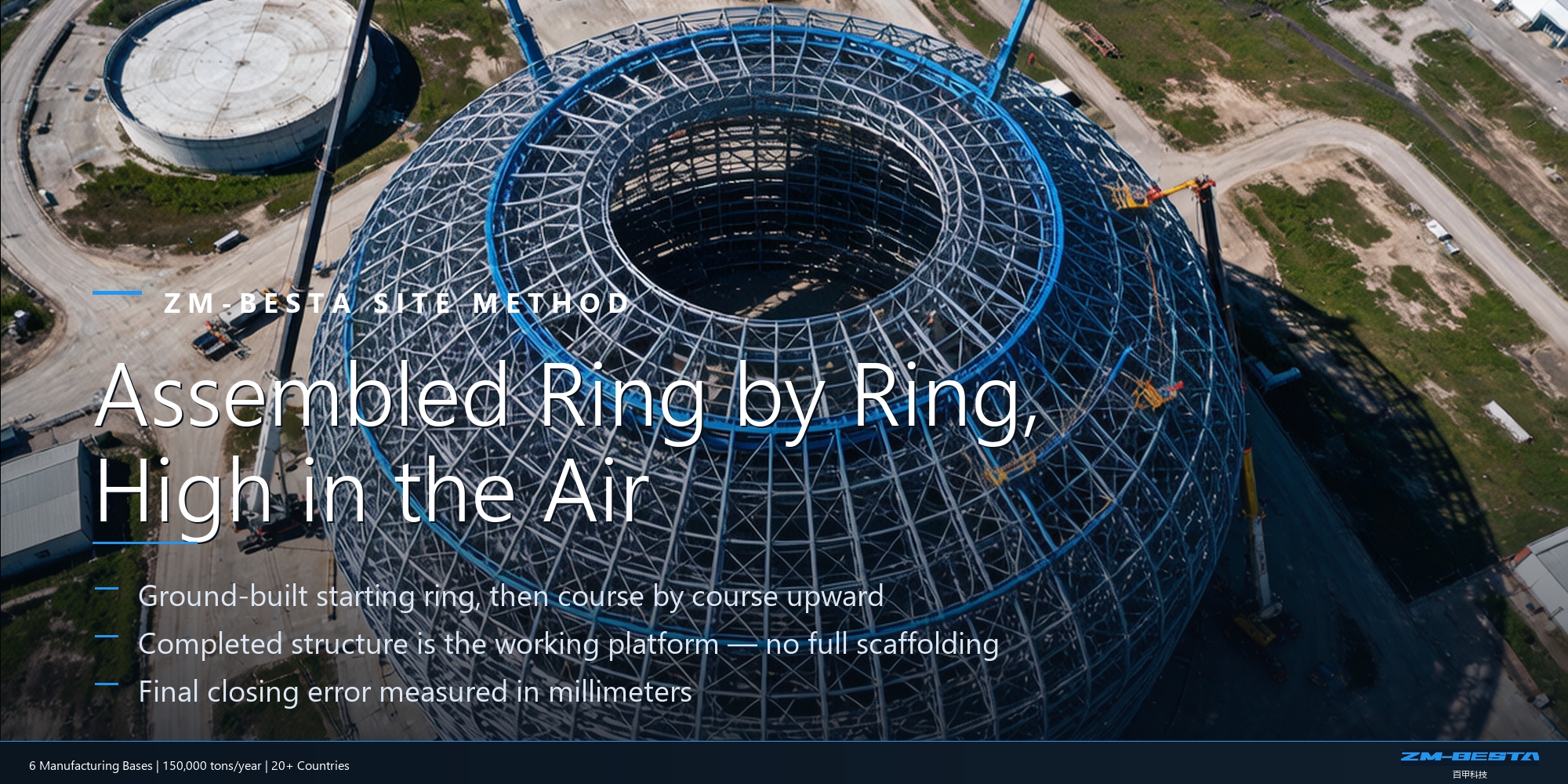
A starter ring assembled on the ground first forms a stable structure, then rings are closed upward one by one. The erected structure itself becomes the working platform for the next step — no full scaffolding required. ZM-Besta holds a provincial-level construction method for this process.
Closure: A Millimetre-Level Finish
When the final ring is closed, the cumulative error is measured in millimetres. Sunlight makes steel expand; cooling makes it contract. The closure window is calculated, not guessed.
Proven Track Record: Numbers Don’t Lie
ZM-Besta large-span project delivery record:
| Project | Structure/Span | Highlights |
| Xinjiang Tianchi Energy circular stockyard | Three 130 m diameter domes | Coal industry quality project award |
| Lianyungang Coal Supply Chain Base | 118 m span × 736 m long barrel shell | Golden Steel Award; set a new record for the one-sided arching method |
| Guohua Xuzhou Power Plant coal yard enclosure | 185 m span prestressed tubular truss | China Installation Star Award |
| Indonesia Labota dry coal shed | Space frame, 18,395 m² | Export delivery |
| San Miguel Corporation storage yard, Philippines | Space frame shed + complete stacker-reclaimer system | Contract value approx. USD 8.62 million |
ZM-Besta is a Top-50 enterprise in China’s building steel structure industry and a Beijing Stock Exchange (BSE)-listed company, with 6 production bases and an annual output value exceeding USD 140 million.
FAQ
Q1: How do I choose between dome storage and silos?
A: The two serve different purposes. A dome with a stacker-reclaimer suits large-capacity circular stockyards; silos suit vertical storage with fixed-point unloading. ZM-Besta specializes in large-span dome storage solutions.
Q2: How are load and seismic performance ensured with a 138 m column-free span?
A: In a spatial space frame system, loads transfer along the shell to the ring beam, with seismic performance superior to rigid planar structures. Design can follow the code specified by the owner.
Q3: How long does an overseas project usually take?
A: Design and factory fabrication run in parallel domestically; the on-site erection period depends on the span and scale. A schedule estimate can be provided once specific project parameters are given.
Q4: Can solar PV be integrated on the dome?
A: Yes. Steel structure + PV integration (BIPV) is ZM-Besta’s strategic direction. PV power generation can be integrated on the dome roof — see our steel-PV integration solution for details.
Q5: For environmental enclosure retrofits, can an existing stockyard be covered directly with a dome?
A: Geological and foundation assessments are needed first, before deciding the latticed shell support scheme. We have mature cases of dry coal shed enclosure for retrofit projects.
What are your stockyard’s span, storage capacity, and stacking/reclaiming method? Send them to us and we will respond with a preliminary structural scheme within 72 hours.
Email: info@xzbesta.com