On overseas steel structure projects, welding—not design—is often the biggest headache on site.
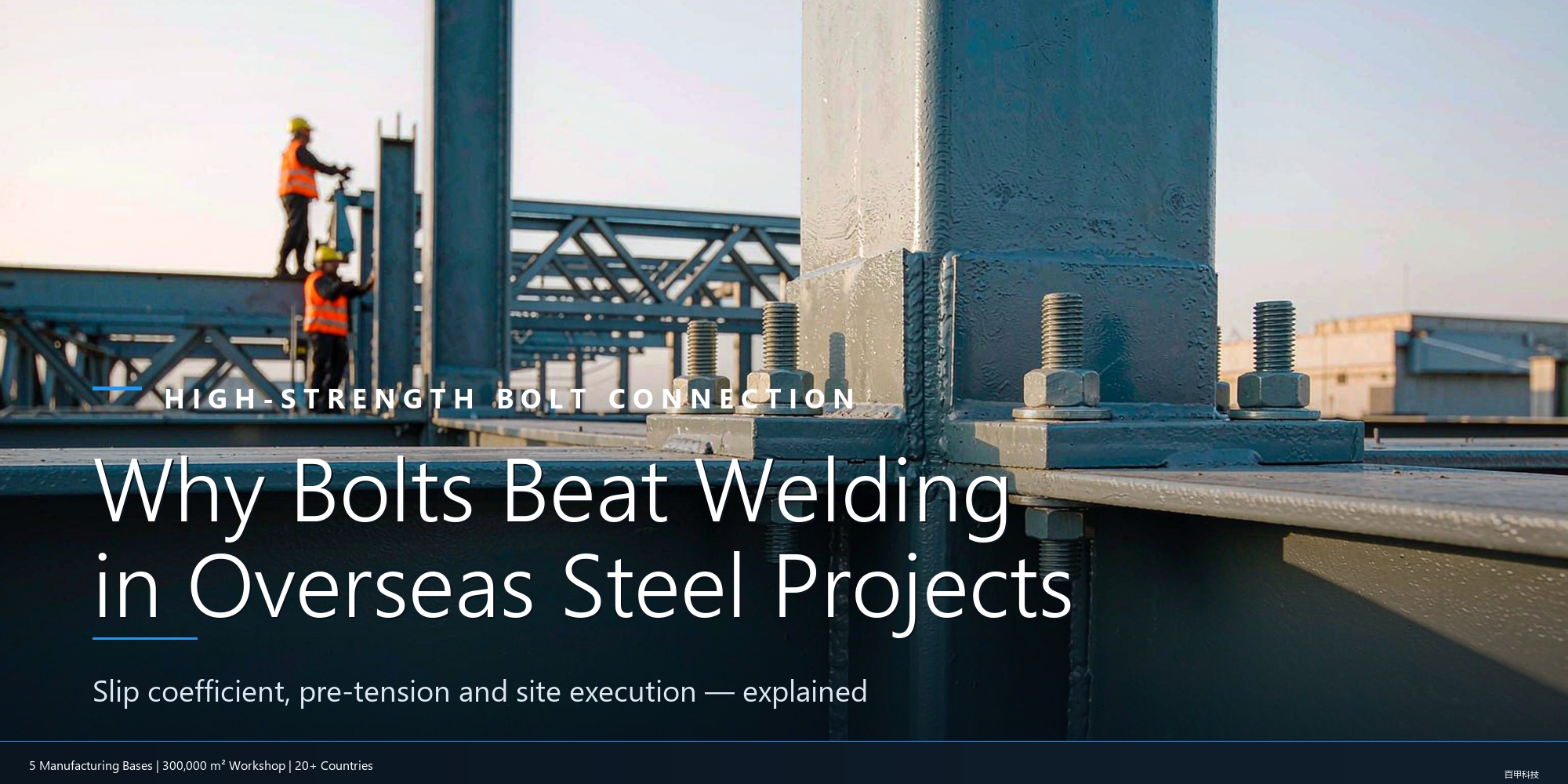
Welding, welders, weld inspection, preheating in rainy weather, and welds completed under schedule pressure: a problem at any stage can delay the project. Over the past two decades, high-strength bolted connections have become an increasingly common alternative on international projects.
This article explains why bolted connections are often preferred from three perspectives: technical principles, project execution, and practical decision-making.
Why Prioritize Bolting? The Project Owner’s Perspective
No On-Site Welding, Less Weather Dependence
Steel members are welded and coated in the factory; on site, crews only bolt the members together and lift them into place. Rainy seasons, humidity, and cold weather are less likely to disrupt installation. This is a key reason bolted solutions are increasingly popular in weather-variable markets such as Southeast Asia, Africa, and the Middle East.
Lower On-Site Skill Requirements
High-strength bolted connections require torque wrenches and standard operating procedures (SOPs), rather than highly skilled welders.
Local welder shortages are common on overseas projects, and owners naturally worry about delays. A bolted solution removes welder availability and skill from the critical path.
Clear Quality Records
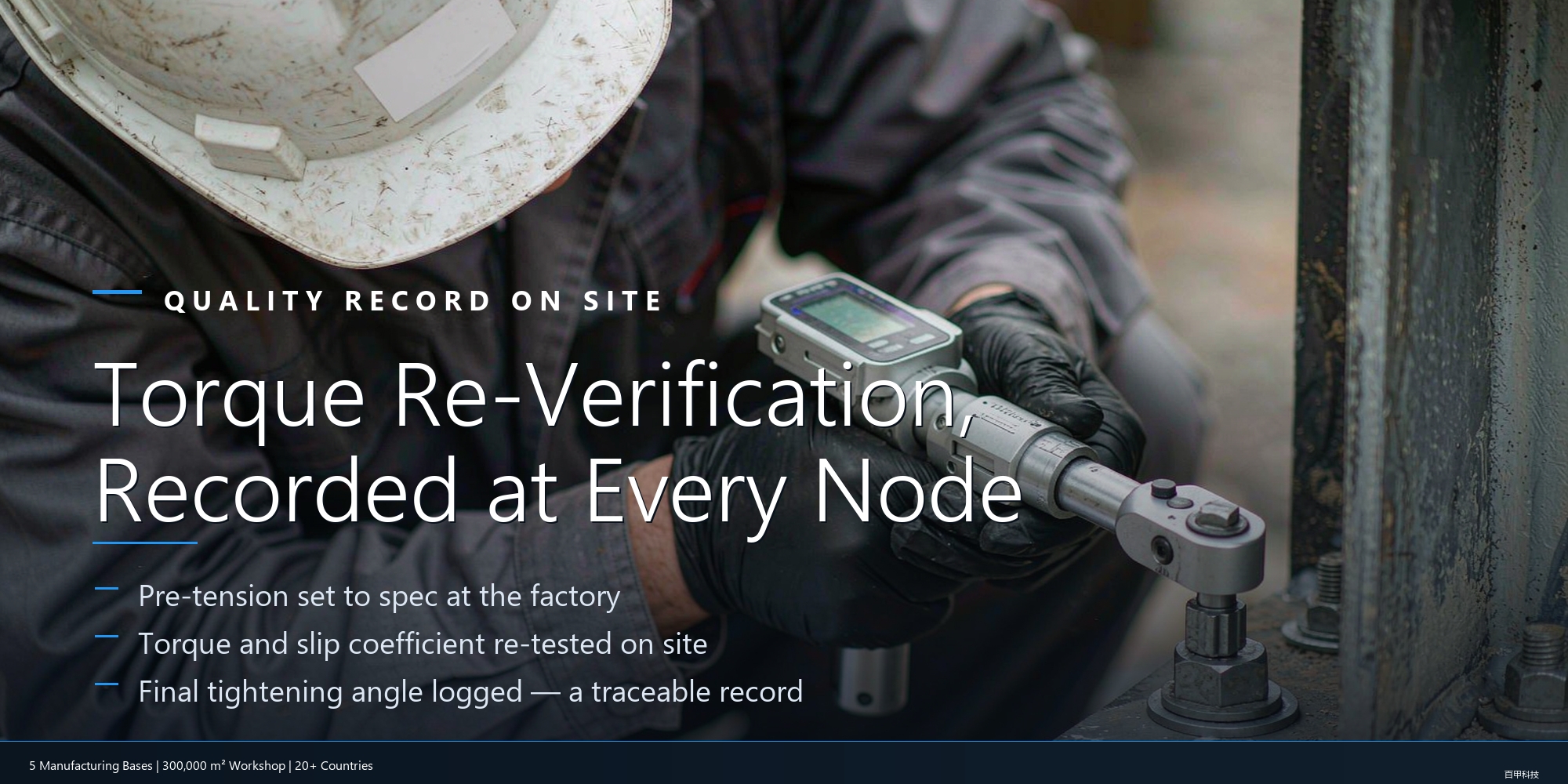
Bolt pretension, torque coefficient, and slip factor can be measured with instruments in the factory and on site, creating traceable records. This also makes verification easier for site supervisors and insurers.
Weld quality depends on welder skill and inspections such as radiographic testing (RT), ultrasonic testing (UT), and magnetic-particle testing (MT), so results can vary more widely.
Technical Principles: How Bolted Connections Transfer Loads
Slip-Critical vs. Bearing-Type Connections
High-strength bolted connections generally fall into two categories:
- Slip-critical connections transfer load through friction between the connected plates. Greater pretension and a higher slip factor increase resistance to slip.
- Bearing-type connections allow limited movement between plates and transfer load through bearing between the bolt shank and the hole wall. They may accommodate some deformation.
Slip-critical connections are common in international projects because they limit movement, provide high stiffness, and perform well under dynamic loads.
Slip Factor
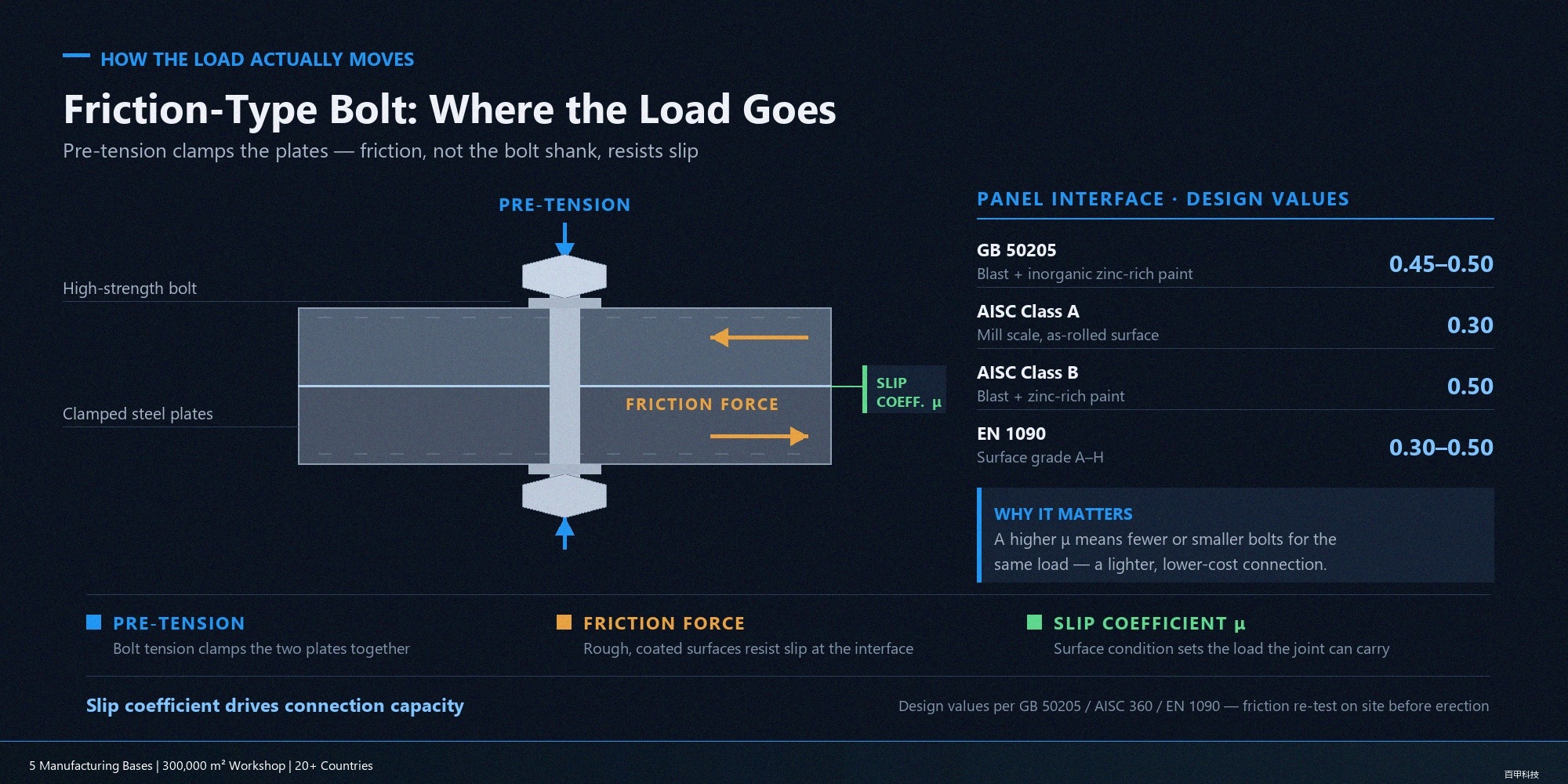
The slip factor (μ) is a key design parameter for bolted connections and depends on the surface preparation of the connected plates.
| Standard | Surface preparation | Slip factor |
| Chinese standard GB 50205 | Sandblasting + inorganic zinc-rich paint | Approx. 0.45–0.50 |
| AISC (US standard) | Class A (mill scale) | 0.30 |
| AISC (US standard) | Class B (sandblasted, zinc-rich coating) | 0.50 |
| EN 1090 (European standard) | Surface classes A–H | 0.30–0.50 |
Use the value specified by the applicable design code. Before site installation, the slip factor should be verified—this is a routine inspection item.
Pretension and Strength Grade
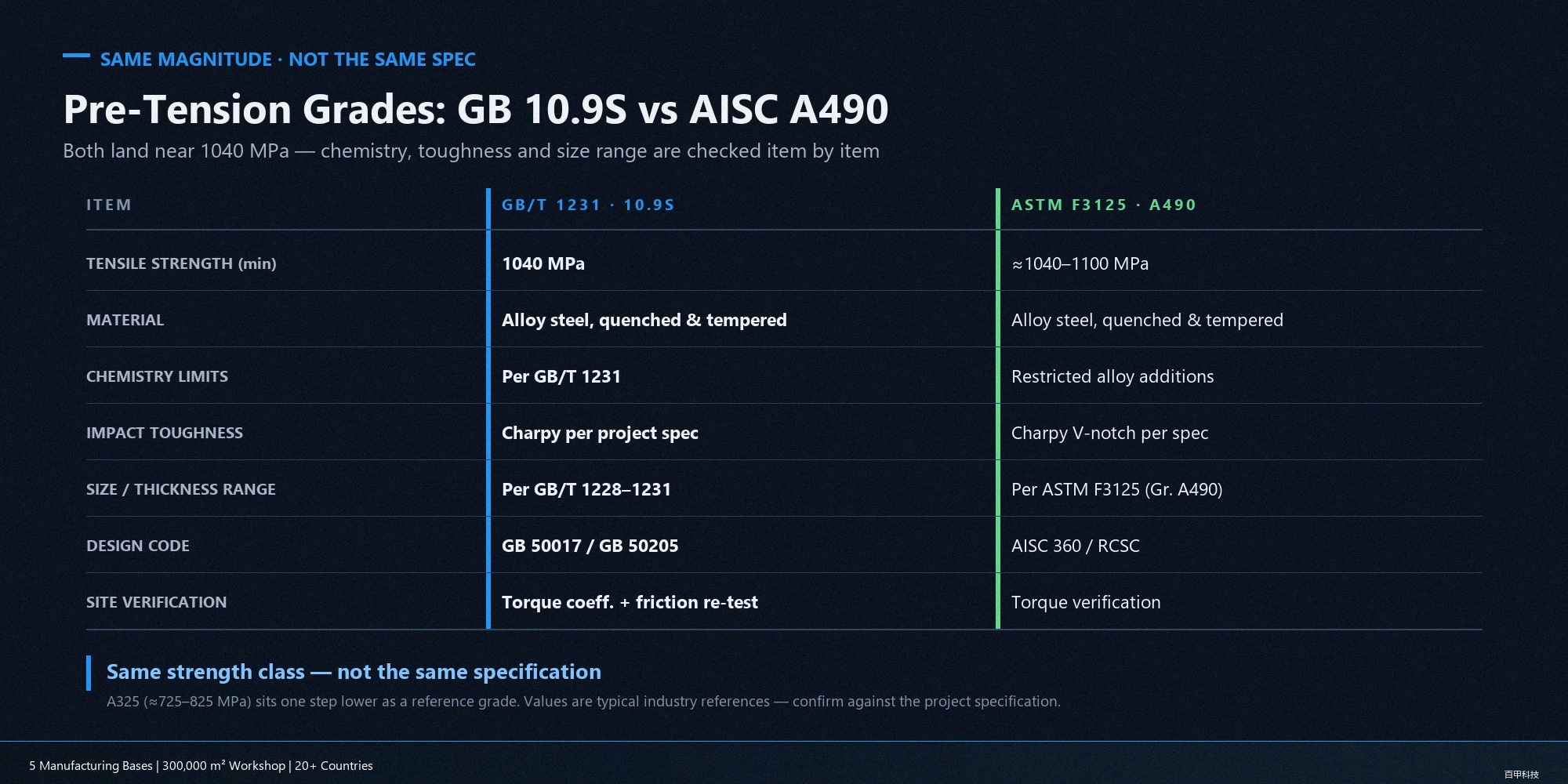
| Standard | Grade | Tensile strength (MPa) |
| Chinese standard GB/T 3077 | 10.9S | Approx. 1,040 |
| AISC | A490 | Approx. 1,040–1,100 |
| AISC | A325 | Approx. 725–825 |
| EN 1993 | 10.9 | Approx. 1,040 |
Chinese grade 10.9S and AISC A490 are in a similar tensile-strength range (about 1,040 MPa), but chemical composition, impact toughness, and thickness range must be checked against the project specification.
Bolting vs. Welding: A Project-Level Comparison
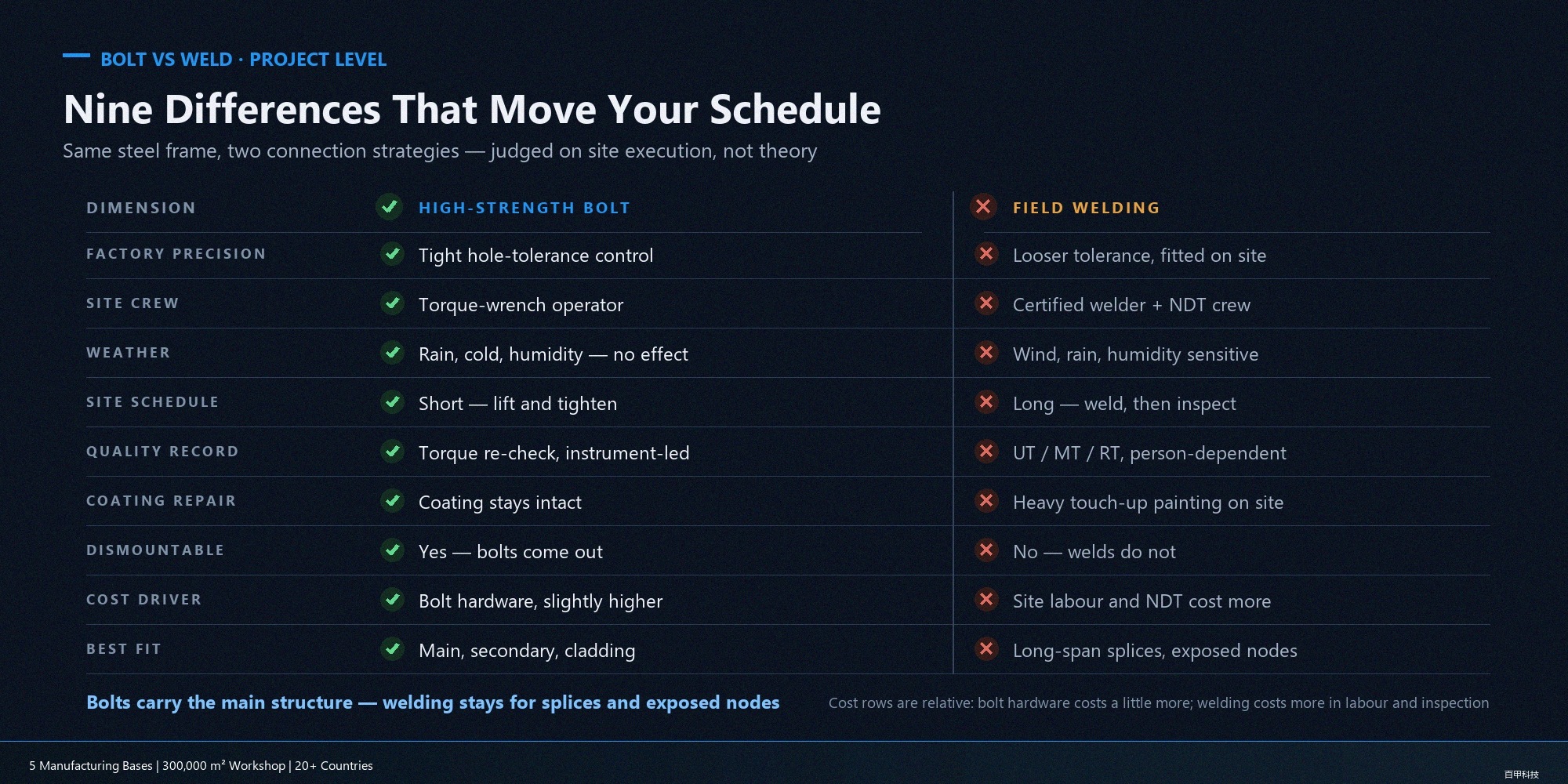
| Aspect | High-strength bolts | On-site welding |
| Factory fabrication precision | Strict control of hole-position tolerances | High |
| On-site labor requirements | Torque-wrench operator | Skilled welder + NDT |
| Weather impact | Minimal | Sensitive to wind, rain, and humidity |
| On-site schedule | Short (lifting + tightening) | Long (welding + inspection) |
| Quality inspection | Torque verification (instrument-measurable) | UT/MT/RT (personnel-dependent) |
| Coating repair | Minimal | Substantial touch-up at joints |
| Disassemblable | Yes | No |
| Cost | Bolts slightly more expensive | Labor and inspection can be costly |
| Typical applications | Primary/secondary structures and cladding | Long-span field splices and exposed architectural joints |
Put these differences into project terms:
- Bolting is generally more favorable for schedule risk.
- Welding offers greater flexibility for unusual joints and adjustable angles.
International projects often use bolting for most connections and welding locally for special details.
When Is Welding Still Necessary?
Bolting is not a universal solution. Welding may still be appropriate in three typical cases:
- Field-spliced joints in long-span trusses—large members may have to be transported in sections because of transport-size restrictions.
- Temporary structures that will later be removed—bolted connections can be dismantled, while welded joints cannot be separated without cutting.
- Exposed architectural joints with strict aesthetic requirements—ground welds can create a seamless appearance, while bolts remain visible.
These cases account for a relatively small share of many international projects. Bolting can be used for most primary and secondary structures and cladding supports.
Corrosion Protection: A Less Obvious Advantage of Bolting
Coating repairs on overseas sites are a common challenge. Welded joints often require touch-up painting on site, where humidity, cleanliness, and temperature variation make it difficult to match factory coating quality.
With bolted connections, connection surfaces can be coated in the factory, reducing the need for on-site touch-up. This benefits projects involving sea freight, long schedules, and tropical climates.
This is particularly relevant for coastal projects exposed to salt spray, desert projects exposed to blowing sand, and chemical plants exposed to corrosive atmospheres.
Practical Advice for Project Owners
At the tender-specification stage, clarify three items with the design institute:
- On-site welding workload—less than 30% of total work is a reasonable target.
- Factory welding—more than 80% of main connection welding completed in the factory is a reasonable target.
- Welder grades and quantities required on site—the fewer highly skilled welders needed, the better.
All three questions point to the same priority: project executability. In overseas conditions, a solution that can be executed reliably is more important than one that is theoretically optimal.
FAQ
Q1: Are high-strength bolted connections more expensive than welding?
Bolts themselves may cost slightly more than welds, but factory prefabrication at scale narrows the gap. Overall project costs may be similar; the main differences are schedule savings and more consistent quality.
Q2: Should all international projects prioritize bolting?
No. Field-spliced long-span trusses, temporary structures, and exposed architectural joints may still require welding. Bolting for primary and secondary structures with local welding for special details is a common combination.
Q3: Do bolted solutions impose transport-size constraints?
Yes. Members connected with bolts may be shipped in larger assembled sections rather than spliced on site, so each piece is constrained by transport dimensions. Oversized international shipments using open-top or flat-rack containers can cost 30%–50% more.
Q4: What do inspectors focus on when checking bolted joints?
Torque verification, slip-factor verification, and final-tightening angle records. All measurements should be documented.
Q5: Does a bolted solution require specific design software?
No special software is required. Common steel structure design tools such as PKPM, 3D3S, MIDAS, and STAAD.Pro support high-strength bolted connection calculations.
Q6: Do bolted joints require periodic maintenance?
Yes. Torque should be checked periodically in high-temperature or vibration-prone environments such as power plants, chemical plants, and equipment foundations. For ordinary industrial buildings, rechecking every 5–10 years may be appropriate, subject to project requirements.
What This Means for Project Owners
- Lower schedule risk: less dependence on local welder availability, weather, and workforce changes.
- Clear quality records: retain torque values, slip-factor verification, and final-tightening records for each connection.
- Lower on-site labor requirements: trained torque-wrench operators can take on the work after 1–2 days of training.
- Easier inspection: bolted connections are widely used under European and US standards, including EN 1993 and AISC 360.
The trade-offs are that high-strength bolts cost slightly more than ordinary bolts and factory fabrication requires tighter hole-position tolerances. These additional costs are often offset by shorter on-site work and reduced risk.
Evaluating a steel structure export project? Contact us:info@xzbesta.com.