Mining sites often have no grid connection. For most projects, a diesel generator is the first choice.
A 200 kW generator set costs tens of thousands of dollars upfront. It may look like the cheaper option. But at a remote mining site, the real cost comes every day afterward: fuel logistics, maintenance-related downtime, and emissions compliance—three hidden costs that keep adding up.
This article breaks down the total cost of two options: diesel generators vs. containerized mobile solar power plants.
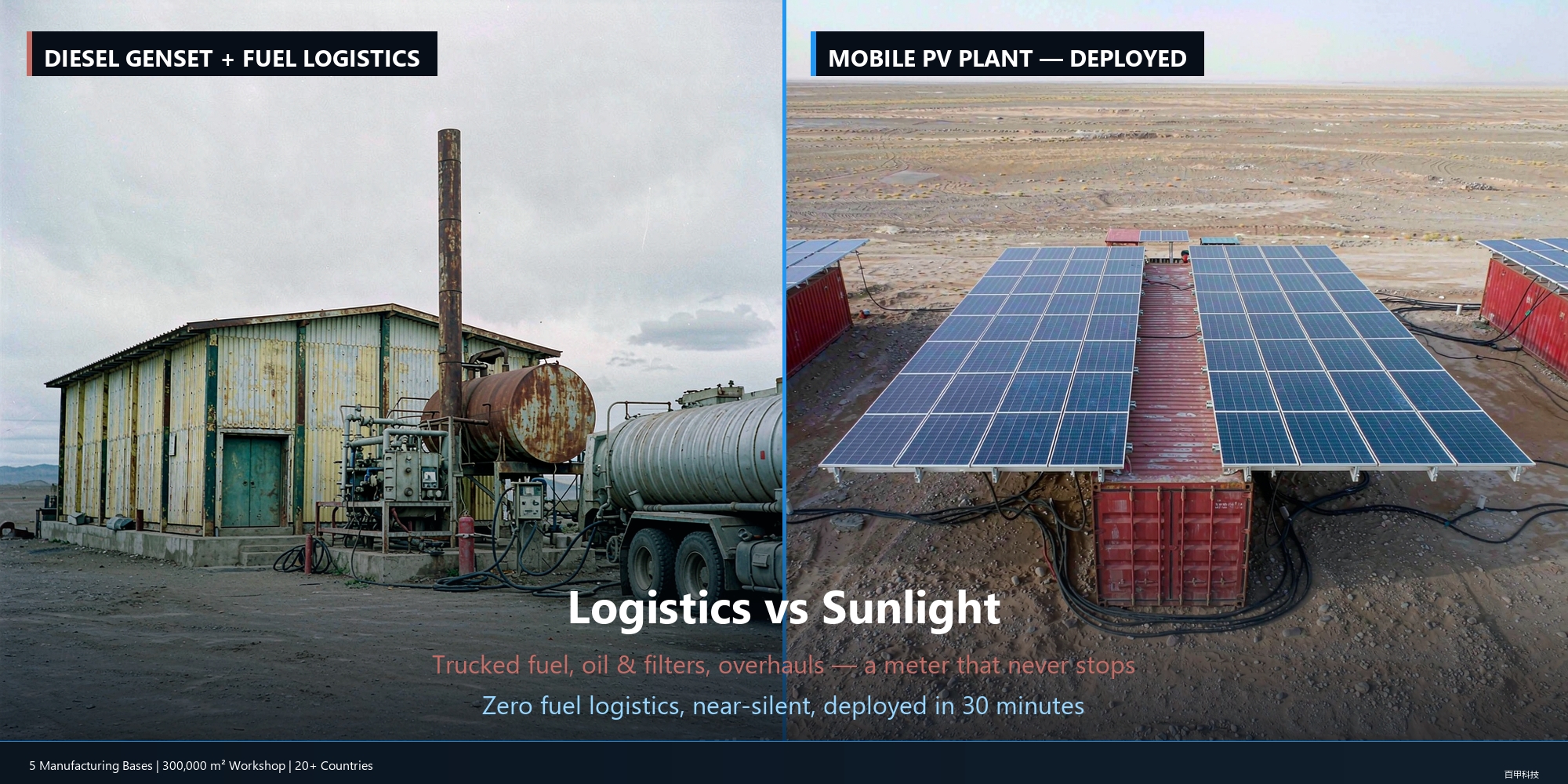
The Three Hidden Costs of Diesel Generation
Fuel Logistics
At remote mining sites, diesel is delivered by truck. Once the haul gets long, the delivered price per liter can easily double. Prices of $1.5–2.5/L at remote sites are common. Fuel spending fluctuates with oil prices and cannot be locked in, leaving the mine’s electricity costs fully exposed to oil-price volatility.
Maintenance and Downtime
Diesel engines contain many moving parts. Oil changes, filter replacements, and periodic overhauls are all essential. Remote sites also face long technician response times: when a major overhaul shuts down the generator, the extraction or processing line may have to stop as well. The cost of downtime often far exceeds the maintenance expense itself.
Emissions Compliance
EU Stage V and US EPA Tier 4 regulations have tightened particulate-matter emission limits for non-road diesel engines to around 3% of the previous generation’s limit. In the ESG reports of international mining companies, diesel generation is a key area for emissions reduction. ICMM (International Council on Mining and Metals) member companies have generally set renewable-energy substitution targets around 2030. These timelines are shortening the period during which diesel engines remain compliant.
Mobile Solar Power Plants: A Different Cost Structure
Product Configuration
Containerized mobile solar power plants are available in capacities from 20 kW to 200 kW. The container is positioned on site, and the PV array unfolds electrically in under 30 minutes. Lithium iron phosphate (LFP) battery storage is included as standard or available as an option, supplying power through the night and during cloudy periods.
| Parameter |
Value |
| Available capacities |
20 / 56 / 75 / 150 / 175 / 200 kW |
| Deployment time |
Rail installation: 4–20 labor-hours; PV array unfolding: ≤30 minutes |
| Operating temperature |
-20°C to +50°C |
| Enclosure protection rating (when stowed) |
IP55 |
| Wind resistance when deployed |
Beaufort Force 9 |
| Energy storage |
LFP battery, standard or expandable option |
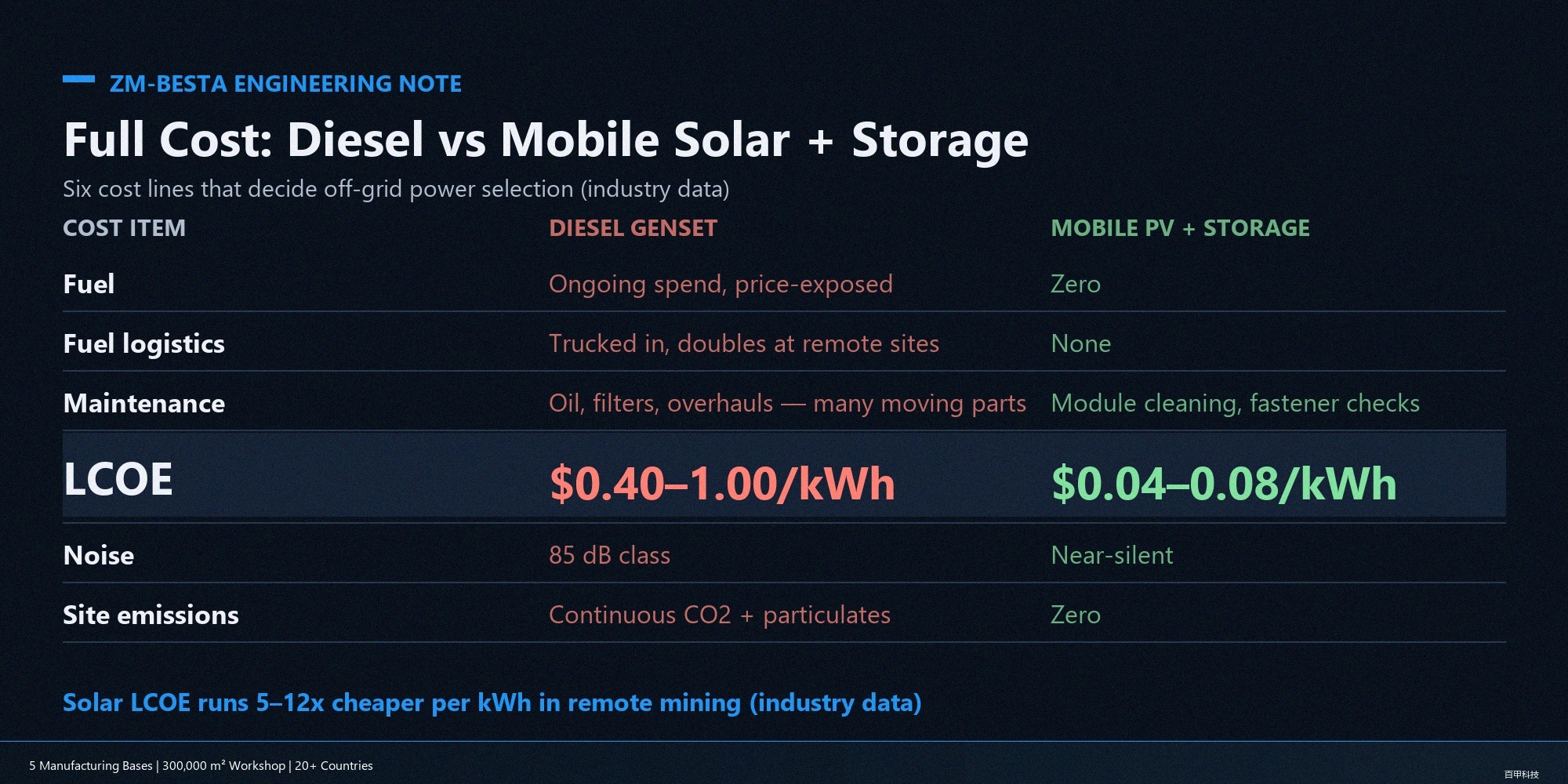
Cost Comparison: Diesel vs. Mobile Solar
| Cost item |
Diesel generation |
Mobile PV + storage |
| Fuel |
Ongoing expense; exposed to oil-price fluctuations |
Zero fuel cost |
| Fuel logistics |
Truck delivery; costs can double at remote sites |
None |
| Routine maintenance |
Oil changes, filter replacement, and overhauls; many moving parts |
PV module cleaning and fastener inspections |
| Cost per kWh |
$0.40–1.00/kWh |
$0.04–0.08/kWh |
| Noise |
Around 85 dB |
Nearly silent |
| On-site emissions |
Ongoing CO₂ emissions and particulate matter |
Zero on-site emissions |
The full cost per kWh of diesel power is 5–12 times that of mobile PV. At remote mining sites, diesel-generated electricity is estimated at $0.40–1.00/kWh, while the levelized cost of electricity (LCOE) for commercial and industrial distributed PV is approximately $0.04–0.08/kWh.
The Changing Role of Diesel Generators
Deploying mobile solar at a mine does not mean removing the diesel generator immediately. A more common approach is a solar-storage-diesel hybrid microgrid:
- During the day, PV supplies power first, and surplus electricity charges the battery storage system.
- At night, the battery storage system discharges.
- The diesel generator becomes a backup source and covers periods of extreme weather.
Diesel-generator operating hours can fall by 60–80%, reducing fuel and maintenance spending proportionally while maintaining power-supply reliability.
How to Calculate the Payback Period
A simple payback estimate based on a typical mining-site load:
- Initial investment:The cost of a mobile solar power plant (including storage) varies by capacity and storage configuration. Publicly available industry quotations cover a wide range, so a project-specific quote based on the load profile is required.
- Daily savings:Cost per kWh of diesel-generated electricity displaced × amount of electricity replaced.
- Simple payback period: Industry estimates commonly fall in the 3–5 yearrange for remote mining sites. The more expensive the diesel and the longer the haul distance, the shorter the payback period.
- Equipment lifetime:25 years for the PV system. After the payback period, each kWh generated delivers a net benefit.
The higher the mine’s electricity cost, the more favorable the economics of PV. At sites where diesel-generated power costs more than $0.60/kWh, the payback period often moves toward the 3-year mark.
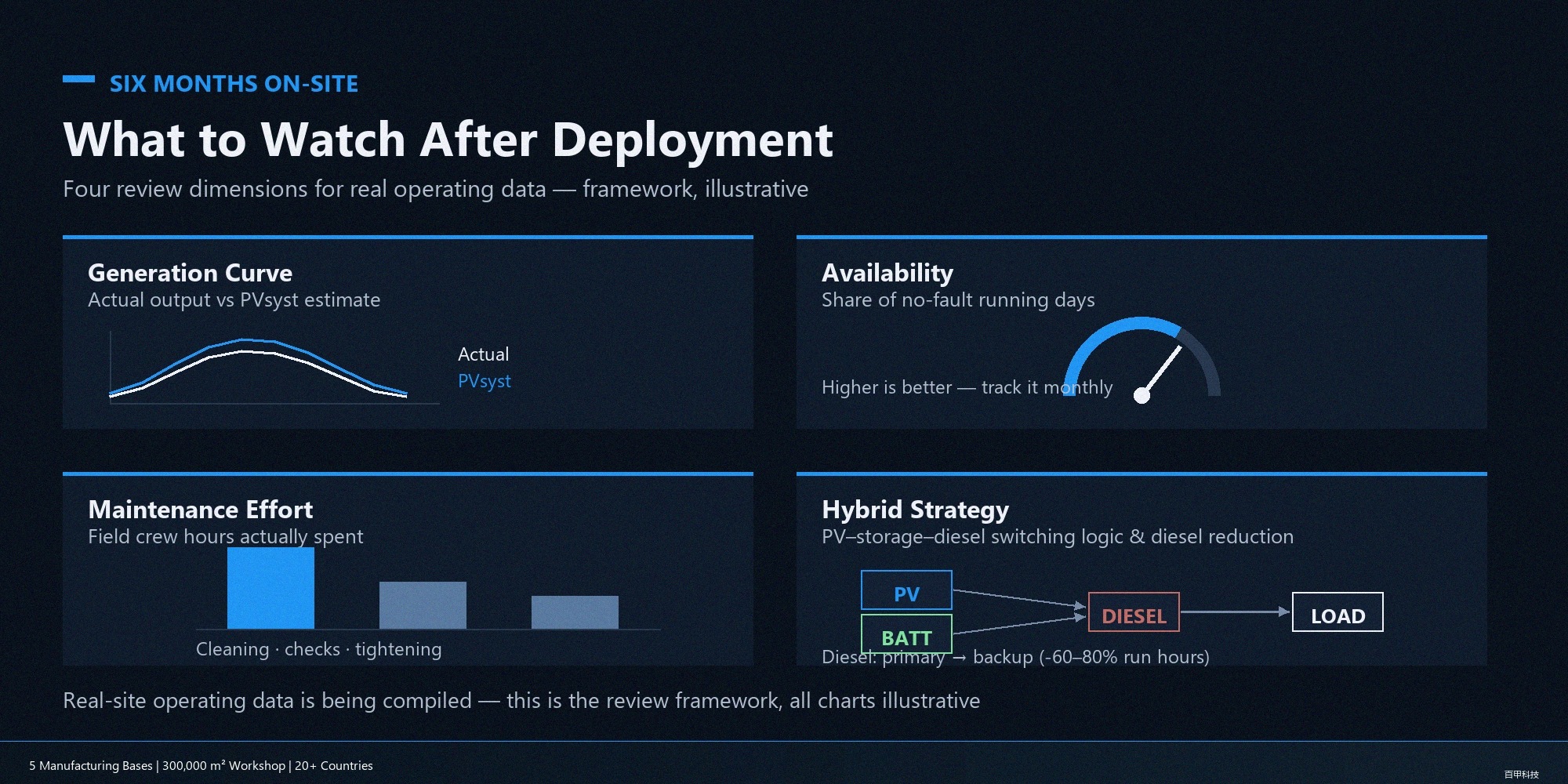
What to Assess During Six Months of Real-World Operation
Beyond the specification sheet, mining customers care most about actual performance once the equipment is running. When reviewing six months of operating data, we recommend assessing four dimensions:
| Dimension |
What to assess |
| Generation curve |
Deviation between actual output and PVsyst’s theoretical estimate |
| Availability |
Share of days operating without faults |
| Maintenance workload |
Actual labor hours required of on-site personnel |
| Hybrid strategy |
Actual switching logic between PV, storage, and diesel, plus the resulting reduction in diesel use |
Frequently Asked Questions
Q1: How is a mobile solar power plant transported to a mine?
The system ships in a standard container using conventional container freight. Models rated at 20–75 kW use 20-foot or 40-foot containers; 150–200 kW models use a 40-foot frame. The unit is lifted into position on site, with no concrete foundation required.
Q2: Can dust and high temperatures affect power generation?
The operating temperature range is -20°C to +50°C. Dust can reduce PV module output, so a cleaning and maintenance plan is recommended; the frequency depends on local dust levels. High-altitude sites with strong solar irradiance generally generate more power than under standard conditions.
Q3: What happens on rainy or overcast days?
Storage is sized according to the load profile. LFP batteries can supply power overnight and bridge short cloudy periods. During prolonged severe weather, the diesel generator provides backup, with switching managed automatically by the microgrid control strategy.
Q4: How do I choose between 20 kW and 200 kW?
Match the system to the daily load profile and peak power demand. Smaller-capacity models suit camps and monitoring loads; multiple units in parallel or larger-capacity models can support auxiliary mining equipment and medium-sized processing lines. Send us your load profile, and we can configure a suitable solution.
Planning a power solution for a mining project? Send us your load profile and site location. Email: info@xzbesta.com