Central Asia’s energy transition is not a new topic. Over the past two years, however, the conversation has shifted from “planning” to “tendering.”
In the first half of 2026, the five Central Asian countries tendered a combined 8.7 GW of solar PV and energy storage projects, representing a year-on-year increase of 127%. The total is expected to exceed 15 GW for the full year. Five years ago, few would have believed the market could reach this scale.
This article breaks down the transition roadmap into three key areas: installed capacity and targets, the real bottlenecks in grid infrastructure and power balancing, and the underestimated off-grid mining market.
Installed Capacity and Targets: The Numbers First
Installed Capacity as of Early 2026
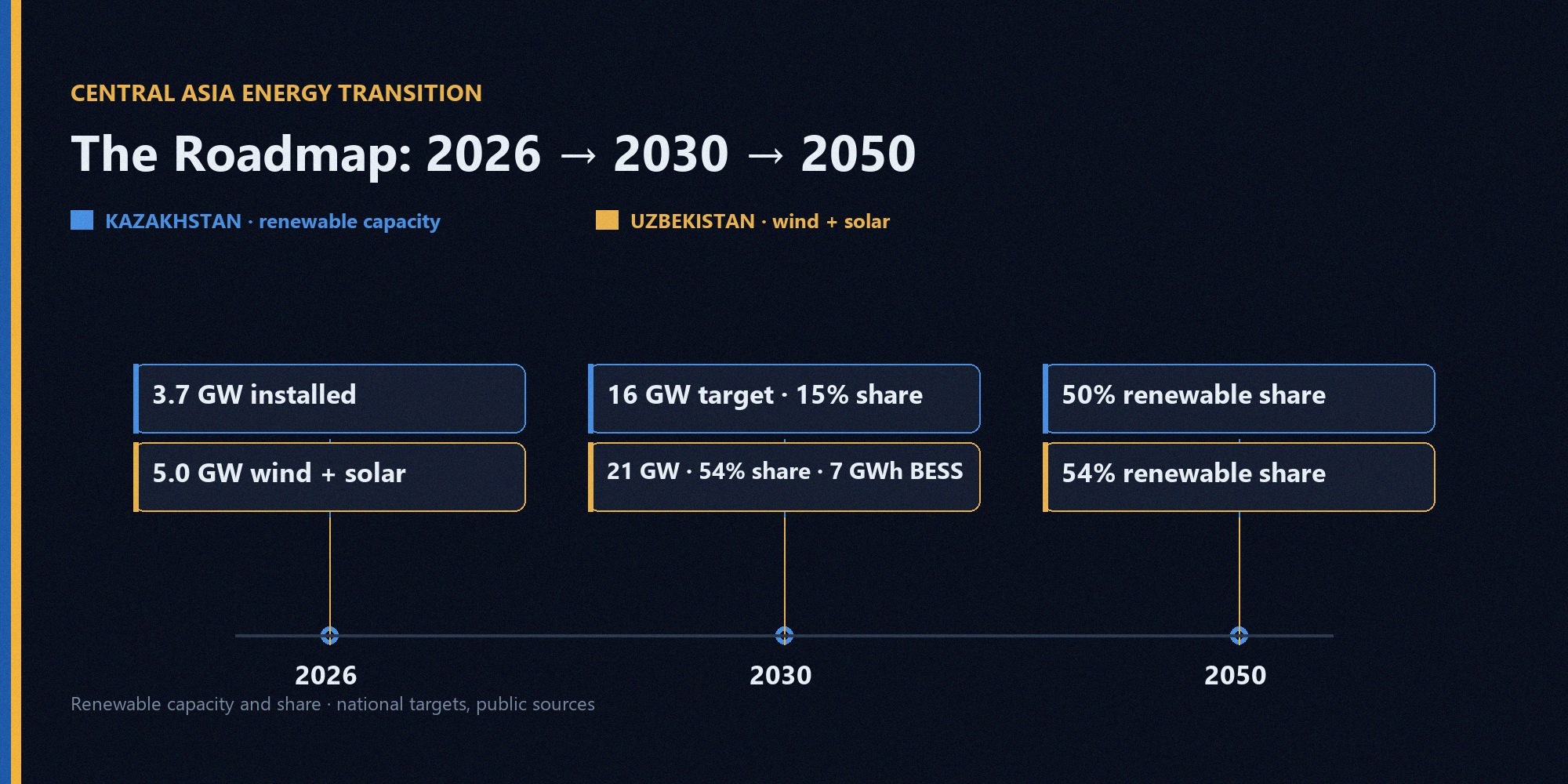
As of January 1, 2026, Kazakhstan had approximately 3,746 MW of installed renewable energy capacity, including 1,353 MW of solar PV and 2,071 MW of wind power.
During the same period, Uzbekistan had 3,347 MW of solar PV, 1,652 MW of wind power, and 897 MW of battery energy storage capacity.
| Country | Solar PV Capacity (MW) | Wind Power Capacity (MW) | Energy Storage (MW / MWh) | 2030 Target |
| Kazakhstan | 1,353 | 2,071 | — | Approximately 16 GW of renewable energy capacity, accounting for 15% of the energy mix |
| Uzbekistan | 3,347 | 1,652 | 897 | 8.64 GW of solar PV, 17 GW of wind power, and 7 GWh of energy storage |
| Kyrgyzstan | 250 (planned capacity under development) | — | — | An additional 3–4 GW over the next 2–3 years |
| Tajikistan | 250 (scheduled to come online by year-end) | — | — | Hydropower remains the primary focus |
Targets Are Far More Ambitious Than Current Capacity
Kazakhstan plans to bring approximately 16 GW of renewable energy capacity online by 2030, targeting a 15% share of renewable energy. The target rises to 50% by 2050.
Uzbekistan has even more ambitious goals. By 2030, it aims to reach 8.64 GW of solar PV and 17 GW of wind power, with a combined solar and wind capacity of approximately 21 GW and a target renewable electricity share of 54%.
According to public statements by the Uzbek government, achieving the 2030 targets could save approximately 18 billion cubic meters of natural gas annually and reduce emissions by around 25 million tonnes per year.
Increasing capacity from 3 GW to 21 GW means a sevenfold expansion. This growth cannot simply be added to the existing grid; transmission infrastructure and power-balancing capabilities must also be upgraded.
The Reality of Central Asia’s Power Structure
High Thermal Power Dependence and Limited Flexibility
The Central Asian Power System (CAPS) relies primarily on thermal power and hydropower. Coal-fired generation has historically accounted for more than 60% of Kazakhstan’s electricity mix, while Uzbekistan relies heavily on natural gas-fired power generation.
Thermal power plants provide strong baseload capacity but generally respond more slowly to rapid changes in electricity demand and supply. As large volumes of wind and solar power enter the grid, the system needs faster ramping and balancing capabilities — precisely where the existing power structure faces its greatest challenges.
Aging Grid Infrastructure and Summer Power Shortages
Much of Central Asia’s transmission and distribution infrastructure was built during the Soviet era. Aging equipment and transmission losses remain widespread problems. During summer heatwaves, air-conditioning demand combines with agricultural irrigation loads, and several regions have experienced electricity restrictions.
This helps explain why energy storage procurement has suddenly become more important. The driver is not simply compliance with government policies. Without adequate storage, integrating large-scale wind and solar projects into the power system becomes much more difficult.
Changes in the Renewable Energy Tender Market
A Sharp Increase in Project Scale
In the first half of 2026, the five Central Asian countries tendered 8.7 GW of solar PV and energy storage projects, representing a year-on-year increase of 127%.
By country, Kazakhstan independently tendered three integrated solar-plus-storage projects in the second quarter of 2026, with a combined capacity of 2.3 GW and more than 900 MWh of supporting energy storage. Uzbekistan’s Ministry of Energy announced a procurement pipeline covering 3.1 GW of capacity for 2026–2027.
Energy Storage Is Becoming Standard Rather Than Optional
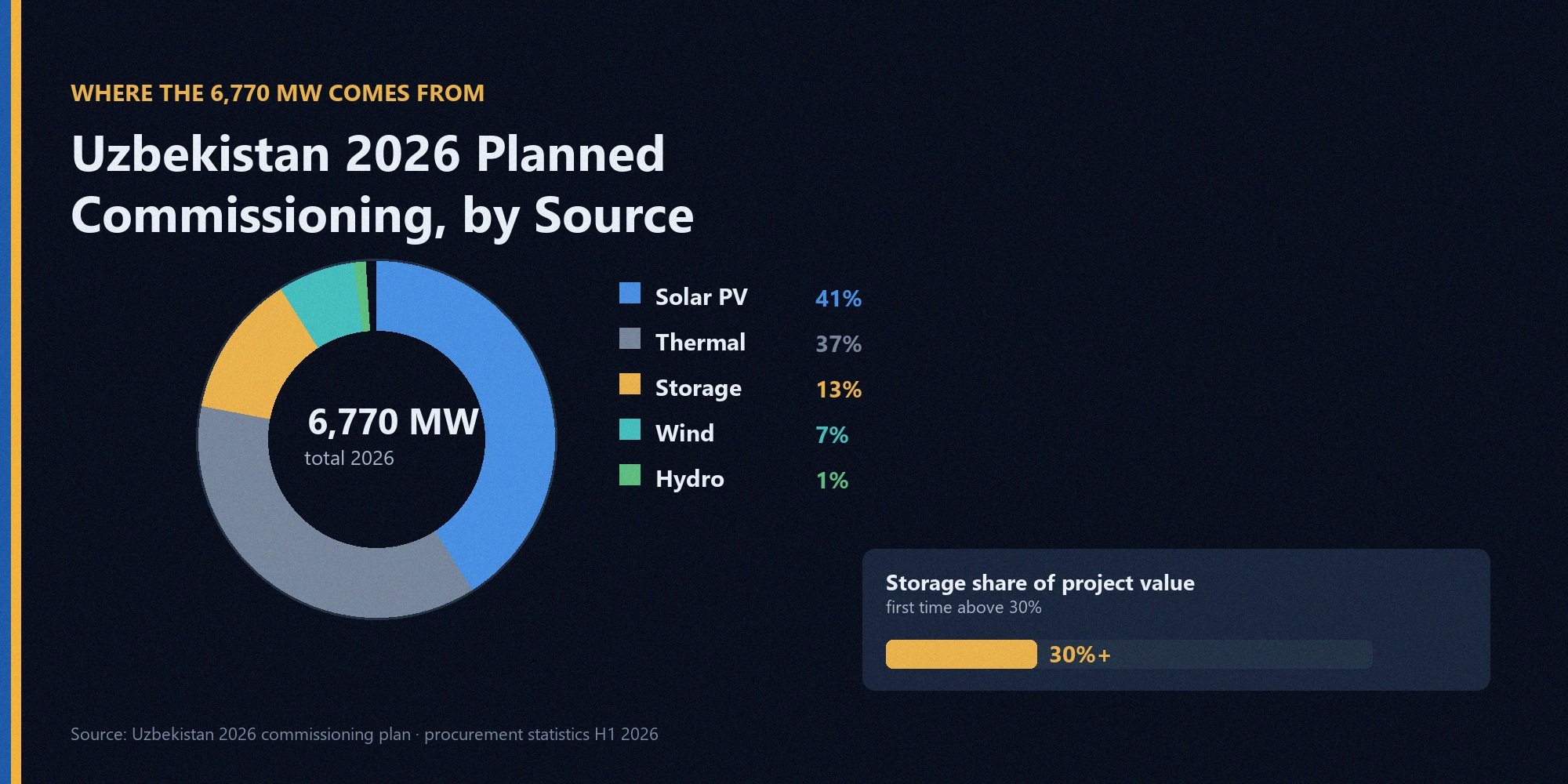
One key change is that energy storage procurement costs have exceeded 30% of total project value for the first time.
| Planned Capacity to Come Online in Uzbekistan in 2026 | Capacity (MW) | Share |
| Solar PV | 2,800 | 41% |
| Thermal Power | 2,500 | 37% |
| Wind Power | 470 | 7% |
| Hydropower | 68 | 1% |
| Energy Storage | 884 | 13% |
| Total | 6,770 | 100% |
Integrated solar-plus-storage solutions are becoming standard across the region. For equipment suppliers, this means the market opportunity for selling PV modules alone is narrowing. Suppliers capable of delivering a complete solution — PV modules + energy storage + supporting structures + grid integration — are increasingly well positioned.
Mining Operations and Off-Grid Power: An Underestimated Market
Central Asia has numerous mining operations located at the edges of the power grid, with some operating entirely off-grid. These sites share three key characteristics:
- Continuous operation:Mining and mineral-processing equipment often runs 24 hours a day, creating relatively stable electricity demand.
- High reliability requirements:Power outages can directly result in production losses.
- Heavy dependence on diesel:Off-grid mines commonly rely on diesel generator sets, while fuel transportation and logistics account for a significant share of operating costs.
Economics Matter More Than Environmental Benefits
For mining operations, the main driver for adopting solar PV is not carbon reduction — it is the levelized cost of electricity.
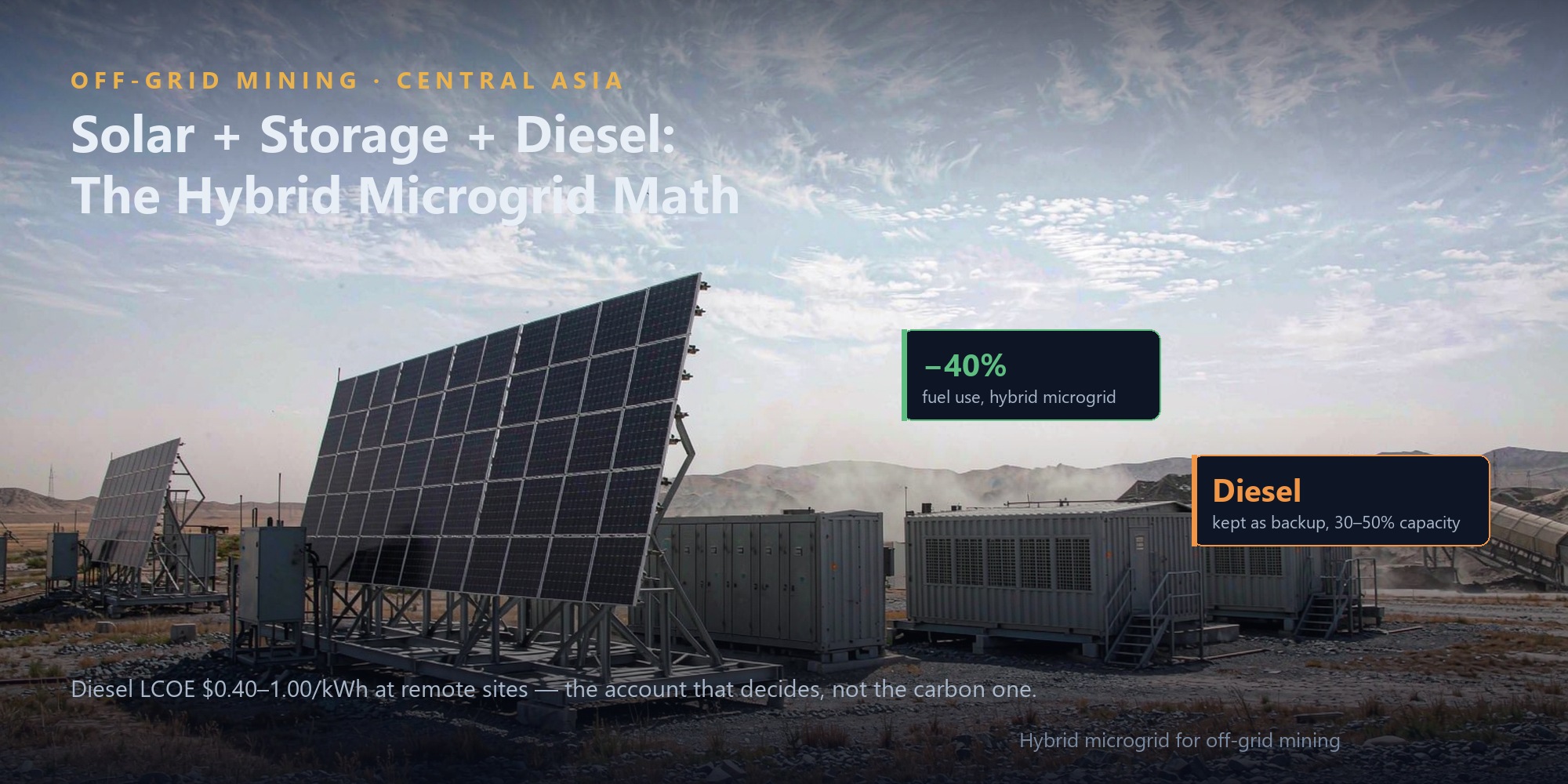
At remote mines located more than 200 km from the nearest grid connection, the total cost of diesel-generated electricity can range from $0.40 to $1.00/kWh. For mines closer to the grid, the cost may range from $0.12 to $0.20/kWh. When diesel generators operate at low loads, fuel waste can reach 20%–40%.
Combining solar PV and energy storage with existing diesel generators in a hybrid microgrid can reduce fuel consumption by approximately 40%. If the economics work, the project has a strong commercial incentive to move forward.
Central Asia’s extreme winter temperatures introduce another critical factor for mining projects. Equipment must be capable of starting and operating reliably below −20°C, making low-temperature performance an essential selection criterion.
Opportunities and Challenges for Chinese Companies
The Opportunity Is Not Just About PV Module Prices
Chinese PV module exports to Central Asia increased by 180% year on year in the first half of 2026. Module prices have become highly transparent, leaving limited room for differentiation through price competition alone.
The real competitive advantages lie in delivery capabilities:
- Can the design team produce drawings in compliance with local standards, including European, Russian, or national codes?
- Can structural components be shipped in full according to the project schedule, minimizing on-site delays?
- Can on-site installation be completed without relying heavily on highly skilled local technicians?
Three Practical Barriers to Market Entry
Barrier 1: Standards and Codes. Central Asian projects often require compliance with European standards (EN 1993 / EN 1090) or Russian standards (SNiP). Drawings and structural calculations must be adapted to the applicable code system. A design team’s ability to work across multiple standards can directly determine whether a company qualifies for a project.
Barrier 2: Logistics and Customs Clearance. Central Asian countries are landlocked. After arriving at a seaport, cargo may need to travel more than 2,000 km by land. Component dimensions and packaging must account for railway and road transportation restrictions.
Barrier 3: Construction Windows. Central Asia has long winters, and the effective construction season typically lasts only 6–8 months. Project schedules must account for this limitation rather than follow construction timelines commonly used in temperate regions.
Frequently Asked Questions
Q1: What are the main drivers of Central Asia’s solar PV market?
There are three main drivers: growing electricity demand, aging thermal power infrastructure and summer electricity shortages, and clearly defined government capacity targets and tax incentives. Uzbekistan’s electricity consumption is projected to reach 123 billion kWh by 2035. Renewable energy projects in Uzbekistan may also qualify for exemptions from property tax and land tax for 10 years.
Q2: Why is energy storage becoming so important in Central Asia?
As the share of wind and solar power increases, the grid needs more rapid-response balancing capacity. Energy storage procurement exceeding 30% of total project value signals a shift from an optional add-on to a key component of grid integration.
Q3: What is a suitable power solution for off-grid mining projects?
A hybrid microgrid combining solar PV, energy storage, and existing diesel generators retained as backup is a practical option. This configuration can reduce fuel consumption by approximately 40% and potentially reduce the required diesel generator capacity to 30%–50% of the original level. The key is a control system capable of smooth transitions between power sources.
Q4: Who are the main competitors of Chinese companies in the local market?
The main competitors include European, Turkish, and South Korean companies, as well as local engineering firms. Chinese companies benefit from integrated supply chains and fast delivery, but may face challenges related to localized services and familiarity with local standards.
Q5: What certifications are required to enter the Central Asian market?
For steel structures, projects commonly require EN 1090 (CE marking) and management system certifications such as ISO 9001, ISO 14001, and ISO 45001. PV modules generally require IEC 61215 and IEC 61730 compliance. Some projects also require third-party factory audits, such as those conducted by SGS or BV.
Have questions about energy projects in Central Asia? Contact us at info@xzbesta.com