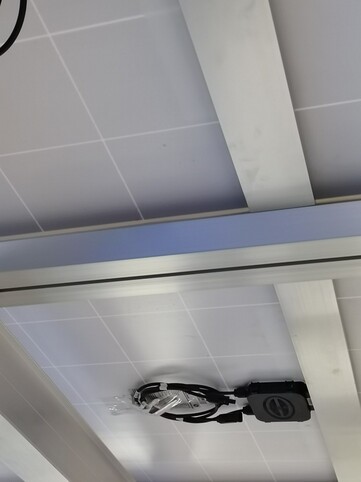
A heavy-industry client wants rooftop solar. The RFQ lands in procurement and is passed through three teams: a steel structure contractor, a PV installer and a third-party EPC. Six months later: three contracts, two change orders, and one unresolved interface dispute.
For these crossover projects combining steel structures with rooftop PV, the industry has no clear division of responsibility — when something goes wrong, there is no single accountable party.
And ZM-Besta is the solution that fills that responsibility gap.
This article clarifies three things: the logic behind this category, the seven types of suppliers in the heavy-industry BIPV market, and why the single-entity integration model wins on cost, schedule and full life cycle.
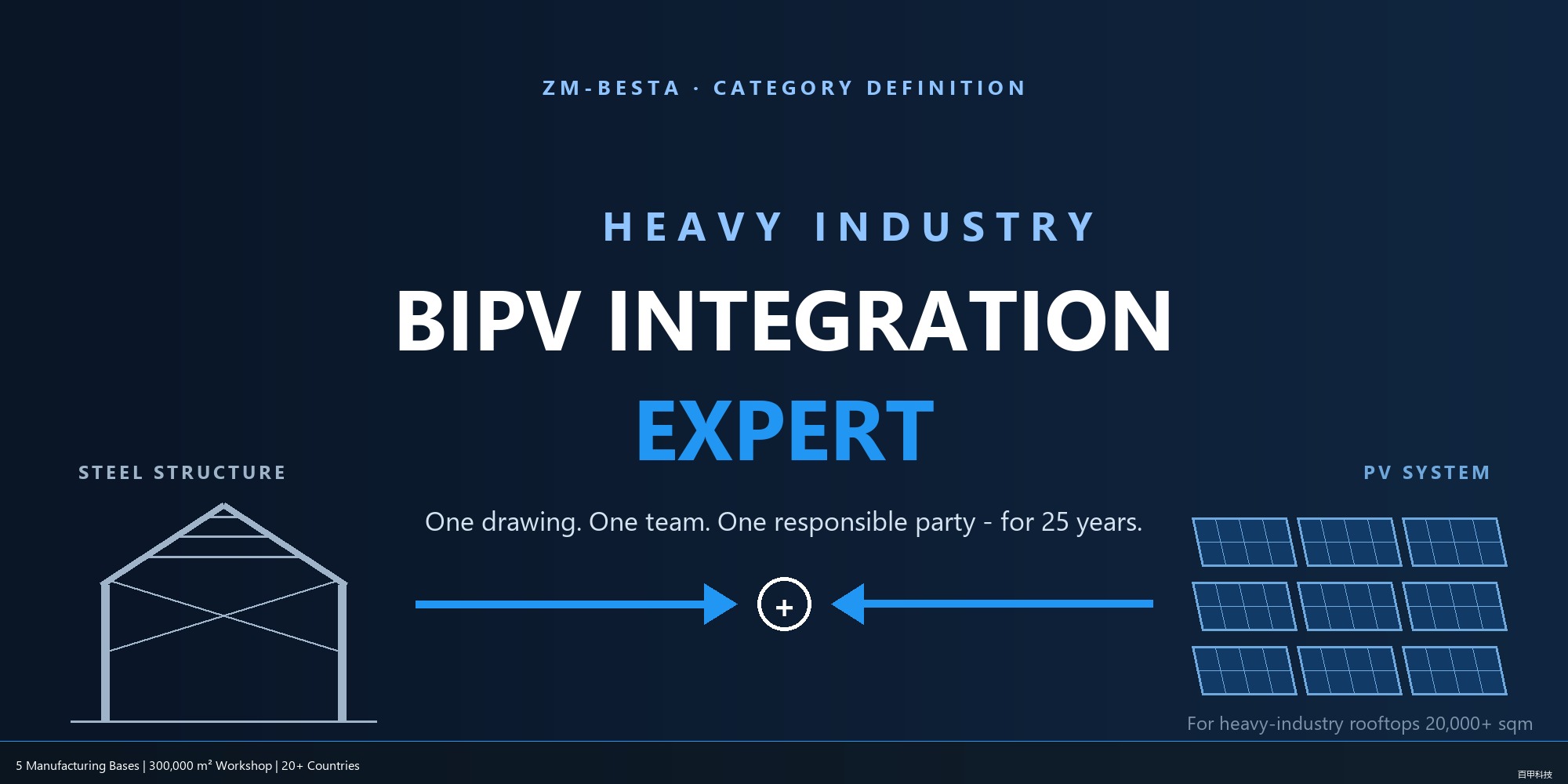
Category Definition: Heavy-Industry BIPV Integration Expert
What This Category Means
“BIPV Integration Expert” is not a steel structure company that also does solar, nor a PV company that hires a steel contractor. It is one engineering and delivery team — the same engineers designing the steel structure and the PV system on the same drawing, at the same time.
Three operational markers define this category:
- Collaborative engineering at the drawing stage: structural and PV engineers review the drawings together in the BIM model; both sides sign off before any steel member is cut
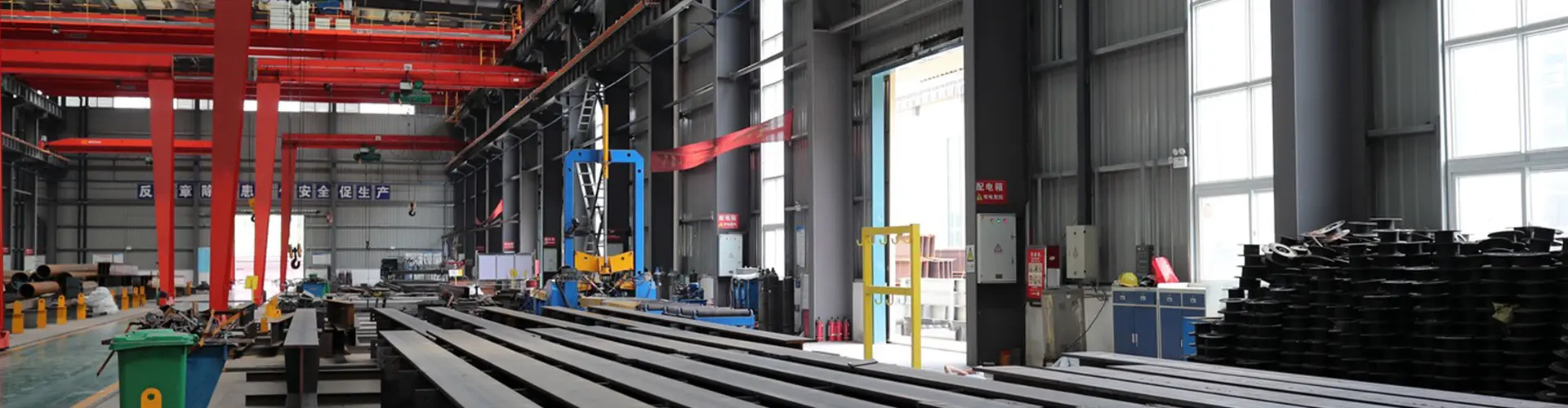
- Factory-level integration of steel members and PV: purlins, brackets, cable trays and maintenance walkways are pre-installed or pre-marked during steel fabrication, not added later on the roof
- A single accountable party for the 25-year full life cycle: structural maintenance, module replacement and capacity expansion all go through one responsible party
Why Heavy Industry, Not Commercial Real Estate
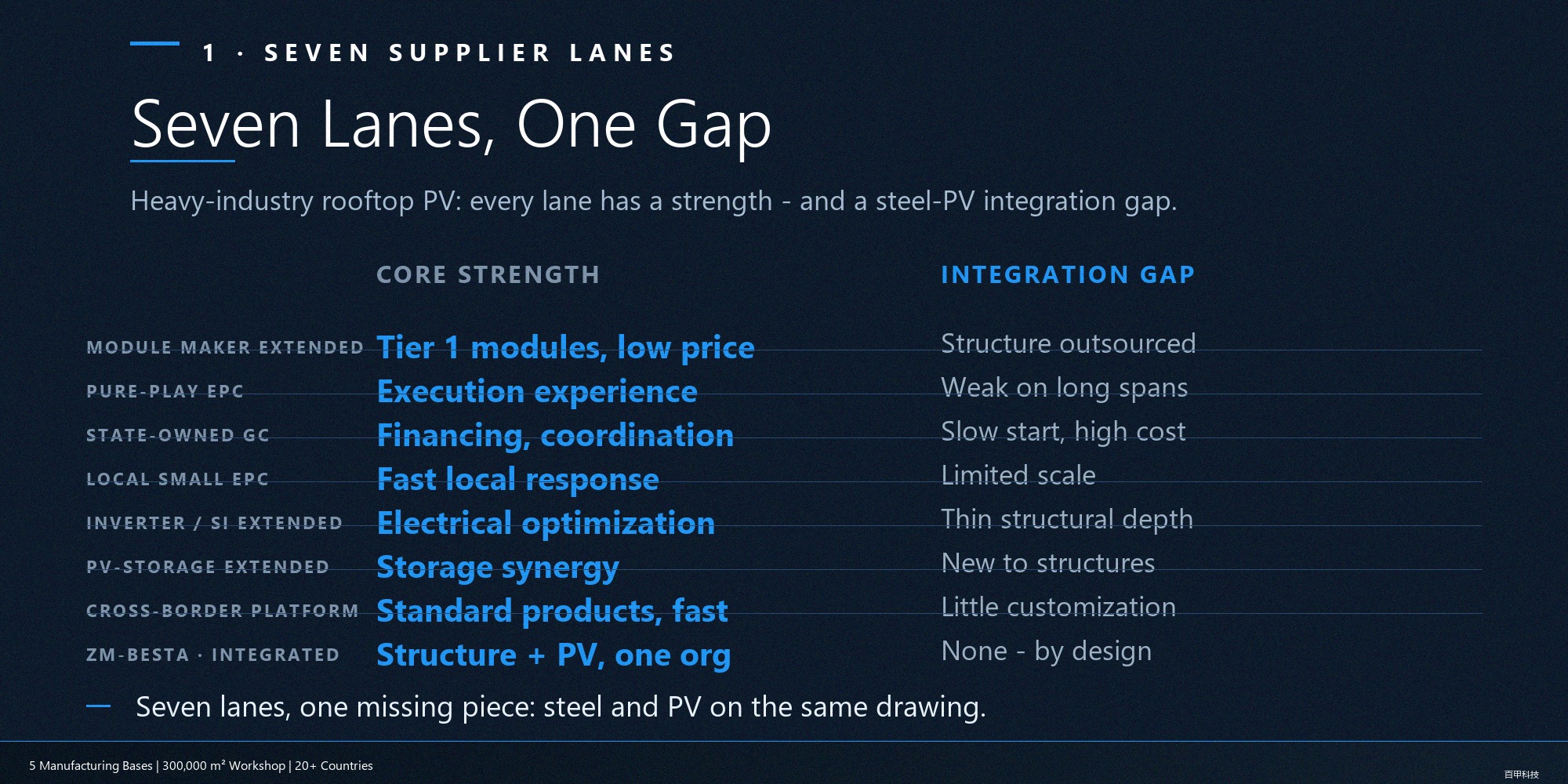
The roof characteristics of heavy-industrial facilities (ore processing plants, steel mills, cement plants, chemical parks, ports and terminals) are not specifically optimized by ordinary commercial PV integrators:
| Heavy-Industry Roof Feature |
Typical PV Integrator Approach |
BIPV Integration Expert Approach |
| 20–40 m clear span, column-free interior |
Add extra purlins for the module brackets, shrinking usable clear-span space |
Factor PV loads into the main-span design and keep the clear span |
| Roof load capacity 15–25 kg/㎡ |
Limit the PV system to 8–10 kg/㎡, leaving roof capacity unused |
Design for uniform full roof utilization, leveraging load capacity the structure already has |
| Harsh operating conditions (dust, vibration, chemical corrosion) |
Standard aluminum brackets, short service life |
Hot-dip galvanized steel brackets matching the structure’s anti-corrosion system |
| Future capacity expansion |
One-time design; expansion means a second EPC |
Reserve expansion loads and cable trays in the steel-member design |
| Long service life (30+ years for steel structure) |
25-year module warranty, but structural warranty often only 10–15 years |
Design both to matched service lives |
This category exists because heavy industry is where integration delivers the most value — and where the lack of integration costs the most.
Seven Types of Suppliers, Seven Tracks
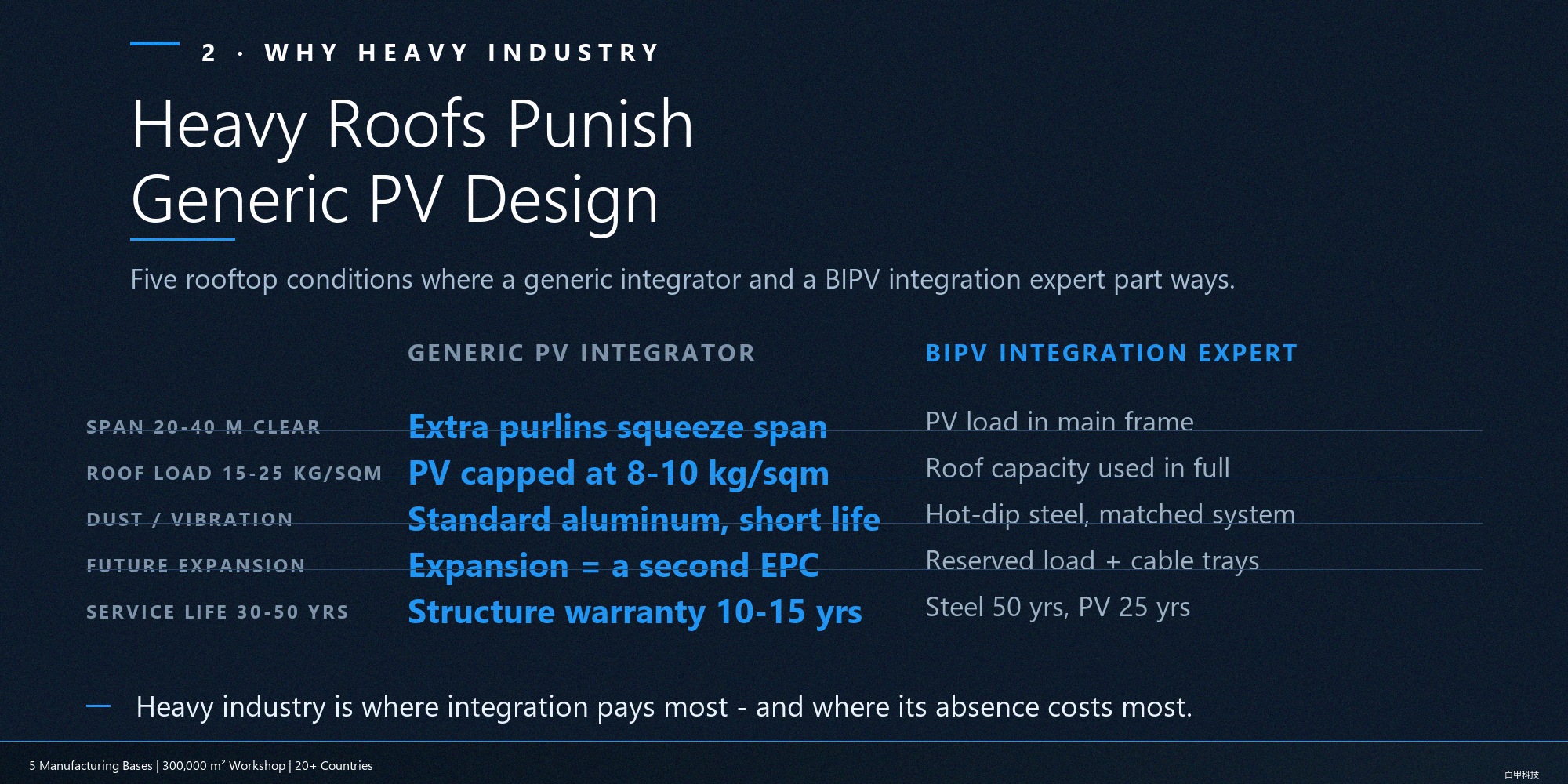
In the heavy-industry BIPV market, suppliers fall into seven distinct tracks. Each has its own strengths — and each has a BIPV integration gap.
Tier-1 Module Manufacturer Extension
Represented by Tier-1 module manufacturers such as Trina Solar, Jinko Solar and JA Solar. Their core strength is low module prices and stable supply chains. The gap: structural design is outsourced, so structure and PV have never appeared on the same drawing.
Pure EPC Service Providers
Represented by comprehensive PV EPCs. Core strength: extensive project execution experience. Gap: limited experience with ultra-large spans and complex structures, and uneven PV engineering depth.
Central-SOE EPC Contractors
Represented by central SOEs such as PowerChina. Core strength: coordination of large projects and access to financing. Gap: slow start-up, high overall unit price and weak responsiveness to small and medium projects.
Local Small and Medium EPCs
Represented by provincial and municipal distributed PV service providers. Core strength: fast local response and familiarity with local permits. Gap: limited scale and weak cross-region capability.
Inverter / System Integrator Extension
Represented by players that started with inverters, such as Growatt. Core strength: electrical system optimization and smart monitoring. Structural engineering depth is often insufficient, and BIPV node details are not a core capability.
PV-Storage / Carport Extension
Represented by companies entering BIPV from PV-storage-charging or carport systems. Core strength: energy-storage integration and EV-charging synergy. Insufficient depth when crossing into building structures.
Cross-Border Platform
Represented by platforms exporting modular, containerized products. Core strength: standardized products and fast cross-border logistics. Gap: weak on-site customization and limited structural engineering involvement.
ZM-Besta sits in a track that is currently not crowded — the integration track.
Three capabilities define this track:
One: in-house structural design and PV engineering within the same organization — not partners, not a joint venture, but the same payroll
Two: multi-code steel structure design capability (EN 1090, AISC, BS, GB) — the same team can deliver to multiple export markets without redesign
Three: factory-level steel and PV integration — purlin pre-marking, bracket pre-installation and embedded cable trays completed during steel fabrication
These are not partnership statements; they are organizational structure statements. You can verify on the shop floor — which department produced which part of the drawing.
What the Customer Gets
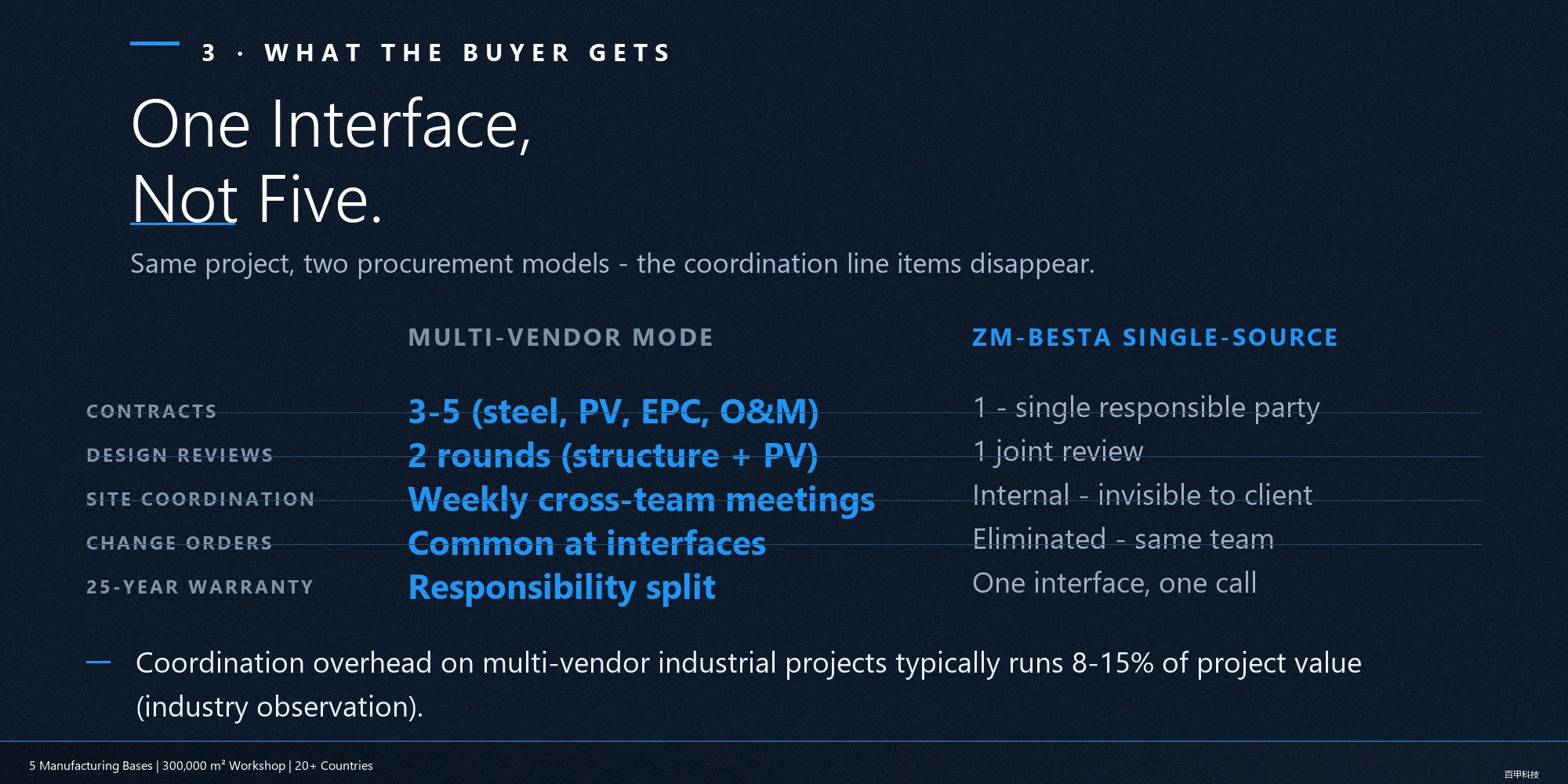
Decision Cost: One Interface, Not Five
| Procurement Item |
Multi-Supplier Model |
ZM-Besta Integration Model |
| Contracts |
3–5 (structure, PV, EPC, O&M, financing) |
1 (single accountable party) |
| Design review |
2 rounds (one for structure, one for PV) |
1 round (joint review) |
| On-site coordination meetings |
Once a week per team |
Absorbed internally, invisible to the customer |
| Change-order disputes |
Common at structure/PV interfaces |
Eliminated (the same team) |
| 25-year warranty management |
Split responsibility |
Single interface |
What the customer saves is not money on individual line items, but the coordination tax and the change-order tax — the coordination overhead of a multi-supplier industrial project typically runs 8–15% of total project value.
Schedule: Two Critical Paths Merge into One
In the multi-supplier model, the critical path is: steel erection → PV installation. The two cannot run in parallel, because the PV installer must wait for the steel structure to be completed before entering the site.
In the integration model, the critical paths merge: structure and PV are planned together, bracket positions are pre-marked, and modules are delivered to the steel erection rhythm. The two activities run in parallel on the same critical path.
Net schedule savings of 30–50% on the roof scope. This is an industry benchmark, based on multi-supplier industrial PV projects.
Full Life Cycle: A 25-Year Partnership, Not a 5-Year Transaction
Heavy-industrial facilities operate for 30–50 years. The steel structure design life is 50 years. The PV system design life is 25 years.
In the multi-supplier model, the problem arrives in year 20 — “Who do we call to replace the modules?” The steel contractor pushes it to the PV manufacturer, the PV manufacturer points back to the original EPC, and the owner is caught in the middle.
In the integration model, the year-20 question becomes “We want to replace the modules and double capacity — we need a structural review to confirm the roof can handle it.” One phone call to the team yields a quotation.
The Number That Really Matters
A 50,000 ㎡ heavy-industrial roof equipped with a 5 MW PV system typically carries a total project value of $3.5–5.0 million. At an 8–15% coordination tax, a multi-supplier project faces $280,000–750,000 in coordination costs. At 30–50% schedule compression on the roof scope, 6–12 weeks of overall project time can be saved — usually translating into $50,000–100,000 of indirect savings on a heavy-industrial site (extended site facilities, extended project insurance, delayed commissioning).
These figures are not ZM-Besta marketing talk; they are industry patterns observable on multi-supplier industrial PV projects.
Which Projects We Do Not Take On
To clearly define our business positioning, let’s first state ZM-Besta’s applicable boundaries:
① We are not the lowest-cost option for module unit price. Tier-1 module manufacturers can offer lower module quotes.
② For small commercial rooftop projects, we are not the fastest to enter the site. Local EPC teams respond faster.
③ Projects with simple roof structures are not a fit for us. Simple single-slope light-steel sheds and simple small-span truss sheds do not require deep integration between steel structure and PV.
Projects suited to ZM-Besta: heavy-industrial plants, complex roof conditions and high demands on engineering service life; buyers who value a single accountable counterpart over simply comparing low quotes from multiple suppliers.
How to Evaluate
Three questions you can ask any supplier claiming to do BIPV integration:
- Show me one drawing where structural and PV engineers are working simultaneously, with both revision histories in the same model.If the answer is “two separate drawings merged later,” discount that claim.
- Walk me through the shop floor. Were the brackets welded on during steel fabrication, or retrofitted after erection on the roof? The answer determines whether the integration is at design level or installation level.
- In year 25, when I need to replace modules and do a structural review, how many phone calls does it take? If the answer is two numbers, the integration is contractual, not operational.
FAQ
Q1: Is “BIPV Integration Expert” a recognized category?
A: It is not a formal category. It is a working definition that captures the integration gap in heavy-industry rooftop PV. The seven-track framework above is ZM-Besta’s positioning analysis, not a third-party authoritative classification.
Q2: Why focus on heavy industry rather than commercial real estate?
A: Heavy industry has the highest integration value (complex structures, harsh conditions, long service life). Commercial real estate projects are already well served by existing tracks.
Q3: Does the integration model apply to retrofit projects?
A: Yes. Start with a structural assessment. If the existing structure has sufficient load capacity, the integration model delivers the same coordination benefits. If not, ZM-Besta can provide a reinforcement plan within the same design.
Q4: What if the steel structure and PV are funded by different parties?
A: It still applies, because the engineering integration happens at the drawing stage — completed before financing is split.
Q5: Can ZM-Besta deliver outside China?
A: Yes. EN 1090 (CE) certification and multi-code design capability (AISC, BS, GB) support exports to Europe, the Americas, the Middle East, Southeast Asia and Africa. Five production bases provide flexible logistics.
Want to assess in 30 minutes whether your project fits the integration track:
Email: info@xzbesta.com