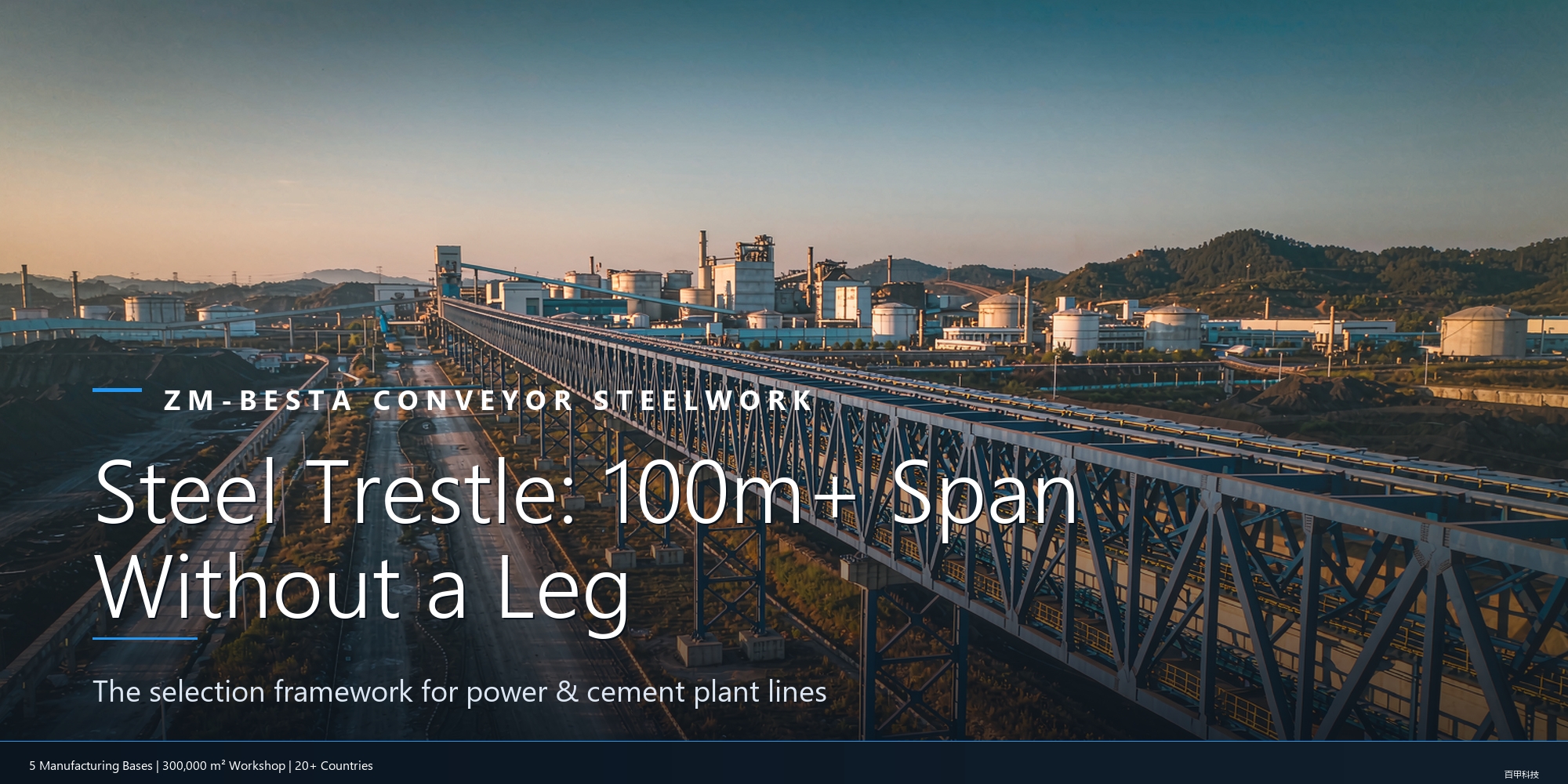
For coal handling at power plants and bulk material conveying at cement plants, how should a conveyor route spanning hundreds of meters be laid out: an overhead steel conveyor trestle or an underground conveyor gallery?
Many project teams initially favor an underground route because it keeps the site visually clear and seems simpler. But once civil works, maintenance access, and land use are considered together, the conclusion often changes. The longer the span and the more complex the terrain, the clearer the advantages of a steel structure conveyor trestle become.
This guide provides a practical framework for selecting a route, using delivered steel structures for coal handling systems as project references.
Three Hidden Costs of an Underground Conveyor Gallery
Earthworks and Underground Construction
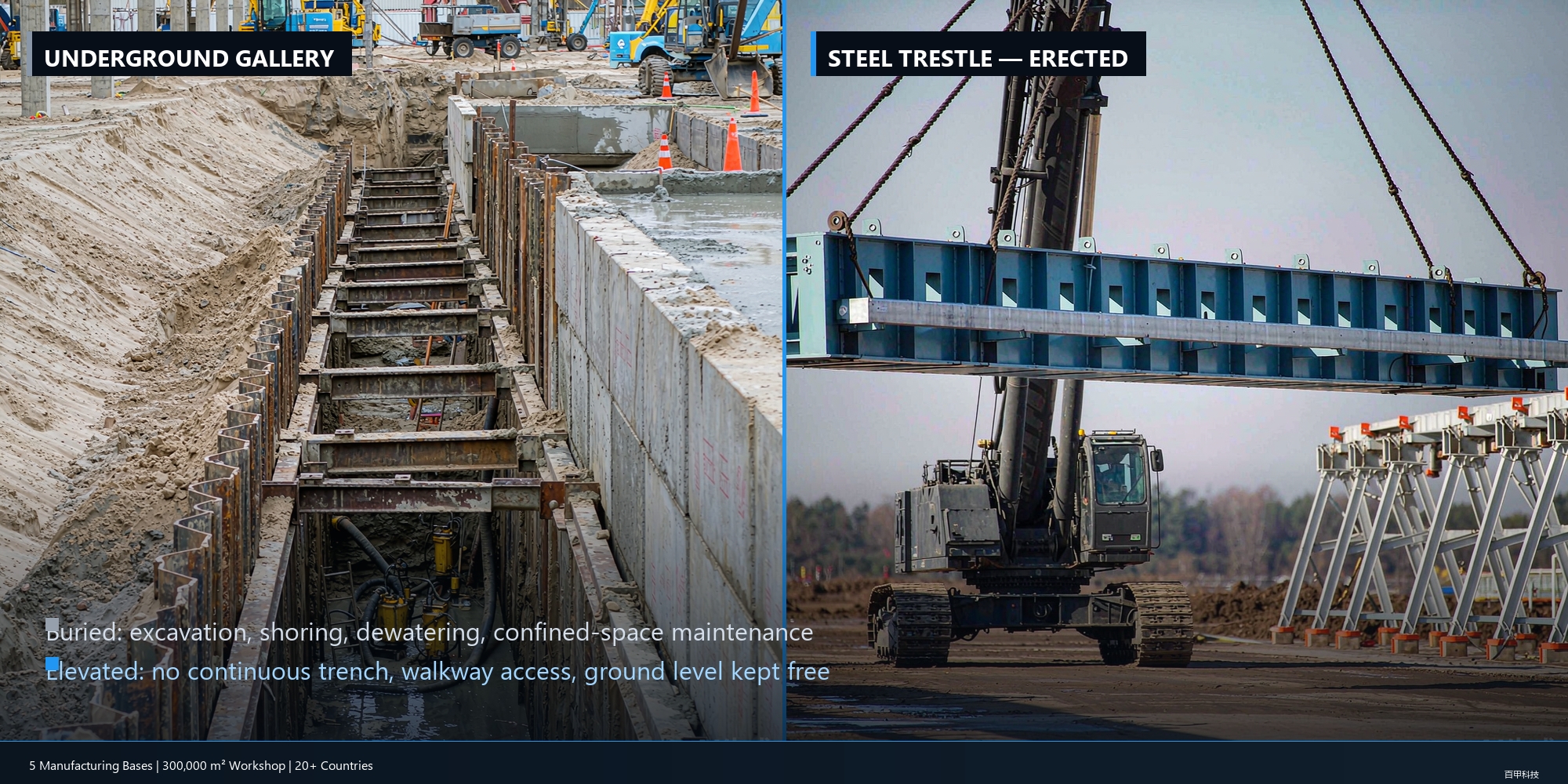
An underground conveyor gallery requires excavation, shoring, and backfilling. Where groundwater is present, dewatering and waterproofing measures are also needed. At plants with complex ground conditions, civil-work schedules and costs can be difficult to control. The rainy season further limits the available construction window.
Maintenance and Operations
When a belt conveyor is installed underground, the spacing of access openings is limited, and idler replacement and routine inspections require work below ground. The resulting safety costs and loss of maintenance efficiency over the system’s service life are often underestimated during the selection stage.
Permanent Use of Surface Space
The area above an underground gallery cannot be freely loaded, landscaped, or developed. In practice, this strip of land is permanently committed to the conveying system, reducing future flexibility in the plant layout.
The Structural Logic of an Overhead Steel Conveyor Trestle
Why Steel Structures Suit Elevated Conveyor Routes
Steel structures combine relatively low self-weight with high strength. An overhead conveyor trestle is supported on individual footings, avoiding the need for a continuously excavated trench. Steel trusses and space-frame structures are two common forms that can achieve long spans with fewer supports:
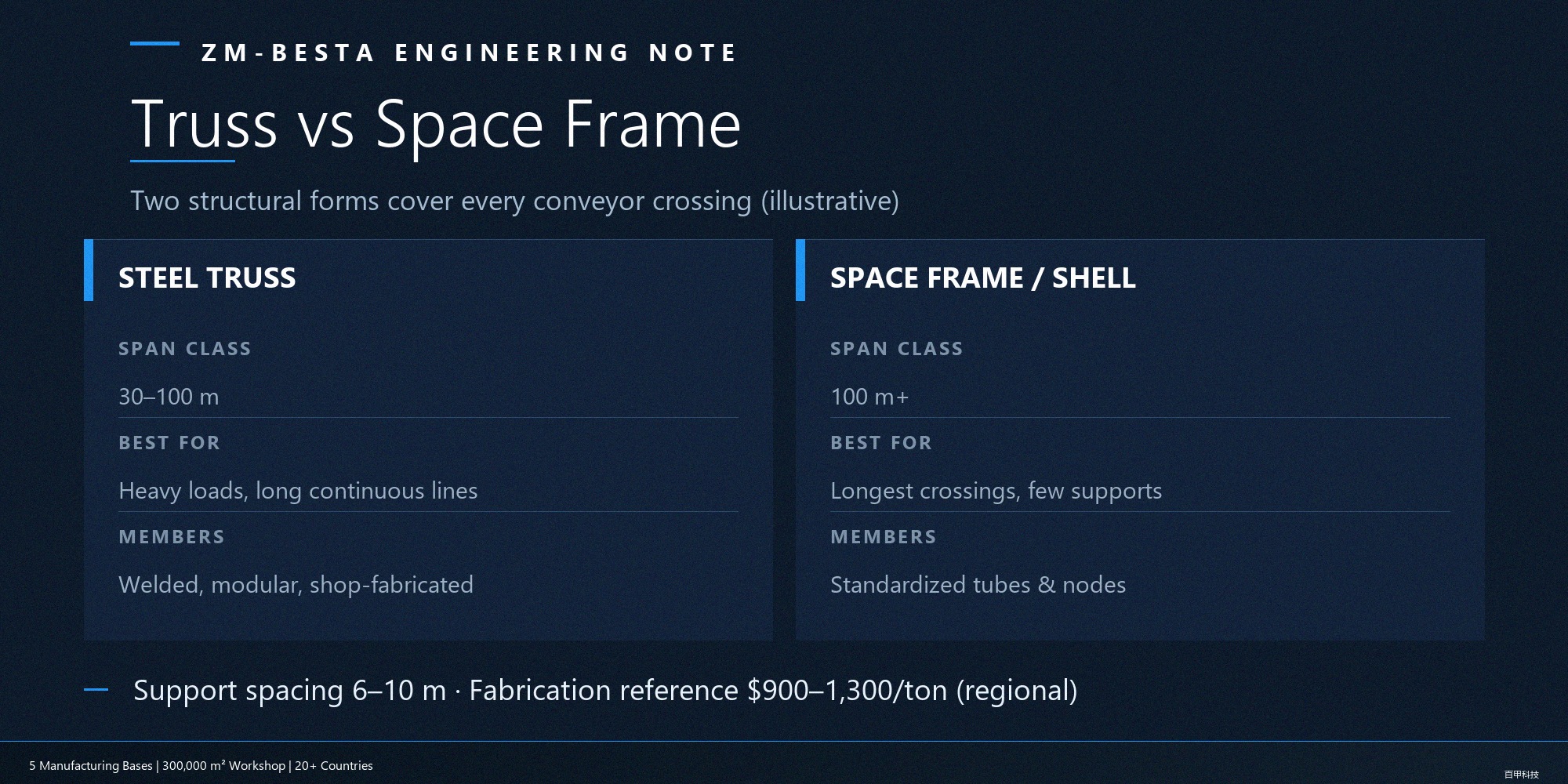
| Structural form | Typical span range | Key characteristics |
| Steel truss (planar or space truss) | Approx. 30–100 m | High stiffness; suitable for heavy loads and long, continuous routes |
| Space frame / lattice shell | 100 m and above | Excellent spanning capability; standardized members |
Support spacing for light steel conveyor trestles is generally 6–10 m. Members are designed using standardized modules, prefabricated in the workshop, then bolted together and lifted into place on site.
Shorter Schedules Through Factory Prefabrication
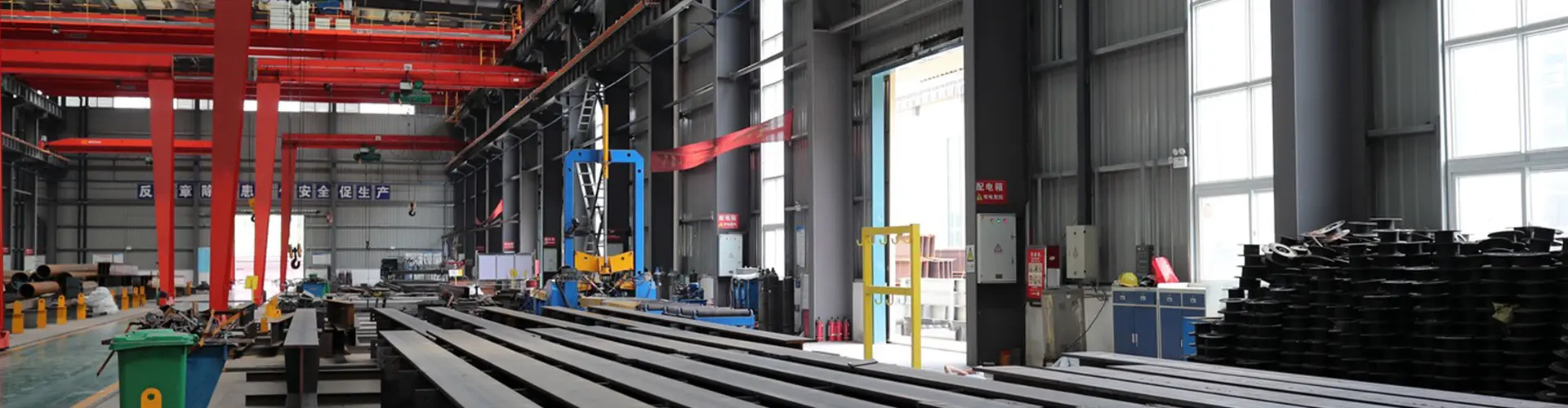
Steel members are welded and coated in the workshop, leaving lifting and connections as the main activities on site. This reduces exposure to rainy-season delays associated with earthworks, and installation can be completed significantly faster than an underground civil-work solution. ZM-Besta project reference: a lattice-shell structure for a circular coal yard with a diameter of 90 m was completed in a total of 3 months.
Corrosion Protection and Life-Cycle Cost
Overhead steel conveyor trestles can be protected by shop-applied coating systems or hot-dip galvanizing. In industrial atmospheric environments, a coating system can have a design service life of 15–25 years, with one maintenance recoating during that period. Although the concrete structure of an underground gallery does not rust, waterproofing deterioration and the cost of repairing water ingress still need to be considered.
Selection Framework: When to Choose an Overhead Steel Conveyor Trestle
Review the project conditions against the following criteria:
| Project condition | Recommended option | Reason |
| Route crosses roads, railways, rivers, or existing pipe racks | Overhead steel conveyor trestle | Often the only viable option; span capability is critical |
| Limited ground space; logistics routes must remain available | Overhead steel conveyor trestle | Keeps ground-level circulation routes available |
| High groundwater table, complex geology, or a long rainy season | Overhead steel conveyor trestle | Avoids much of the cost of excavation, dewatering, and shoring |
| Environmental requirements call for enclosed, dust-controlled conveying | Overhead trestle + enclosed gallery | An enclosed steel space-frame gallery combines long-span crossing with containment |
| Flat terrain, no crossings, and no planned use of the surface area | Compare with an underground gallery | An underground option may be competitive on civil-work cost in this situation |
One guiding principle: the more crossings a route has and the longer its spans, the stronger the total-cost advantage of a steel conveyor trestle tends to be. The direct cost per meter of an underground gallery may be lower, but once civil works, schedule, maintenance, and land use are included, an overhead solution is often more competitive for long-span routes.
References from Delivered Projects
Long-span conveyor trestles and steel structures for coal handling systems are a specialty product line of Xuzhou ZM-Besta, covering the full chain from design and fabrication to supply and installation. Delivered projects include:
| Project | Structural parameters | Delivery scope |
| Coal handling system for a 2 × 350 MW combined heat and power project in Turpan | Total length: 145 m; span: 107 m | EPC: space-frame design, procurement, fabrication, and installation |
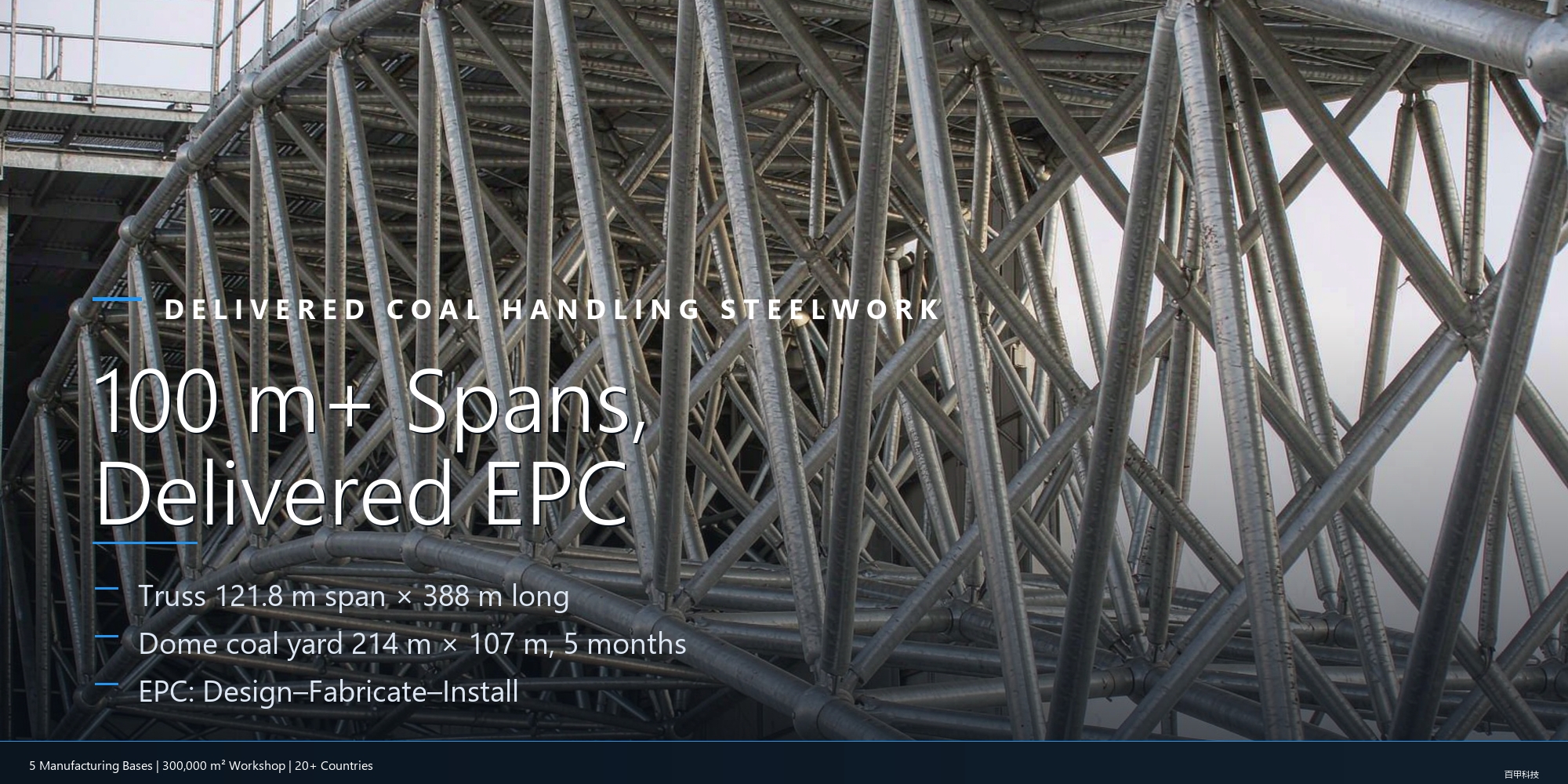
| Coal-handling space frame for a power plant with 2 × 1,000 MW units | Span: 121.8 m; length: 388 m | Design, fabrication, supply, and installation |
| Coal-yard space frame at a thermal power plant | Coal-yard length: 214 m; span: 107 m | EPC delivery; 5-month schedule |
| Comprehensive coal-gas utilization project at a coking plant | Conveyor trestles, pipe racks, and equipment steel structures | Fabrication |
Founded in 2006, Xuzhou ZM-Besta is listed on the Beijing Stock Exchange (stock code: 920057) and ranks among China’s Top 50 competitive companies in the building steel-structure industry. The company operates five production bases with 300,000 m² of factory space, holds Class A special-grade qualification for light-steel-structure engineering design, special-grade qualification for steel-structure manufacturing, and Grade I qualification for general contracting of construction works. It also provides overseas clients with design services in accordance with European standards, including EN 1090, and other national codes.
Frequently Asked Questions
Q1: What is the maximum span of a steel conveyor trestle?
Pipe trusses commonly cover spans in the 30–100 m range, while space-frame and lattice-shell structures can span more than 100 m. The actual span depends on loads, wind-induced vibration, and support arrangement, and must be verified through project-specific engineering calculations.
Q2: How much does a steel trestle cost compared with an underground conveyor gallery?
There is no universal figure for the direct cost per meter because it varies by location and project conditions. During selection, compare life-cycle costs by including earthworks and underground construction, schedule costs, maintenance and operations, and the land occupied. Overhead solutions are often advantageous on routes with many crossings and long spans.
Q3: How is a steel trestle protected against corrosion, and how often does it need maintenance?
Common options include shop-applied coating systems suited to C2–C4 industrial atmospheric environments or hot-dip galvanizing. The design service life of the coating can be 15–25 years, with one maintenance recoating during that period. For coastal projects, a higher corrosion-protection level and shorter inspection intervals are recommended.
Q4: Which design standards can be used for overseas projects?
Projects can be designed in accordance with the relevant Eurocodes and EN 1090 requirements, or coordinated with the codes applicable in the destination country. Available design software includes PKPM, 3D3S, MIDAS, and STAAD.Pro.
Evaluating a power plant, cement plant, or chemical industry project? Send us your conveyor route parameters for an initial assessment. Email: info@xzbesta.com