When deciding whether to enclose a coal storage yard, project owners often get stuck between two extremes: “An environmental inspection is coming, so we need to cover it first,” or “The investment is too high, so we should wait.”
Both approaches overlook the same essential tool: a comprehensive cost comparison. Put coal losses, calorific value, moisture, dust-control operating costs and land use into one calculation, then convert them into a cost per tonne of coal handled annually. The answer is usually clearer than intuition alone.
What Does an Open Coal Stockpile Lose Every Year?
Coal Quantity Losses
Coal quantity losses at open storage yards generally come from three sources: fine particles carried away by wind, pulverized coal washed away by heavy rain, and deterioration caused by oxidation during prolonged storage.
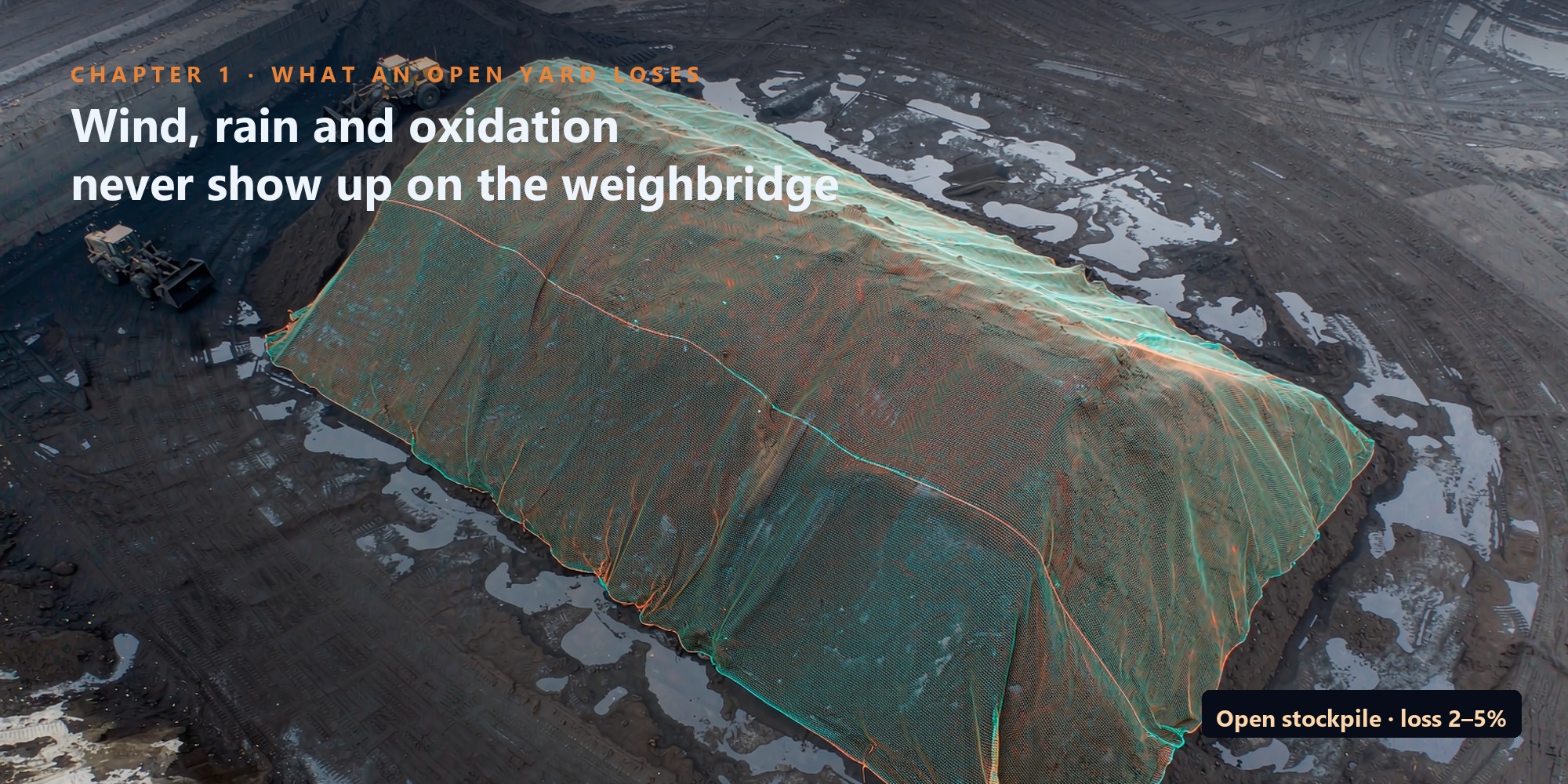
Published industry measurements vary considerably depending on the measurement method. Some coal preparation plant enclosure retrofit cases report coal losses of approximately 0.5%, but this figure accounts only for measurement differences during loading, unloading and internal handling. When weathering, oxidation and calorific value deterioration are also considered, the overall loss rate is typically estimated at 2%–5%.
For preliminary calculations, a mid-range assumption of 1%–3% is recommended, adjusted according to coal type and local climate. Higher values may be appropriate for high-volatile coal stored in dry, windy regions.
Calorific Value Losses
When coal is exposed to air, pyrite reacts with oxygen and moisture, increasing stockpile temperature and causing volatile matter to escape. This process is irreversible.
Enclosed coal storage can reduce calorific value losses by approximately 300–500 kcal/kg. For thermal coal with a calorific value of 5,500 kcal/kg, this is equivalent to approximately 5%–9% of its calorific value.
These losses do not appear on weighbridge records. However, when coal is priced according to calorific value, they translate directly into lost revenue.
Moisture and Material Handling
Rainwater entering an open coal stockpile can increase moisture content by 2–3 percentage points. This can trigger a chain of operational problems: reduced crusher throughput, conveyor belt slippage, frozen coal lumps in winter and lower boiler efficiency. For exported coal, excess moisture may also result in price deductions or contractual penalties.
Environmental Compliance: What Coal Storage Operators Need to Consider
Four Levels of Dust Control
From lower to higher cost, common dust-control options include:
- Water spraying and crust-forming agents
- Windbreak and dust-suppression screens
- Partially enclosed sheds
- Fully enclosed storage buildings or domes
The first two options involve recurring operating expenses. Their effectiveness depends on wind speed and operational intensity. The latter two require capital investment and become fixed assets.
The regulatory trend is toward greater enclosure of new and upgraded coal storage facilities in many markets. Coastal ports and power plants near urban areas are among the locations facing particularly strong environmental pressures. Applicable requirements vary by jurisdiction and project.
Measured Performance of Fully Enclosed Coal Storage
Published data from enclosed port storage shed projects indicate the following potential improvements: Fugitive dust emissions reduced by 80%–95%, PM10 (inhalable particulate matter with a particle diameter of ≤10 μm) concentrations reduced by more than 90%, Dust dispersion height reduced by 75%–80%.
These figures help translate general environmental objectives into measurable acceptance criteria. For projects undergoing environmental impact assessment or facing a remediation deadline, verified project data can provide a useful reference.
The Other Side of Environmental Compliance Costs
Dust-control expenses at open coal yards—including water spraying, electricity, dust-screen replacement and cleaning—are recurring operating costs that do not create a fixed asset. During periods of severe air pollution, operators may also be required to reduce production.
Production losses caused by shutdowns are difficult to quantify in advance, but they are among the costs most easily underestimated when evaluating an enclosure project.
Calculating Coal Storage Cost per Tonne
Calculation Assumptions
| Parameter | Assumption | Description |
| Annual coal throughput | 300,000 t | A medium-sized mine or power plant coal yard |
| Reference coal price | $130/t | Midpoint of the stated 2026 price range of $125–150/t for Newcastle 6,000 kcal coal |
| Overall loss rate | 1% / 2% / 3% | Three scenarios covering coal quantity, calorific value and moisture-related losses |
| Enclosure construction cost | $63–92/m² | Based on a color-coated steel sheet enclosure cost of RMB 450–650/m², converted at RMB 7.1 per US dollar |
| Enclosure area | 30,000 m² | Corresponding to a stated storage capacity of 60,000 tonnes |
The reference coal price is based on the 2026 forecast range cited in the pricing and cost discussion of the IEA’s Coal 2025 report. Higher coal prices generally shorten the payback period of an enclosure project.
Annual Losses at Three Different Loss Rates
| Overall Loss Rate | Annual Coal Loss | Annual Loss Value | Description |
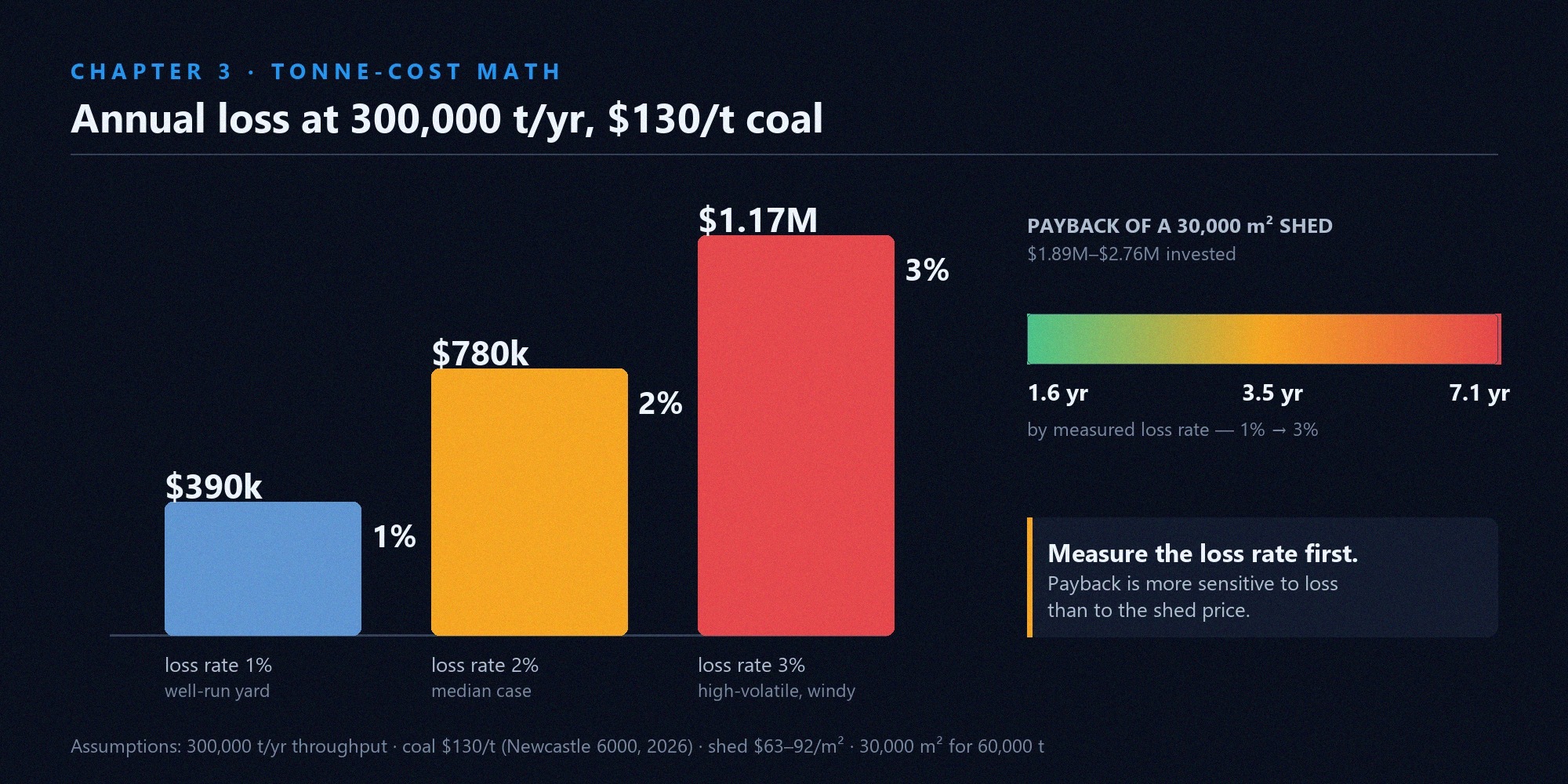
| 1% | 3,000 t | $390,000 | A well-managed open coal storage yard |
| 2% | 6,000 t | $780,000 | Mid-range assumption |
| 3% | 9,000 t | $1,170,000 | High-volatile coal in dry, windy regions |
Investment and Payback Period
For a 30,000 m² enclosure, the estimated investment ranges from $1.89 million to $2.76 million.
| Overall Loss Rate | Annual Savings | Payback at Lower Investment | Payback at Higher Investment |
| 1% | $390,000 | 4.8 years | 7.1 years |
| 2% | $780,000 | 2.4 years | 3.5 years |
| 3% | $1,170,000 | 1.6 years | 2.4 years |
The payback period is highly sensitive to the actual loss rate. The first step should therefore be to measure losses under real operating conditions rather than focus on construction cost alone.
The calculations above exclude savings in dust-control operating expenses, the value of land released by enclosure, and avoided production disruption risks. Including these factors may shorten the payback period.
Comparing Three Coal Storage Solutions
| Item | Open Coal Stockpile | Partially Enclosed Shed | Fully Enclosed Dome or Barrel-Vault Structure |
| Construction cost | Lowest | Medium | High (approximately three times the open-yard cost, as stated) |
| Coal quantity loss | 2%–5% | 1%–2% | Near zero, as stated |
| Calorific value retention | Poor | Moderate | Good |
| Moisture control | None | Partial | Full enclosure; actual control depends on design and operation |
| Dust control | Dust screens and water spraying | 50%–80% reduction | 80%–95% reduction |
| Land area for 60,000 t of coal | Approx. 30,000 m² | Approx. 8,000–12,000 m² | Approx. 4,500 m² |
| Stacking and reclaiming equipment | Multiple machines may be needed for material handling | Reduced equipment requirements | Automated stacking and reclaiming may be adopted |
| Environmental assessment and acceptance | More challenging | Generally more manageable | Generally easier to meet dust-control objectives, subject to applicable requirements |
| Suitable applications | Short-term transfer and low-throughput operations | Transitional solution | Long-term storage and environmentally sensitive locations |
An open stockpile holding 60,000 tonnes of coal may require approximately 30,000 m², compared with around 4,500 m² for an enclosed storage facility—a ratio of nearly 6.7:1. For projects with limited available land, this difference can be more decisive than construction cost.
Where Plane Trusses and Spatial Lattice Shells Differ
Span is one of the primary variables in structural selection. For spans of up to approximately 60 m, plane trusses and portal frames can both be economical options. As the span increases, plane structures may require larger cross-sections to resist bending moments, causing steel consumption to rise more rapidly.
Spatial lattice shells distribute loads through members in two directions and primarily rely on axial forces. For spans of around 100 m or more, differences in steel consumption per unit of floor area can be evaluated through structural analysis rather than treated simply as a matter of preference.
Applications of Three Structural Forms
| Structural Form | Plan Shape | Key Advantages | Suitable Stacking and Reclaiming Methods |
| Circular dome | Circular | Typically low steel consumption per unit area, relatively uniform load distribution and good wind resistance | Central-column stacking and reclaiming machines |
| Barrel vault (longitudinal shed) | Long rectangular strip | Can be extended along its length and is suitable for large storage capacities | Portal-type reclaimers and longitudinal stockyards |
| Prestressed tubular truss | Large rectangular-span structure | Single spans can exceed 180 m | Bridge-type reclaimers and ultra-large-span longitudinal stockyards |
The correct sequence is to determine the stacking and reclaiming process first, then select the plan shape, and finally choose the structural system. Reversing this sequence can result in a structure that does not suit the material-handling process, undermining the expected savings.
Reference Project Parameters
| Project Type | Structural System | Key Parameters | Building Area |
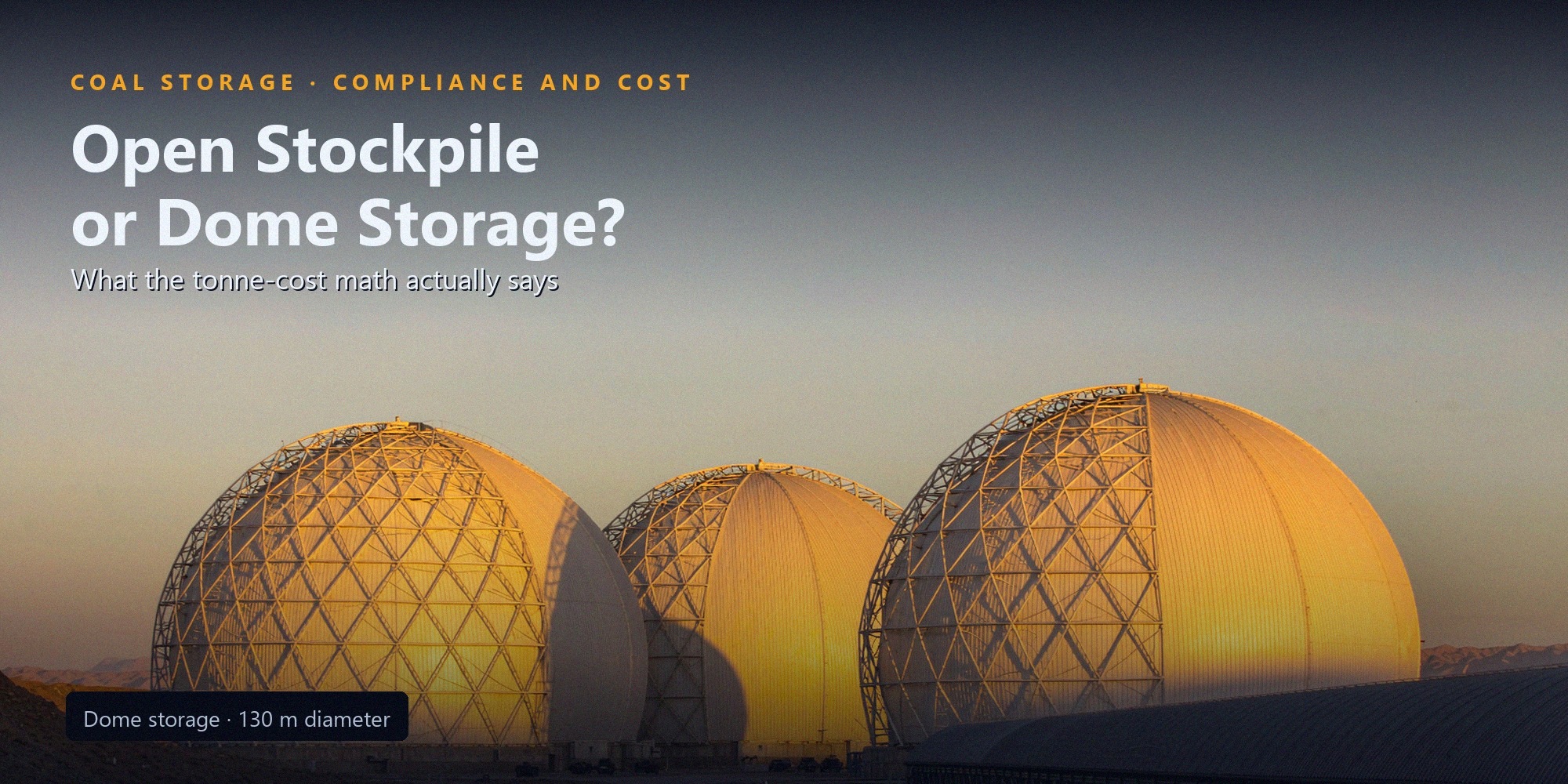
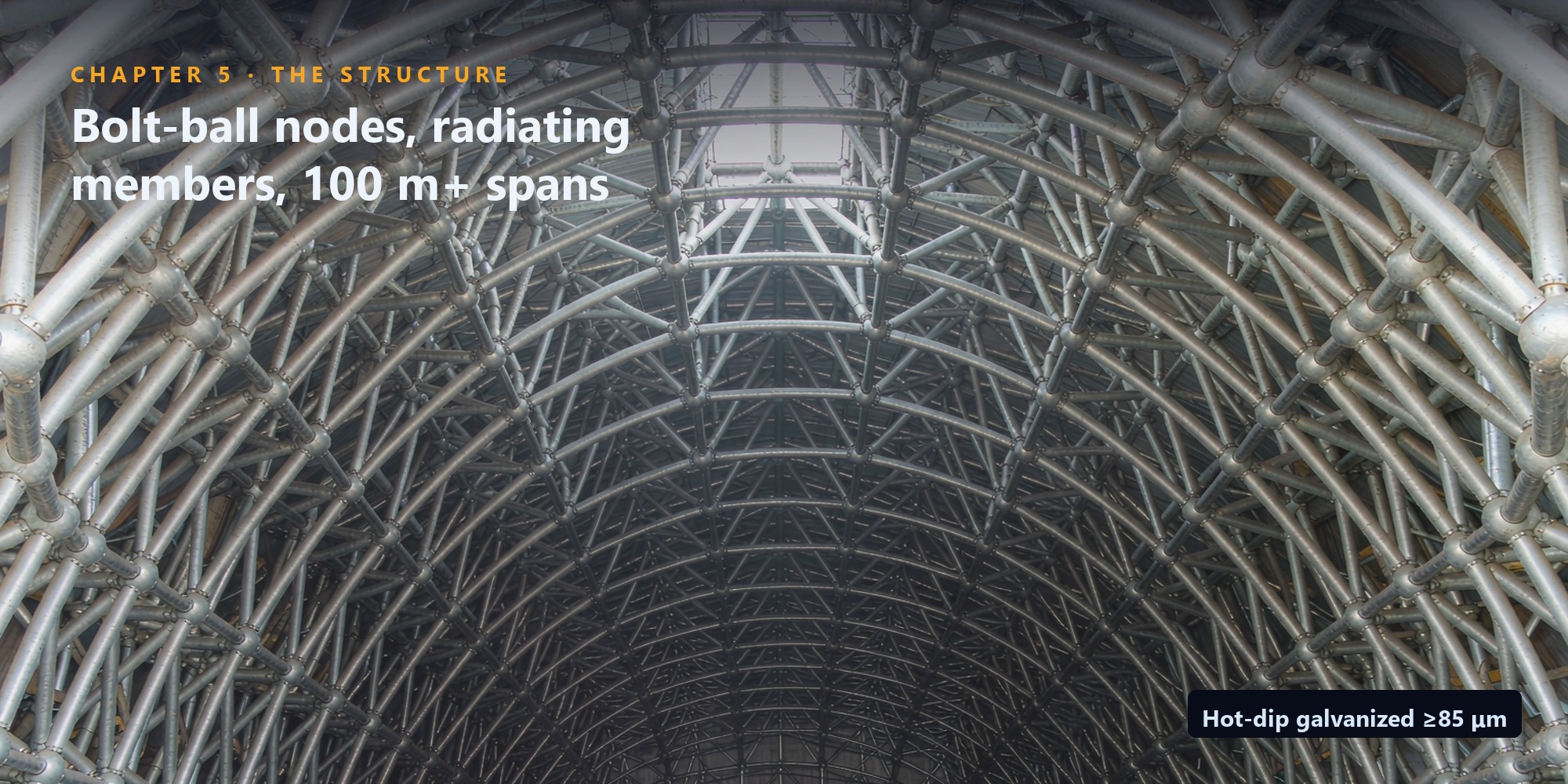
| Circular stockyard at a mining site | Spherical space frame with bolted spherical joints | Diameter: 130 m; space frame crown elevation: +64 m; 3 structures | 39,799.5 m² |
| Enclosed coal storage shed at a port | Barrel-vault space frame with bolted spherical joints | Span: 118 m; length: 736 m; roof elevation: 46 m | 86,848 m² |
| Coal storage enclosure retrofit at a power plant | Prestressed tubular truss | Span: 185 m; length: 254 m | 46,990 m² |
Coal-related corrosion must be considered separately. Hot-dip galvanizing is recommended for space frame members and joints, with a zinc coating thickness of at least 85 μm. Additional corrosion-protection coatings and sealing measures may be required for high-sulfur coal or coastal projects.
Which Projects Should Consider Enclosed Coal Storage?
The decision generally comes down to three factors: annual throughput, coal price and type, and regulatory requirements and land availability.
For low-throughput operations, the payback period may extend beyond ten years, making an open stockpile with dust-suppression screens a reasonable option.
For high coal prices or high-volatile coal types, enclosure may offer greater economic benefits. In environmentally sensitive areas, ports or locations with limited land, enclosure is not just an economic decision—it may be a prerequisite for project approval or continued operation.
If at least two of these three factors favor enclosure, a formal feasibility and cost analysis is worth undertaking.
Frequently Asked Questions
Q1: How much does a fully enclosed coal storage building cost?
For a steel structure with color-coated steel sheet cladding, the estimated main construction cost is $63–92/m². This excludes stacking and reclaiming equipment, foundation treatment and fire protection systems. Actual project costs must be calculated based on span, eaves height, ground conditions and other project-specific requirements.
Q2: Which is more economical: a coal storage dome or a longitudinal enclosed shed?
For the same storage capacity, a circular dome typically uses less steel per unit of floor area and requires less land. However, if the material-handling process requires a longitudinal stockyard with a portal-type reclaimer and long-distance conveyors, a dome may not be compatible with the operating layout. A barrel-vault structure or truss system may then be necessary.
Q3: Does a fully enclosed coal storage building automatically meet dust-control requirements?
No. Full enclosure is a major control measure, but ventilation, mist-suppression systems and operational management are still required.
Gas accumulation and coal dust explosions must also be prevented inside the building. Appropriate ventilation and gas monitoring systems may be necessary, while loading and unloading points still require dust suppression. Enclosure does not eliminate the need for operational controls.
Q4: Can an existing open coal yard be enclosed without stopping operations?
Phased construction may make this possible. The stockyard can be divided into sections, with one section enclosed while another continues operating, supported by temporary material handling and relocation arrangements.
This approach requires construction phasing and temporary coal storage to be incorporated into the design from the outset.
Q5: How long can a space frame remain protected against corrosion?
Coal storage facilities may be exposed to moderately to highly corrosive conditions. With a hot-dip galvanized coating of at least 85 μm and regular inspections, a nominal design life of 25 years may be considered, subject to the actual exposure conditions and project specifications. Inspect coating deterioration every 2–3 years as a recommended maintenance interval. If more than 70% of the zinc coating has been consumed, recoating should be considered following a professional assessment.
Contact: info@xzbesta.com