Customers buying mobile solar power stations often overlook one cost: freight from the factory in China to the mining site.
This cost can be calculated at the selection stage, with one condition — the equipment itself must be designed for transport. This article provides a complete cost framework for three transport modes, plus one design detail most buyers overlook.
Start with Design: Why Container Size Determines Freight Cost
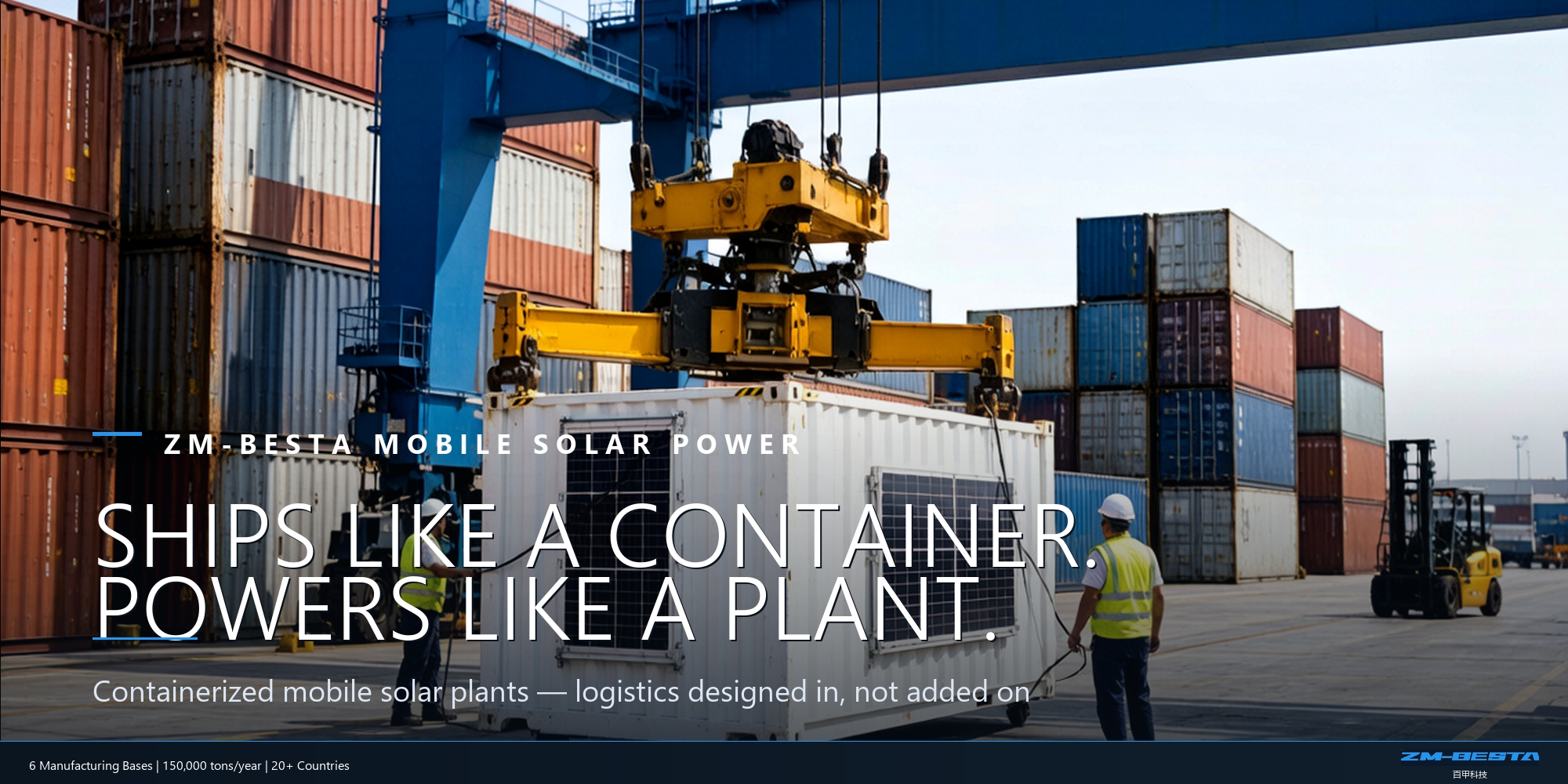
The container of ZM-Besta’s mobile solar power station is designed to standard container dimensions:
| Model | Container spec | Self-weight (excl. storage) | Installation method |
| 20 kW | 3.6 m × 2.15 m × 2.2 m | Approx. 3.5 t | Forklift set-down |
| 56 kW / 75 kW | 20 ft standard container | 12-16 t | Crane set-down |
| 150-200 kW | 40 ft container | 20-32 t | Crane set-down |
This means the equipment can be lifted, stacked, and customs-cleared exactly like an ordinary container. No special cargo channels, no special cargo charges. The first gate on logistics cost is already narrowed at the drawing stage.
The counterexample: non-standard stations need flat rack or open-top containers, with freight typically 30%-50% higher, plus separate booking.
Cost Comparison of Three Transport Modes
Container Sea Freight: The Mainstay for Cross-Ocean Shipments
Reference port-to-port rates from China (subject to ±30% fluctuation with fuel prices and seasons):
| Destination | 20 ft container | 40 ft container | Sea freight time |
| Southeast Asia | $400-800 | $700-1,300 | 1-2 weeks |
| Middle East | $1,800-2,600 | $2,800-3,800 | 3-4 weeks |
| South Africa | $2,400-3,500 | $3,600-5,400 | 3-5 weeks |
| Central Asia (transshipment port + trucking) | $2,000-3,200 | $3,200-4,800 | 3-4 weeks |
Truck / Trailer Transport: Overland & the “Last Mile”
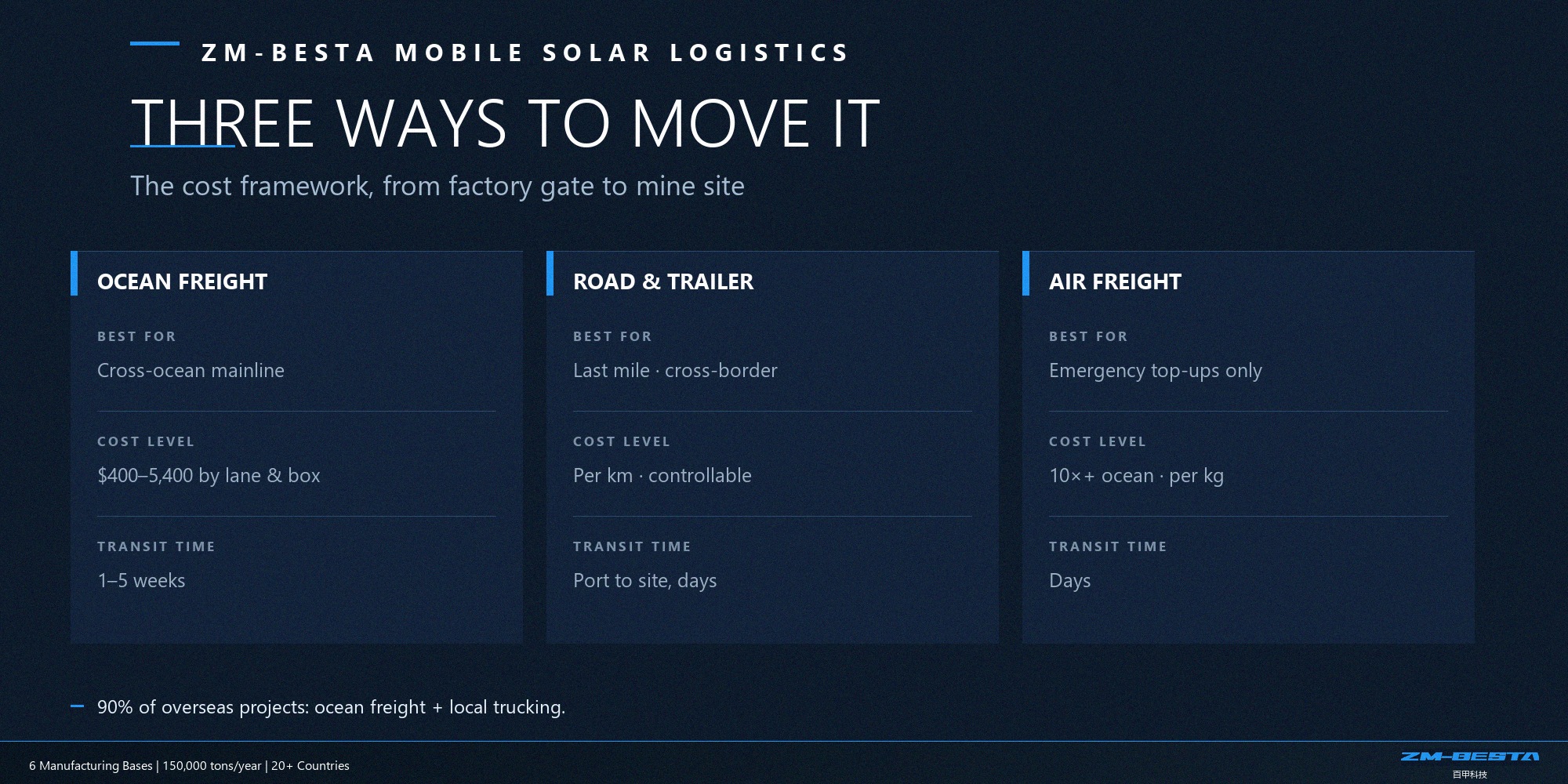
Ideal for domestic transfer, cross-border trucking, and drayage from the port to the site. Billed by the kilometer, with relatively controllable costs. Key step: confirm the height and width limits of bridges and culverts along the route in advance — standard container dimensions win again here; a 3.6 m container does not even need a crane, a forklift can set it down directly.
Air Freight: Only for Emergencies
Costs more than 10 times sea freight, billed per kilogram. Recommended only for urgent situations where the loss from production stoppage exceeds the freight cost, or for emergency replenishment of small 20 kW models.
Conclusion: for over 90% of overseas projects, we recommend combining sea freight with local trucking.
After Arrival: Deployment Speed Is Also a Cost
The end point of transport is power generation, not the port. BESTA mobile stations’ on-site efficiency:
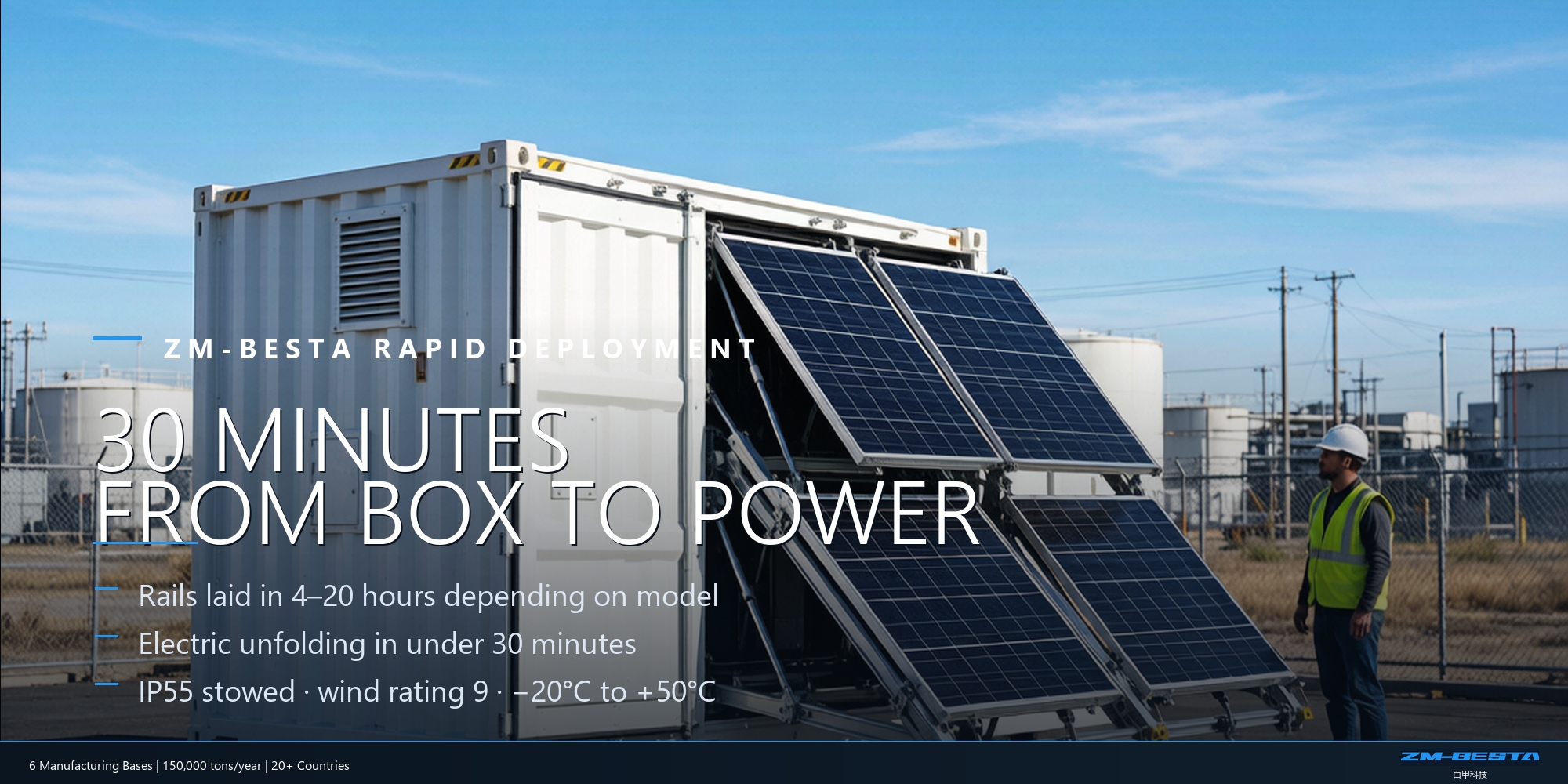
- Rail installation: 4-20 hours (depending on model)
- Electric unfolding: ≤30 min
- Protection rating in stowed state: IP55
- Wind resistance when deployed: Force 9 wind
- Operating temperature: -20°C to +50°C
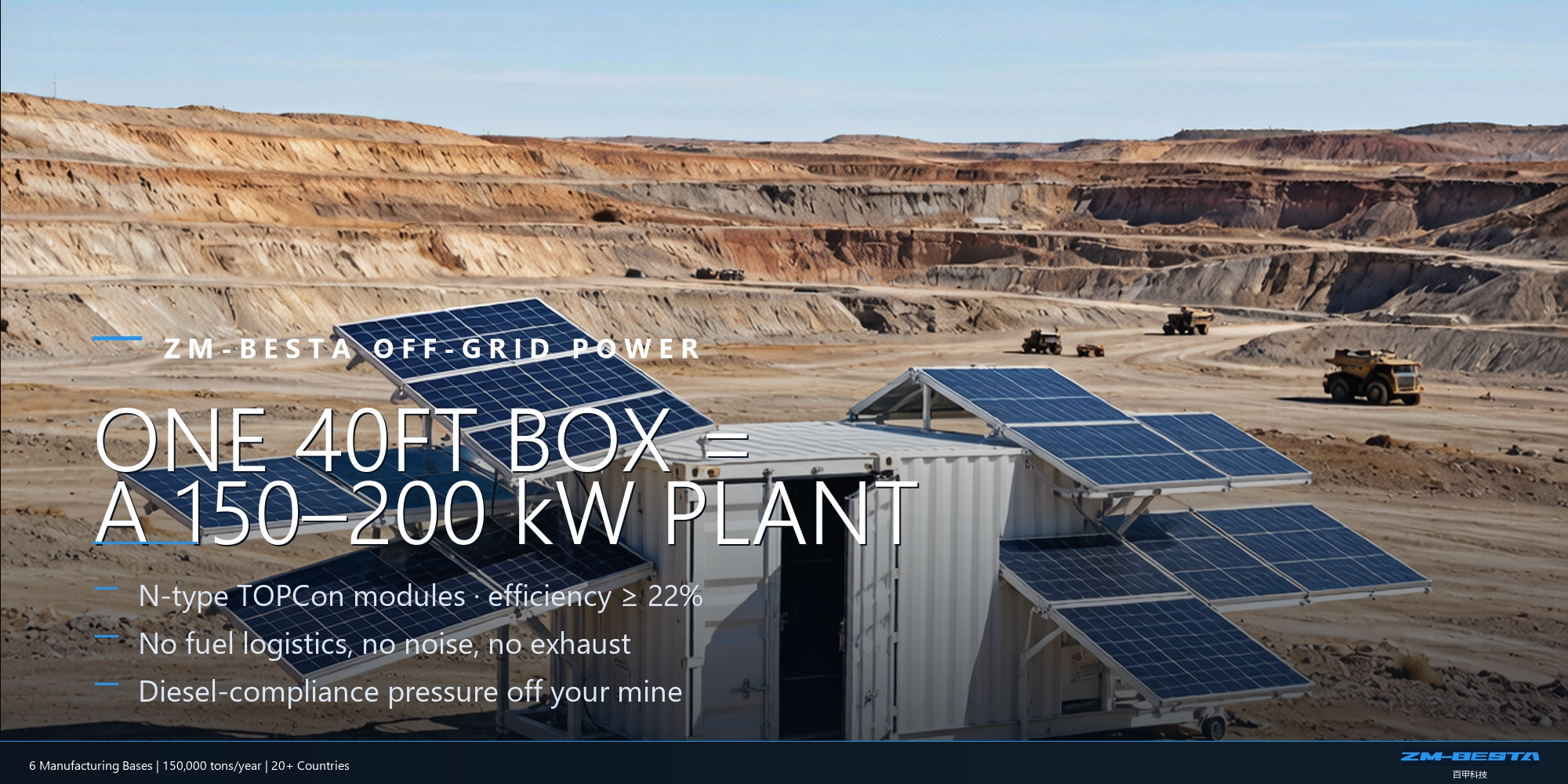
- Modules: N-type TOPCon, conversion efficiency ≥22%
Compared with diesel power: no fuel logistics, no noise, no emissions — compliance pressure at the mine disappears. A single 40 ft container delivers a 150-200 kW power station, not a box of consumables.
How to Estimate Your End-to-End Logistics Cost?
Three steps:
- Confirm the model and container specification (see table above)
- Check the sea freight rate range from the port of departure to the destination port
- Add the trucking quote for the distance from the destination port to the site
Send us the project country and the distance from the mine to the port, and our technical team will prepare an end-to-end logistics cost estimate and a full-cost comparison table against the diesel power option.
FAQ
Q1: How far have your mobile solar power stations been shipped?
A: Our solar and steel structure products have been exported to Indonesia, the Philippines, Bulgaria, and other overseas markets, and mobile power stations can be shipped worldwide. Specific case data can be confirmed with us.
Q2: What capacity can a 40 ft container hold?
A: With a standard 40 ft container layout, total installed capacity can reach the 150-200 kW range, and capacity can be fine-tuned by the number of frame modules.
Q3: Is energy storage needed?
A: It depends on the load profile. For continuous loads, lithium iron phosphate (LFP) storage is recommended (40 kWh standard on 20 kW models, 121 kWh standard on 56 kW models, expandable on request); for daytime-only operation, it can be reduced or omitted.
Q4: Who installs it after arrival?
A: Small models can be set down by forklift and unfolded electrically — customers can do it themselves; for larger models, technical guidance or an installation crew can be arranged.
Q5: Will modules be damaged during transport?
A: IP55 protection in stowed state; module front and back sheets are tempered glass with anodized aluminum frames, and the frames are galvanized to ≥55 μm. Loss rates are extremely low under normal sea freight conditions, and cargo is loaded and secured to standard before shipment.
Want to know how much it costs to ship a mobile solar power station to your mine?
Email: info@xzbesta.com